


Understanding photography terminology is essential for anyone looking to improve their skills, whether you're a beginner or a seasoned professional. Photography is a language of its own, filled with specific terms and concepts that help describe the tools, techniques, and processes involved in capturing images. Knowing these terms not only enhances your technical proficiency but also allows you to communicate more effectively with other photographers.
This guide breaks down the key photography terms and explains their meanings. Learning these terms helps you better navigate the world of lenses, exposure settings, composition, and post-processing. With a clearer understanding of photography vocabulary, you can capture better images and communicate your vision more effectively.
Let's dive in and explore the essential photography terminology every photographer should know!
Also see: Best Photography Cheat Sheet for Beginners with Tips and Camera Settings
A-Z List of Photography Terminology
A
1. Aperture
Aperture refers to the opening in a camera lens through which light enters. It is one of the three key components (along with shutter speed and ISO) that control the exposure of an image. Aperture size is measured in f-stops (such as f/1.4, f/2.8, f/5.6, etc.), and it affects two primary factors: the amount of light that passes through to the sensor and the depth of field in the photo.
- Larger Apertures (smaller f-number) like f/1.4 allow more light and create a shallow depth of field, often used for portraits where the subject is in focus while the background is blurred (bokeh effect).
- Smaller Apertures (larger f-number) like f/16 allow less light and create a deeper depth of field, keeping more of the image in focus, often used in landscape photography.
2. Aspect Ratio
The aspect ratio is the proportional relationship between the width and height of an image. It is often expressed as two numbers separated by a colon, such as 4:3, 16:9, or 3:2.
For example, a 4:3 aspect ratio means the width is 4 units for every 3 units of height. Different aspect ratios are used for various applications, with 16:9 being common for video and 3:2 often used for photography. The aspect ratio impacts the composition and framing of the final image.
3. Automatic Exposure
Automatic exposure is a camera mode that automatically adjusts the aperture, shutter speed, and ISO to produce a correctly exposed image based on the lighting conditions.
This is particularly useful for beginners who may not have yet mastered manual exposure settings. Cameras typically offer different modes for automatic exposure, such as Program Mode (P), Aperture Priority (A or Av), and Shutter Priority (S or Tv), each giving the photographer different levels of control.
B
4. Bokeh
Bokeh refers to the aesthetic quality of the out-of-focus areas in an image. The term comes from the Japanese word "boke," meaning "blur" or "haze." Bokeh is created when a lens has a shallow depth of field, and the areas outside the plane of focus become blurred. The quality of this blur can be affected by the shape of the aperture, lens characteristics, and lighting.
Bokeh can be used creatively in portraiture and macro photography to make the subject stand out by isolating it from a soft, blurred background. Good bokeh tends to appear smooth and round, while poor bokeh might look harsh or distracting.
5. Backlighting
Backlighting occurs when the light source is positioned behind the subject, creating a silhouette or emphasizing the contours of the subject.
Backlighting can add a dramatic or artistic effect, especially when shooting portraits or nature scenes. A common challenge with backlighting is that the subject may appear too dark (underexposed), so photographers often use fill flash or HDR techniques to balance the exposure.
6. Bulb Mode
Bulb mode is a camera setting that allows the photographer to control how long the shutter stays open. In bulb mode, the shutter remains open for as long as the shutter button is pressed, making it ideal for very long exposures.
This is commonly used in night photography, for capturing things like star trails, light painting, or long exposures of moving water. Photographers often use a tripod and remote shutter release to avoid camera shake during long exposures.
C
7. Composition
Composition refers to how elements are arranged within the frame of a photograph. It's the art of deciding what to include and exclude in the shot, guiding the viewer's eye and creating visual harmony.
There are several key principles of composition, such as the Rule of Thirds, Leading Lines, Framing, and Symmetry. Good composition enhances the story or message of the image and can transform a simple photo into a powerful visual statement. A well-composed image leads the viewer's eye to the main subject while maintaining balance and interest across the entire frame.
8. Chromatic Aberration
Chromatic aberration, also known as color fringing, is a type of distortion that occurs when a lens is unable to focus all colors of light at the same point. This results in color fringes around the edges of high-contrast areas in a photo, typically seen as purple or green halos.
This is more noticeable in wide-aperture lenses and can be reduced or eliminated by stopping down the aperture or using lenses with better optical quality. In post-processing, chromatic aberration can often be corrected using software like Adobe Lightroom or Photoshop.
9. Contrast
Contrast refers to the difference between the lightest and darkest parts of an image. A high-contrast image has stark differences between light and dark areas, while a low-contrast image has more gradual transitions between these tones.
High contrast images often appear bold and dramatic, with deep shadows and bright highlights, whereas low contrast images tend to have softer transitions and a more muted feel. Contrast can be adjusted in both camera settings and post-processing to enhance the mood or clarity of an image.
D
10. Depth of Field (DOF)
Depth of field refers to the range of distance within a photo that appears sharp and in focus. It is influenced by three main factors: aperture, focal length, and distance from the subject.
- Shallow Depth of Field (created by using a wide aperture, e.g., f/1.4) keeps only a small area of the image in focus, often used in portrait photography to blur the background and isolate the subject.
- Deep Depth of Field (achieved with a smaller aperture, e.g., f/16) keeps more of the scene in focus, making it ideal for landscape photography, where you want both the foreground and background to be sharp.
11. Dynamic Range
Dynamic range refers to the difference between the lightest and darkest elements of a scene that can be captured by a camera. It represents the range of detail in the shadows and highlights. Cameras with a wide dynamic range can preserve more detail in bright and dark areas, preventing the image from becoming too overexposed or underexposed. High dynamic range (HDR) imaging is used to combine multiple exposures and extend the dynamic range, ensuring that both highlights and shadows are well-represented.
E
12. Exposure
Exposure is the amount of light that reaches the camera's sensor, influencing how light or dark an image appears. Exposure is controlled by three factors: aperture, shutter speed, and ISO.
- Overexposure occurs when too much light hits the sensor, resulting in a bright image with lost highlight details.
- Underexposure happens when not enough light reaches the sensor, creating a dark image with lost shadow detail.
Proper exposure ensures that details in both the light and dark areas are preserved, and the image is visually balanced.
13. Exif (Exchangeable Image File Format)
EXIF is a standard for storing metadata within image files, which includes information about the camera settings, time, location, and other technical details. This metadata can be embedded in formats like JPEG, TIFF, and PNG.
Information stored in the EXIF data can include the camera model, exposure time, aperture, ISO, white balance, GPS coordinates (if available), and more. EXIF data is valuable for photographers and image editors to review the technical details behind a photo and help replicate settings for future shoots.
14. Exposure Triangle
The exposure triangle represents the three primary factors that affect exposure in photography: aperture, shutter speed, and ISO.
- Aperture controls how much light enters the camera.
- Shutter speed determines how long the camera's sensor is exposed to light.
- ISO adjusts the sensitivity of the camera's sensor to light.
All three components must be balanced to achieve a well-exposed image. Adjusting one requires compensating with the other two to maintain proper exposure.
F
15. F-Stop
The f-stop (or f-number) refers to the measurement of the aperture opening in a lens. It represents the ratio of the lens' focal length to the diameter of the aperture.
- A lower f-number (e.g., f/1.4) corresponds to a wider aperture, allowing more light to enter and creating a shallow depth of field. This is useful for low-light conditions or when you want to isolate the subject from the background (portraiture).
- A higher f-number (e.g., f/16) corresponds to a narrower aperture, letting in less light and increasing the depth of field. This is ideal for landscape photography, where you want both foreground and background in sharp focus.
16. Focal Length
Focal length is the distance (in millimeters) between the lens' optical center and the camera's sensor when the subject is in focus. It determines the angle of view (how much of the scene the lens can capture) and the magnification of the subject.
- Short focal lengths (e.g., 18mm, 35mm) provide a wide-angle view, capturing more of the scene, which is ideal for landscapes and architecture.
- Long focal lengths (e.g., 85mm, 200mm) offer telephoto views, magnifying distant subjects, making them perfect for wildlife or portrait photography, where the subject needs to be isolated from the background.
17. Fill Flash
Fill flash is a technique used to illuminate subjects that are in shadow due to backlighting or harsh lighting conditions. It involves using a flash to brighten the subject without overpowering the natural light.
It's particularly useful in portrait photography when the subject is in front of a bright background (like a sunset or a window), ensuring that the face isn't too dark while still maintaining the natural lighting effect. The key to fill flash is balancing the intensity of the flash with the ambient light so that the subject is lit without looking artificial or overexposed.
G
18. Grain
Grain refers to the visible texture or noise in a photograph, often caused by high ISO settings or when using film. It appears as random color specks or pixel-like artifacts.
- In digital photography, grain is often a result of the camera sensor's noise, which becomes more noticeable in low-light situations or at higher ISO settings.
- In film photography, grain is a natural characteristic of the film itself. Some photographers embrace grain for its artistic or nostalgic effect, while others may reduce it in post-processing for cleaner images.
19. Graduated Filter
A graduated filter is a photographic filter that has a gradual transition between a darker and lighter portion. It's often used to balance the exposure between a bright sky and a darker foreground in landscape photography.
The dark part of the filter helps darken the sky, while the lighter part allows more light through to the foreground. Graduated filters come in neutral density (ND) versions, which reduce the amount of light, or in color versions, which can affect the image's tone.
20. Golden Hour
Golden hour refers to the period shortly after sunrise and just before sunset when the light is soft, warm, and diffused.
- During golden hour, the sunlight is low, casting long shadows and creating a rich, golden glow that enhances the textures and tones of a scene.
- This time is often considered the best for portrait and landscape photography because the light is flattering and gives images a magical, dreamy quality.
H
21. Histogram
A histogram is a graph that shows the distribution of tones in an image, from black (shadows) on the left to white (highlights) on the right, with midtones in between. A well-balanced histogram typically has a smooth distribution across the range. A histogram that's skewed to the left indicates underexposure (too many shadows), while a skew to the right indicates overexposure (too many highlights).
Photographers use histograms to check the exposure of their photos and adjust settings for better results, ensuring that no important details are lost in the shadows or highlights.
22. High Key
High key is a photographic style that uses bright lighting to create a light, airy, and almost overexposed look. It typically results in images with few shadows and a predominantly white or very light background.
High key photography is often used for fashion and beauty portraits, as it creates a soft, clean, and flattering appearance. To achieve high key lighting, a lot of light is used to illuminate the subject, with little contrast between highlights and shadows.
23. HDR (High Dynamic Range)
HDR refers to a technique where multiple exposures of the same scene are taken and then combined in post-processing to create a final image with a wider range of light and detail. This is particularly useful in scenes with both bright and dark areas that a single exposure may not capture well, such as landscapes with both a bright sky and dark shadows. HDR helps retain details in both the highlights and shadows, creating a more realistic or dramatic image than what could be achieved with a single exposure.
I
24. ISO
ISO is the sensitivity of your camera's sensor to light. A higher ISO allows you to shoot in lower light, but it also increases the amount of noise (grain) in the image.
- Low ISO (e.g., ISO 100) is ideal for bright environments where there is plenty of light, producing clean, sharp images with minimal noise.
- High ISO (e.g., ISO 1600 or above) is used in low-light conditions, but it can lead to a grainy or noisy image. Modern cameras handle high ISO better, but it's still important to find a balance between exposure and noise.
ISO is part of the exposure triangle, along with aperture and shutter speed, and it's crucial to set the right ISO for proper exposure and image quality.
25. Incident Light
Incident light is the light that directly falls on the subject or scene, rather than light that has been reflected or diffused. Photographers use incident light meters to measure the amount of light hitting the subject, which helps in adjusting exposure settings. Knowing the incident light is crucial for achieving accurate exposure, particularly in outdoor photography or under artificial lighting.
26. Infrared Photography
Infrared photography uses infrared light, which is outside the visible spectrum, to capture images. This technique results in surreal, dream-like photos with glowing white foliage, dark skies, and unique color shifts.
Infrared photography requires special filters or cameras modified to capture infrared light. It's commonly used for artistic purposes or to capture landscapes with a distinct, otherworldly aesthetic.
J
27. JPEG (Joint Photographic Experts Group)
JPEG is a widely-used image file format known for its lossy compression, meaning that some image data is discarded to reduce file size.
JPEG files are ideal for web use and general photography, as they balance good image quality with small file sizes. The compression used in JPEG can lead to a loss of fine detail, especially in areas with sharp edges or gradients. When editing JPEG images repeatedly, the quality can degrade further, which is why photographers often prefer working with RAW files during post-processing.
28. Jitter
Jitter refers to unwanted, erratic motion in an image, often caused by camera shake or movement during the exposure. This is especially noticeable during long exposures or when shooting handheld with slow shutter speeds. To reduce jitter, photographers use tripods for stability, image stabilization (in lenses or cameras), or faster shutter speeds to minimize motion blur.
29. Joiner
A joiner is a type of photographic collage or montage where multiple images are stitched together to create a larger, panoramic scene. This technique can be used to showcase wide vistas or to create surreal, abstract compositions. The term "joiner" was popularized by photographer David Hockney, who used this method to explore the concept of time and space in photography.
K
30. Knee (In Photography)
The knee in photography refers to a point in an image's tonal range where highlight details start to compress, usually to prevent clipping (where the brightest parts of the image lose all detail).
In high dynamic range (HDR) photography and video, adjusting the knee can help preserve highlight details and prevent overexposure. The knee setting is most commonly found in professional video cameras and allows for smoother highlight transitions.
31. Kelvin
Kelvin is a unit of measurement for color temperature, which determines the warmth or coolness of light.
- Lower Kelvin values (e.g., 2700K) produce warmer, yellow-orange light, often seen in incandescent lighting.
- Higher Kelvin values (e.g., 6500K) produce cooler, blue light, typical of daylight.
Adjusting the white balance to the correct Kelvin value helps ensure accurate color representation in photos and videos. This is especially important when shooting in mixed lighting conditions.
32. Kirlian Photography
Kirlian photography is a technique that captures the electrical coronal discharges around an object, creating a glowing, aura-like effect. It's based on the principle that a high-voltage electric field can create visible patterns on photographic film. While often used for artistic purposes or in metaphysical contexts, Kirlian photography is not widely used in mainstream photography.
L
33. Lens Distortion
Lens distortion refers to optical aberrations that cause straight lines to appear curved, typically in wide-angle lenses.
- Barrel distortion makes straight lines curve outward, resembling the shape of a barrel. This is common in wide-angle lenses.
- Pincushion distortion causes straight lines to curve inward, often seen in telephoto lenses.
Lens distortion can be corrected in post-processing using photo editing software like Adobe Lightroom or Photoshop.
34. Long Exposure
Long exposure refers to the technique of using a slow shutter speed to capture an image over a long period of time. Long exposure photography is commonly used to capture motion, such as flowing water, moving clouds, or light trails from cars at night.
A tripod is often required to prevent camera shake during long exposures, and a neutral density (ND) filter may be used to reduce the amount of light entering the lens, allowing for longer exposure times even in bright conditions.
35. Low Key
Low key is a style of lighting and photography that focuses on dark tones and shadows, resulting in a moody, dramatic effect.
In low-key photography, the subject is often lit with a single light source, and the background is kept dark, creating strong contrasts between light and shadow. This style is commonly used in portraiture, fashion photography, and fine art to emphasize mood, mystery, or emotion.
M
35. Megapixel (MP)
A megapixel is a unit of measurement for image resolution, representing one million pixels. Higher megapixels allow for larger prints and more detailed images, especially when cropping or enlarging. However, more megapixels don't always mean better image quality, as other factors like sensor size, lens quality, and lighting conditions also influence the final result.
36. Manual Mode
Manual mode is a camera setting that allows the photographer to have full control over all exposure settings, including aperture, shutter speed, and ISO. In manual mode, the photographer decides how much light enters the camera by adjusting these three parameters, which can result in more creative control and better exposure in challenging lighting conditions. This mode is ideal for experienced photographers who understand how the exposure triangle works and want to fine-tune their settings for optimal results.
37. Macro Photography
Macro photography is the art of capturing extreme close-ups of small subjects, such as insects, flowers, or textures, at a 1:1 magnification or higher.
Macro lenses are specifically designed to focus at very short distances, allowing photographers to capture fine details that are often invisible to the naked eye. Lighting can be challenging in macro photography due to the small depth of field, so it's common to use specialized lighting setups like ring flashes or diffused light.
N
38. Noise
Noise refers to random variations in brightness or color in an image, often seen as grainy or speckled pixels. It is particularly noticeable in low-light images or when using high ISO settings.
Luminance noise affects the brightness levels, while chrominance noise affects color information. Noise can degrade the quality of an image, especially in shadowed areas. High-quality cameras and post-processing techniques can help reduce noise, but excessive noise may be difficult to eliminate completely.
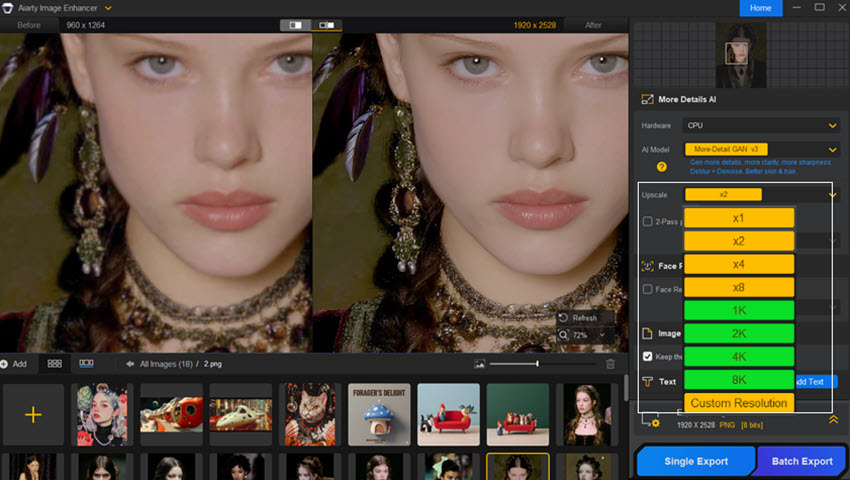
Even the best photographers deal with digital noise or missed focus. While traditional editing has limits, AI-powered tools are changing the game. If you have a great shot that's a bit too grainy or needs to be printed large, Aiarty Image Enhancer is a powerful ally. It intelligently generates missing details and removes artifacts while upscaling, ensuring your final output looks like it was shot on a much higher-end sensor.
39. Neutral Density (ND) Filter
A neutral density filter is a type of optical filter that reduces the amount of light entering the camera lens without affecting the color of the image.
ND filters are often used in situations where you want to use a slow shutter speed (such as for long exposure photography) or a wide aperture (for shallow depth of field) in bright conditions, without overexposing the image. ND filters come in different strengths, such as 3-stop, 6-stop, or even 10-stop, depending on how much light they reduce.
40. Normal Lens
A normal lens typically refers to a lens with a focal length that is roughly equal to the diagonal size of the camera's image sensor. For a full-frame camera, this is typically around 50mm.
A normal lens provides a natural perspective, similar to what the human eye sees, and is often considered the most versatile for general photography. It offers a balanced view without distortion, making it great for street photography, portraits, and everyday scenes.
O
41. Overexposure
Overexposure occurs when an image receives too much light, resulting in areas that are too bright and lack detail (blown highlights).
This can happen if the aperture is too wide, the shutter speed is too slow, or the ISO is too high.
To prevent overexposure, photographers use the exposure triangle to balance these settings, or they can use tools like the histogram to check exposure in real-time.
42. Optical Zoom
Optical zoom refers to the zoom function of a lens that changes its focal length physically, allowing you to magnify the subject without losing image quality.
Unlike digital zoom, which enlarges the image electronically and can degrade quality, optical zoom maintains full resolution by using the lens to zoom in on the subject. Optical zoom is commonly found in both DSLR and mirrorless cameras, as well as many high-end point-and-shoot cameras.
P
43. Perspective
Perspective refers to the way objects appear to the viewer based on their relative distance, size, and angle of view. The concept of perspective is crucial in photography as it influences how depth and dimension are conveyed in an image.
Changing the angle of view, such as shooting from above or below, can dramatically alter the perceived perspective and make a photo more dynamic. Photographers often use wide-angle lenses to exaggerate perspective and create a sense of depth in landscape or architectural shots.
44. Pixel
A pixel is the smallest unit of an image, representing a single point of color. Images are made up of millions (or even billions) of pixels, and the more pixels there are, the higher the resolution of the image. Higher-resolution images have more pixels and offer greater detail, but they also require more storage space. The term "pixel" is short for "picture element," and it's the basic building block of digital images.
45. Post-Processing
Post-processing refers to the editing and enhancement of a photo after it has been taken, usually done with software like Adobe Lightroom, Photoshop, or other editing tools.
Common post-processing techniques include adjusting exposure, correcting color balance, cropping, removing distractions, and sharpening. The goal of post-processing is to refine the image, enhance its aesthetic, or correct any issues with the original shot, without compromising its overall integrity.
46. Portrait Mode
Portrait mode is a setting or orientation used in photography when the camera is held vertically, as opposed to landscape mode (horizontal).
It is typically used for photographing people or subjects in a vertical frame, emphasizing height and depth. Many modern smartphones offer portrait mode as a feature that uses software to simulate a shallow depth of field, mimicking the effect of a wide-aperture lens to blur the background and make the subject stand out.
47. Panorama
A panorama is a wide-angle image, often much wider than the standard aspect ratio of a photo. It captures a larger field of view and is commonly used for landscapes or cityscapes. Some cameras and smartphones have a panorama mode, which helps the photographer capture wide scenes by automatically stitching together multiple images into one continuous photo. Photographers also use manual stitching techniques in post-processing to create high-resolution panoramas from several images.
R
48. RAW
RAW is an image file format that captures all of the data from the camera's sensor without any processing or compression. Unlike JPEG, which applies compression and adjusts colors, RAW files retain maximum detail, offering greater flexibility in post-processing. RAW files allow photographers to make significant adjustments to exposure, white balance, sharpening, and contrast without degrading the image quality.
However, RAW files are larger than JPEGs and require specialized software, such as Adobe Lightroom or Photoshop, to open and edit them.
49. Resolution
Resolution refers to the amount of detail in an image, determined by the number of pixels it contains. A higher resolution means more pixels, and thus more detail.
DPI (dots per inch) is often used to describe the resolution of printed images, while PPI (pixels per inch) is used for digital images.
Resolution is important for determining how large an image can be printed without losing quality. A higher resolution is ideal for large prints or when cropping images for detail.
50. Reflector
A reflector is a tool used to bounce light onto a subject in photography. It helps fill in shadows and add more light to the subject, often used in portraiture.
Reflectors come in various shapes and sizes, and are typically made from white, silver, or gold materials. A white reflector provides a soft, neutral fill light, while a silver reflector gives a cooler, higher contrast effect, and a gold reflector produces a warmer, more flattering light.
51. Refractive Index
The refractive index of a lens refers to how much light is bent or refracted as it passes through the lens material.
Lenses with a high refractive index can bend light more effectively, allowing for smaller, lighter lenses without sacrificing image quality. This concept is important in designing lenses with specific focal lengths and apertures to achieve clear, sharp images with minimal distortion.
S
52. Shutter Speed
Shutter speed is the amount of time the camera's shutter is open to allow light to reach the sensor. It's measured in seconds or fractions of a second (e.g., 1/1000, 1/500, 1/30, 1").
A fast shutter speed (e.g., 1/1000) captures quick action and freezes motion, while a slow shutter speed (e.g., 1/30) allows more time for light to hit the sensor, often resulting in motion blur.
Shutter speed is a key component of the exposure triangle, along with aperture and ISO, and plays a significant role in capturing motion and controlling exposure.
53. Silhouette
A silhouette is a dark, shadowy outline of a subject set against a brighter background, usually created by placing the subject between the light source and the camera. Silhouettes are often used in dramatic compositions, where the details of the subject are hidden, but the shape is clearly defined. This technique is commonly used in portraiture, nature photography, and conceptual imagery to create contrast and evoke a sense of mystery or intrigue.
54. Smartphone Photography
Smartphone photography refers to capturing images using a mobile phone's built-in camera. Modern smartphones have advanced cameras equipped with multiple lenses, image stabilization, and AI-powered features.
Smartphone photography has become a popular medium due to the convenience and portability of phones, as well as the availability of editing apps and social media platforms.
Though smartphone cameras have limitations compared to professional DSLRs or mirrorless cameras, they offer ease of use and portability for everyday photography.
55. Softbox
A softbox is a light modifier used in photography to soften the light emitted by a flash or continuous light source.
It is typically a box-shaped structure with a translucent front surface, which diffuses the light, creating a softer, more flattering light on the subject. Softboxes are often used in portrait and product photography to reduce harsh shadows and produce a more even, natural-looking light.
56. Saturation
Saturation refers to the intensity or purity of the colors in an image. A highly saturated image has vivid, intense colors, while an image with low saturation appears muted or washed out.
- High Saturation: Increases the vibrancy of the colors, making the image appear more dynamic and visually striking. However, too much saturation can result in unnatural-looking colors and loss of detail in highlights.
- Low Saturation: Reduces the intensity of colors, creating a more subtle, toned-down effect. If you remove all saturation, the image becomes black and white.
Photographers can adjust saturation in post-processing to enhance or correct the colors in an image. Tools like Aiarty Image Enhancer allow users to tweak the color saturation and make subtle adjustments, ensuring the colors are vivid without overdoing it.
T
57. Time-Lapse Photography
Time-lapse photography involves taking a series of images at set intervals over an extended period of time and then playing them back at normal speed to create the effect of rapid motion. Time-lapse is commonly used to capture slow events like sunsets, cloud movement, flowers blooming, or city traffic. It requires a stable camera setup, often on a tripod, and the use of intervalometers (a tool that automates the process of taking pictures at regular intervals).
58. Telephoto Lens
A telephoto lens is a lens with a long focal length, typically 70mm or more, that allows you to capture distant subjects in great detail.
Telephoto lenses magnify distant subjects, making them appear much closer, and are often used in wildlife, sports, and portrait photography.
They have a narrow field of view and a shallow depth of field, which helps isolate the subject from the background and create a pleasing bokeh effect.
59. Tilt-Shift Photography
Tilt-shift photography refers to a technique using a specialized lens that allows you to tilt or shift the lens elements to control perspective and depth of field.
It's often used to correct the convergence of lines in architectural photography (making buildings appear straight) or to create a miniature effect, where real-life scenes look like tiny models. This technique is achieved by using a tilt-shift lens or applying digital manipulation in post-processing.
U
60. Underexposure
Underexposure occurs when not enough light hits the camera sensor, resulting in a dark image.
This can happen if the aperture is too narrow, the shutter speed is too fast, or the ISO is too low. While underexposure can sometimes be used intentionally for creative effect (like creating moody or dramatic images), it often results in loss of detail in shadow areas. Adjustments can be made in post-processing, but extreme underexposure may lead to image noise.
61. Ultra-Wide-Angle Lens
An ultra-wide-angle lens is a lens with a very short focal length, usually 14mm to 24mm for full-frame cameras, designed to capture a much wider field of view than standard wide-angle lenses. Ultra-wide-angle lenses are often used in landscape photography, architectural photography, and interior shots to emphasize space and perspective. They create a distorted look at the edges of the image, making objects appear farther away and enhancing the sense of depth in the scene.
62. Uptight (Uptight Portrait)
The term "uptight" in photography refers to a style of portrait where the subject is posed in a stiff, formal manner with little to no movement.
This style is commonly seen in traditional portraiture or corporate headshots. While it can convey professionalism and formality, it may lack the relaxed, candid feel that many modern photographers prefer in more creative portraiture.
V
63. Viewfinder
The viewfinder is the small window on a camera through which the photographer looks to compose and frame a shot.
There are two types of viewfinders: optical (found in DSLR cameras) and electronic (found in mirrorless cameras).
The viewfinder allows photographers to see the scene as it will appear in the final image, helping them make precise adjustments for composition and exposure before taking the photo.
64. Vignetting
Vignetting refers to the gradual darkening or lightening of the image corners relative to the center. This can happen naturally due to lens design (e.g., in wide-aperture lenses), or it can be used creatively to draw attention to the center of the image.
In post-processing, vignetting can be added or reduced to enhance the composition and focus of the photo.
65. Virtual Photography
Virtual photography refers to the art of capturing images in a simulated environment, such as video games or computer-generated imagery (CGI).
Photographers use virtual cameras within these environments to create photorealistic images that mimic the characteristics of real-world photography, including lighting, perspective, and composition.
This technique is used in film production, gaming, and for creating still images that represent computer-generated worlds.
66. Visual Storytelling
Visual storytelling refers to the practice of conveying a narrative through images, often combining elements like composition, lighting, and subject matter to tell a compelling story without words.
In photography, visual storytelling can be seen in photojournalism, portraiture, and fine art photography, where the image evokes emotions, communicates a message, or illustrates an event. The goal of visual storytelling is to engage the viewer and communicate a message through the power of the image alone.
W
67. White Balance
White balance refers to the process of adjusting the colors in an image to ensure that white objects appear white under different lighting conditions.
Different light sources (e.g., sunlight, tungsten, fluorescent) emit light at different color temperatures, which can cause a color cast in your images (yellowish, bluish, etc.).
The white balance setting compensates for these color shifts, ensuring that the colors in the scene are accurately represented. Most cameras have automatic white balance, but it can also be manually adjusted for more precision, particularly in tricky lighting situations.
68. Wide-Angle Lens
A wide-angle lens is a lens with a short focal length (usually between 14mm and 35mm on full-frame cameras) that captures a broader field of view than a standard lens.
Wide-angle lenses are ideal for capturing landscapes, architecture, and group portraits, where you want to include more of the scene.
These lenses have a distorting effect on objects at the edges of the frame, often making them appear stretched or exaggerated, which can be used creatively in some compositions.
X
69. X-Rite ColorChecker
The X-Rite ColorChecker is a color calibration tool used to ensure color accuracy in photography.
It is a physical card with a grid of colors that serves as a reference for photographers and videographers to match the colors in their photos or videos.
The ColorChecker is often used in post-processing to adjust for color consistency across different shots, making sure that colors are accurate and true to life.
70. Xenon Flash
A xenon flash is a type of flash that uses a xenon gas discharge to produce a bright, short burst of light, commonly used in photography.
Xenon flashes are known for their ability to produce a very intense and powerful light in a very short duration, which is ideal for freezing fast-moving subjects. They are commonly found in external camera flashes and studio lighting setups, providing powerful illumination for both still photography and video work.
Y
71. Yellow Filter
A yellow filter is a type of photographic filter that can be placed in front of the lens to enhance contrast in black-and-white photography, particularly in outdoor or landscape shots.
It helps darken skies, making clouds more defined, and can also increase the separation between different colors, such as green foliage and a blue sky.
While yellow filters are primarily used in black-and-white photography, they are also useful in color photography for adding warmth or for specific color-correction effects.
72. Yottabyte
A yottabyte (YB) is a unit of digital information storage that equals 1,000 zettabytes or one quadrillion (1,000,000,000,000,000,000) bytes.
While not directly related to everyday photography, this term is relevant in contexts where photographers deal with massive amounts of data, like archives or digital storage systems for high-resolution images and video files. Yottabytes are mostly used for measuring the capacity of very large data centers or cloud storage systems.
Z
73. Zoom Lens
A zoom lens is a lens that allows the photographer to vary the focal length within a specified range, enabling you to zoom in and out on a subject without changing the lens.
Zoom lenses are versatile and can cover a wide range of focal lengths (e.g., 24-70mm or 70-200mm), making them ideal for situations where you need flexibility and don't want to switch lenses frequently.
They are commonly used in event photography, wildlife photography, and travel, where the subject may change distance quickly.
74. Zero Compression
Zero compression refers to the process of saving a photo file without any reduction in quality or loss of data, preserving every detail of the image.
RAW files are an example of zero compression formats, as they retain the full amount of image data captured by the sensor. This is in contrast to lossy compression formats like JPEG, where data is discarded to reduce file size.
75. Zone System
The Zone System is a photographic technique developed by Ansel Adams and Fred Archer to help photographers control exposure and develop black-and-white images with a full range of tones, from pure black to pure white.
The system divides the tonal range into 10 zones, with Zone 0 representing pure black and Zone X representing pure white. Photographers use the Zone System to determine the correct exposure and processing times for each part of the image to achieve the desired tonal balance.
 FAQs
FAQs
RAW and JPEG are two common image file formats in photography.
- RAW files retain all of the data captured by the camera's sensor, offering greater flexibility for post-processing. They allow for more detailed adjustments to exposure, color balance, and sharpness without losing quality.
- JPEG files, on the other hand, are compressed and processed by the camera, making them smaller in file size but losing some image quality in the process. While RAW files are preferred for professional work, JPEGs are more convenient for quick sharing or printing without further editing.
Low-light photography often results in noisy, grainy images. To improve image quality in these situations:
- Use a wide aperture to let in more light.
- Increase the ISO setting, but be mindful of noise.
- Use a longer exposure time, but make sure your camera is stable (use a tripod).
Additionally, Aiarty Image Enhancer helps enhance camera photos, reduce noise in low-light photos and restore lost details, making your images cleaner and sharper without compromising quality.
Shutter speed controls how long the camera's shutter remains open to expose the sensor to light.
- Fast shutter speeds (e.g., 1/1000s) freeze motion, making them ideal for fast-moving subjects like athletes or wildlife.
- Slow shutter speeds (e.g., 1/30s) allow you to capture motion blur, which can add a sense of movement or create a dreamy effect in landscapes.
Shutter speed is one of the key elements of the exposure triangle, along with aperture and ISO. Adjusting all three in balance allows you to achieve the desired exposure and creative effect.
Depth of field (DOF) refers to the area in your image that appears sharp and in focus.
- A shallow depth of field results in a blurred background and a sharp subject, often used in portrait photography to isolate the subject.
- A deep depth of field ensures that most of the image is in focus, which is commonly used in landscape photography to capture vast scenes with clarity from foreground to background.
The amount of aperture you use will influence the depth of field: a wide aperture (e.g., f/1.8) creates a shallow DOF, while a narrow aperture (e.g., f/16) gives a deeper DOF.
To enhance or upscale images without sacrificing quality, it's essential to use advanced software tools. Aiarty Image Enhancer is an excellent option, utilizing AI technology to upscale images while retaining sharpness, detail, and clarity. Whether you need to enlarge a low-resolution photo for print or recover fine details in an overexposed or underexposed shot, Aiarty can help enhance the image, making it suitable for professional-grade results. It offers noise reduction, sharpening, and detail recovery features, making it a must-have for photographers who want to improve their images without starting from scratch.
Vignetting is a photographic effect where the corners of an image appear darker than the center.
It can happen naturally, especially with wide-angle lenses or at large apertures. Some photographers use vignetting intentionally to focus attention on the subject or add a mood to the image.
However, excessive vignetting can be undesirable, especially when it interferes with the composition. It can be corrected in post-processing software like Aiarty Image Enhancer, which allows you to adjust the brightness and exposure in the corners of your image to achieve a more balanced result.
Yes, grain (or noise) can be reduced in photos, especially when shooting in low-light environments or at high ISO settings.
To minimize grain in-camera, try using a lower ISO, use a tripod for stability (to enable slower shutter speeds), and consider shooting in RAW format for better post-processing flexibility.


This post was written by Brenda Peng who is a seasoned editor at Digiarty Software who loves turning ordinary photos into extraordinary works of art. With AI assistance for brainstorming and drafting, the post is reviewed for accuracy by our expert Abby Poole for her expertise in this field.
