


DxO and Topaz are often compared as if they solve the same problem. They do not.
DxO is strongest at the front of the workflow, while the file is still RAW. PhotoLab 10 and PureRAW 6 are built around demosaicing, DeepPRIME noise reduction, measured lens corrections, and extracting clean detail without making the image look processed. Topaz Photo is more useful when the photograph itself needs repair. It can denoise RAW files, but its broader appeal is sharpening soft subjects, recovering slightly missed focus, enlarging heavy crops, restoring faces, and improving low-resolution or rendered files.
That difference is the key to this comparison. For technically good but noisy RAW files, DxO is usually the more convincing choice. For photographs that are soft, undersized, or otherwise compromised, Topaz offers the more capable rescue toolkit.
DxO vs Topaz: Quick Verdict
| What Matters Most | Better Choice |
|---|---|
| RAW noise reduction | DxO |
| Natural fine-detail rendering | DxO |
| Lens corrections | DxO |
| Complete RAW editing | DxO PhotoLab 10 |
| Lightroom RAW preprocessing | DxO PureRAW 6 |
| Missed-focus recovery | Topaz Photo |
| Blur correction | Topaz Photo |
| Heavy crop recovery | Topaz Photo |
| Upscaling | Topaz Photo |
| Low-resolution restoration | Topaz Photo |
| Perpetual licensing | DxO |
The short version is simple: DxO is better at developing the information the camera actually captured; Topaz is better at reconstructing information when the capture itself is weak.
DxO PhotoLab 10, PureRAW 6, and Topaz Photo: What Are We Comparing?
DxO PhotoLab 10
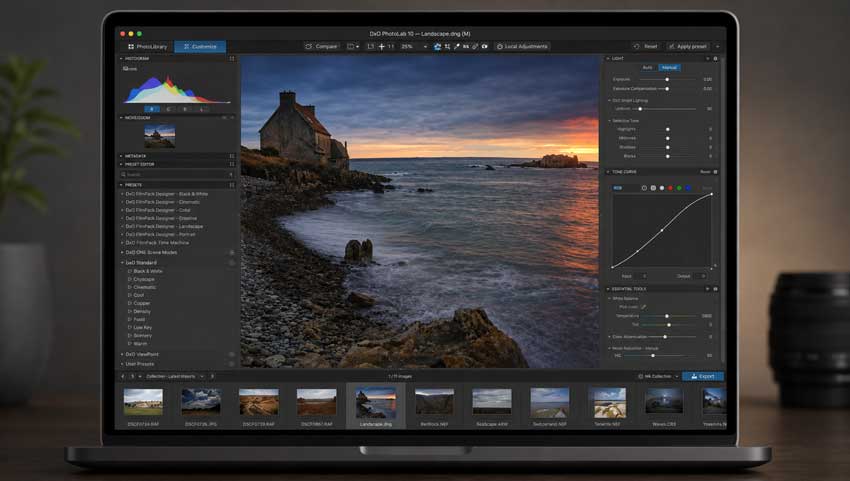
DxO PhotoLab 10 is a full RAW editor. Exposure, tone, color, local adjustments, masking, optical corrections, DeepPRIME noise reduction, and export all sit in one workflow. PhotoLab 10 adds more capable local editing, including depth-based masking, expanded AI masks, improved U Point controls, and dedicated color-grading tools. It is the logical option if you want DxO technology inside a complete Lightroom-style RAW environment.
DxO PureRAW 6
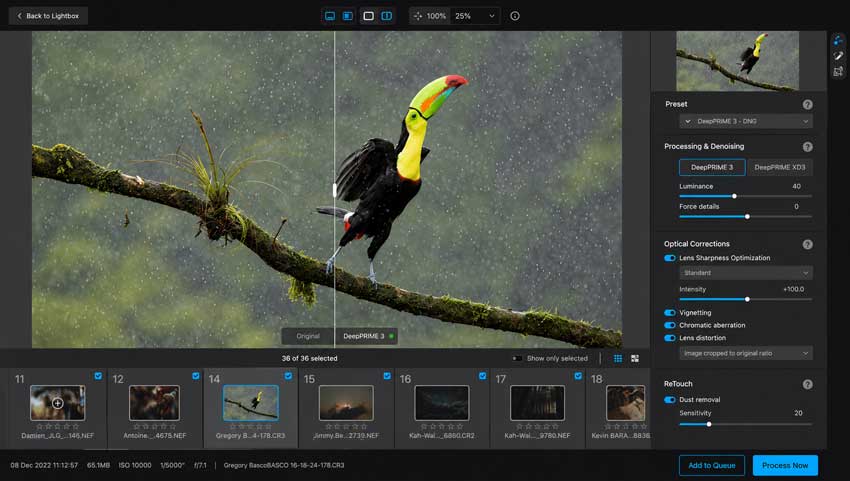
DxO PureRAW 6 is a different proposition. It is a RAW preprocessing tool rather than a full editor. The normal workflow is RAW > PureRAW > DNG > Lightroom or Photoshop. PureRAW handles demosaicing, denoising, lens sharpness, distortion, chromatic aberration, and vignetting before sending the file to your normal editor. Version 6 adds DeepPRIME XD3 support across Bayer and X-Trans files, sensor-dust removal, improved batch processing, and compressed DNG output. For photographers who already work comfortably in Lightroom, PureRAW is often the more practical DxO purchase.
Topaz Photo
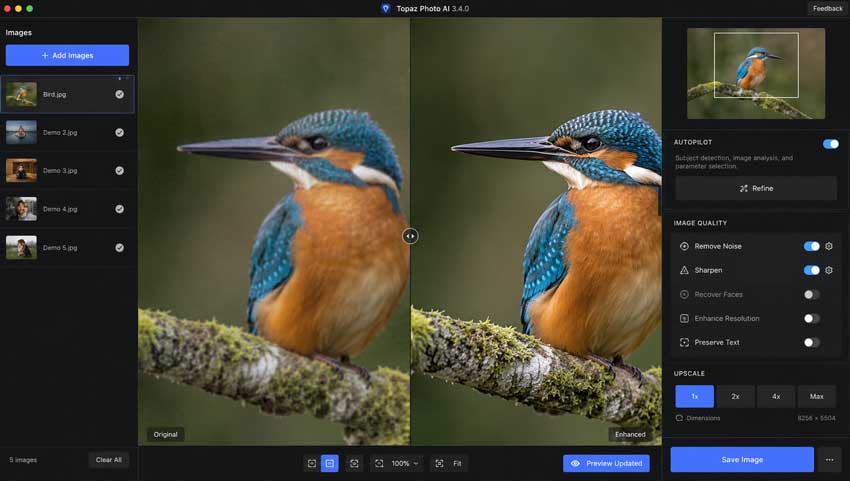
Topaz Photo is the successor to Topaz Photo AI, a name that still appears frequently in searches. It is not a complete RAW editor in the PhotoLab sense. Its strength is enhancement: RAW Denoise, Denoise, Sharpen, Super Focus, Recover Faces, Preserve Text, Upscale, and restoration tools. In other words, it is built for files that need more than conventional development.
DxO vs Topaz Image Quality
Noise Reduction: DxO Has the Better RAW Pipeline
Noise reduction is one of the strongest reasons to choose DxO.
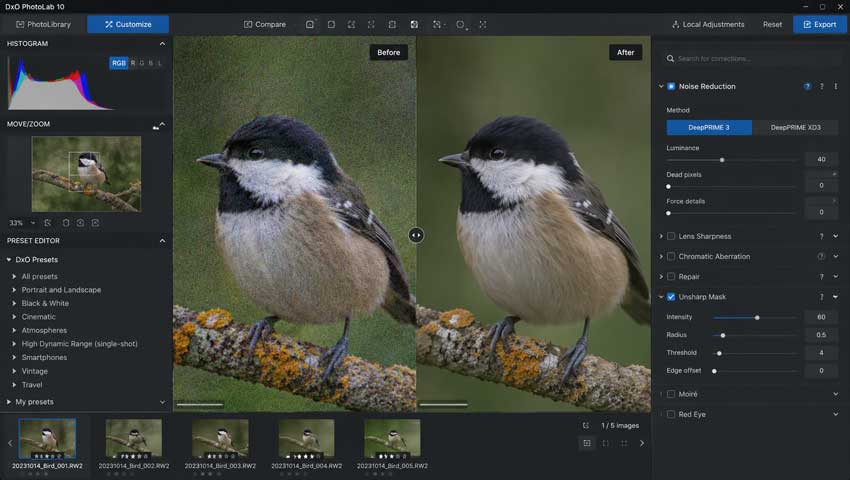
The challenge is not simply making a noisy background smooth. A serious denoiser has to remove chroma and luminance noise without flattening the weak detail underneath it. That is particularly obvious in wildlife photographs, where feather structure, fur, fine edges around the eye, and low-contrast texture can disappear long before the background looks overprocessed. DeepPRIME works during RAW demosaicing rather than treating noise only after the file has been rendered. In practice, this tends to give DxO a restrained, photographic texture. Fine repetitive structures remain coherent, and edges do not need to be unnaturally hard to look detailed.
Topaz RAW Denoise has improved considerably and is a legitimate RAW workflow rather than a simple post-processing filter. It is effective on high-ISO files and gives more scope for aggressive correction. The difference is that Topaz often invites more intervention, while DxO usually needs less.
For a properly focused RAW photograph at ISO 3200, 6400, or above, I would start with DxO. Topaz becomes more interesting if noise is only one of several problems in the frame.
Fine Detail and Texture: Preservation vs Reconstruction
The easiest way to judge both applications is to ignore the smooth background and look at the subject. Feathers, fur, eyelashes, hair, foliage, bark, fabric, and low-contrast shadow texture reveal whether software is preserving genuine information or replacing uncertainty with a plausible-looking pattern. DxO is generally conservative. On a high-resolution RAW file, that restraint is an advantage. Detail tends to remain connected to the capture, even if the result looks less dramatic at first glance.
Topaz is more willing to reconstruct weak information. That can be useful when a subject is slightly soft or a crop contains too few pixels, but it also creates the familiar "clean but plastic" risk when settings are pushed too far. Texture can become smooth, engraved, or mechanically sharpened.
For preserving existing natural texture, DxO is the safer choice. When genuine detail is weak and some reconstruction is acceptable, Topaz has more headroom.
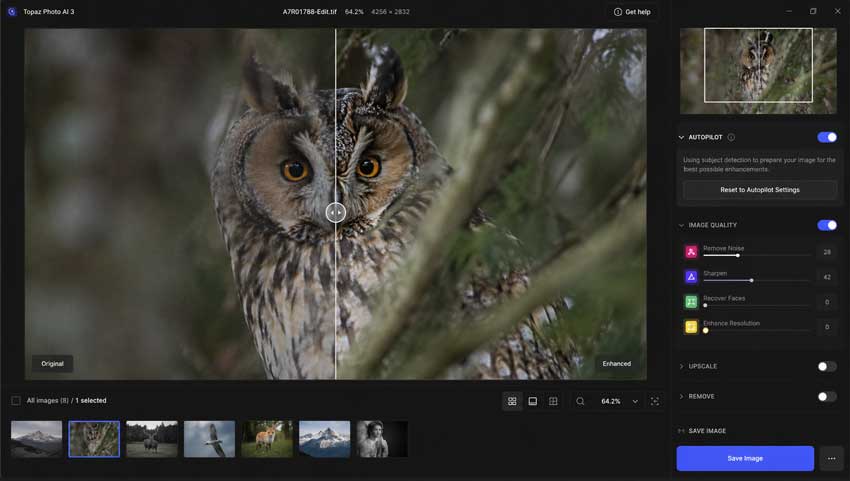
Sharpening and Blur Recovery: Topaz Has More Rescue Power
DxO sharpening is at its best on an image that is already in focus. Its optical corrections and lens-aware sharpening are designed to optimize captured detail rather than invent new structure.
A genuinely soft image is different. Topaz has more ambitious tools for this problem, including dedicated Sharpen models and Super Focus. If a bird's eye is slightly out, a portrait is a little soft, or motion has taken the edge off a subject, Topaz gives you more ways to attempt a recovery.
There are limits. No software can retrieve optical detail that was never recorded. At strong settings, reconstructed edges and textures may look convincing while no longer representing literal captured detail. That matters for documentary or fidelity-sensitive work.
For natural sharpening of a technically sound file, I prefer DxO. For missed focus or visible blur, Topaz is clearly more useful.
RAW Processing, Color, and Lens Corrections
As a complete RAW editor, PhotoLab 10 is in a different class from Topaz Photo.
White balance, highlight recovery, shadow control, tone curves, color work, masking, local corrections, optical corrections, and DeepPRIME all operate in one coherent pipeline. PhotoLab 10's depth masks and expanded local-editing tools also make it much more credible as a primary editor than older versions.
DxO also has a long-standing advantage in measured camera-and-lens profiles. Distortion, vignetting, chromatic aberration, and lens softness can be corrected according to specific body-and-lens combinations. PureRAW includes these corrections even though it is not a full editor. Topaz can improve the appearance of a soft image, but that is not the same as applying a measured optical correction. Its color and lighting controls are useful, but I would normally finish serious color work in Lightroom, Capture One, Photoshop, or PhotoLab.
For RAW development and lens correction, DxO wins decisively.
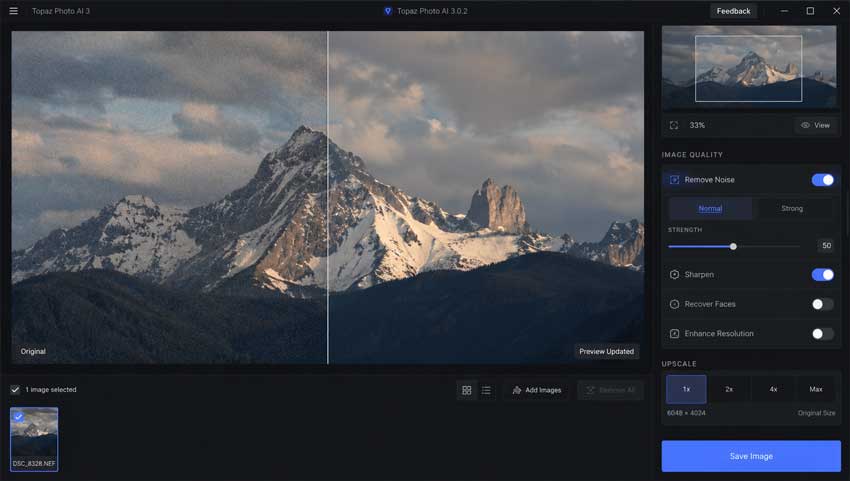
Upscaling and Heavy Crops: Topaz Wins
When resolution becomes the problem, the balance changes.
A wildlife photograph may be sharp and reasonably clean but still require a crop that leaves only a small fraction of the original frame. DxO can improve the RAW before the crop, but it is not primarily an enlargement tool.
Topaz Photo is. Upscale is one of its core functions, alongside Denoise, Sharpen, Super Focus, and Recover Faces. That makes it far more useful when the final deliverable needs substantially more pixels than the crop contains.
The most sensible workflow for a difficult RAW can therefore involve both products: use DxO to produce the cleanest source information, then use Topaz only if the final crop genuinely needs focus recovery or enlargement.
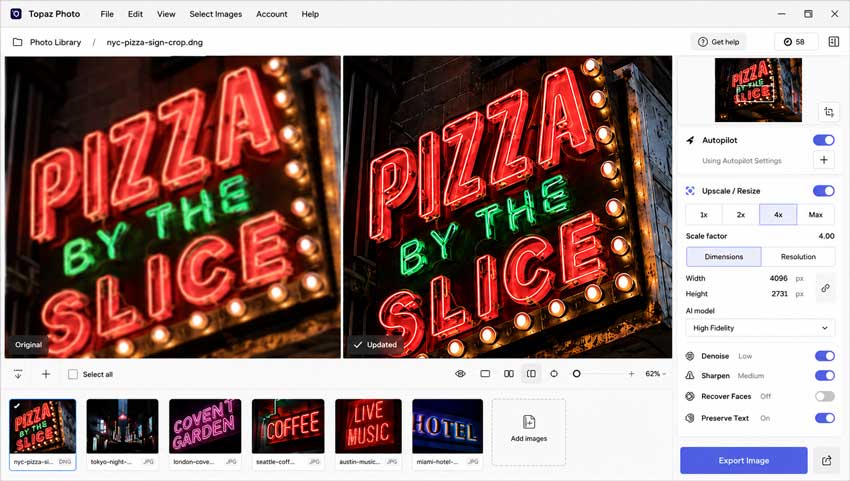
DxO vs Topaz for Different Types of Photography
Wildlife: I prefer DxO when the RAW is sharp but noisy. Feather and fur texture benefit from its restrained denoising, and PureRAW fits neatly into a Lightroom workflow. If the frame is slightly soft or severely cropped, Topaz becomes more valuable because Super Focus, Wildlife-oriented sharpening, and Upscale address problems DxO is not designed to solve.
Landscape: DxO is the stronger primary tool. Lens profiles, shadow denoising, natural foliage texture, local adjustments, and PhotoLab's color tools are more relevant than aggressive reconstruction.
Portrait: The comparison is more balanced. DxO is preferable for clean skin texture and hair on a properly focused RAW. Topaz earns its place when the face is small, soft, or poorly resolved, particularly through Recover Faces and more aggressive sharpening.
Old, compressed, or low-resolution images: Topaz is the obvious choice. These are not really RAW-development problems, and its restoration and upscaling tools are better suited to them.
DxO vs Topaz Workflow
Lightroom Integration
PureRAW has one of the clearest Lightroom workflows in this category: RAW > PureRAW > processed DNG > Lightroom Classic.
The advantage is that PureRAW handles the technical conversion before creative editing, while the resulting DNG still provides considerable editing flexibility inside Lightroom.
Topaz Photo also integrates with Lightroom Classic, but RAW files need to be sent through its dedicated RAW route if you want RAW Denoise to operate correctly. A normal rendered "Edit In" workflow changes the comparison because the RAW has already been converted.
For a photographer who wants better RAW quality without leaving Lightroom, PureRAW is the cleaner solution.
Photoshop, Batch Work, and Performance
Once the file has already been rendered into TIFF, PSD, or a layer-based composite, Topaz becomes more useful. At that point you may need to sharpen a subject, recover a face, or enlarge a layer rather than improve demosaicing.
For large groups of RAW files, PureRAW's batch workflow is more predictable. Topaz also supports batch processing, but I am less comfortable applying aggressive recovery settings across a varied shoot. Defects such as blur, noise, and missing detail are too image-specific.
Performance should be tested on your own machine. Both applications depend heavily on modern GPU hardware, and processing time varies substantially by model, file size, operating system, and enhancement type. A simple denoise pass and a Super Focus or large upscale operation are not comparable workloads.
DxO vs Topaz Pricing
Licensing is now one of the clearest practical differences. DxO sells PhotoLab and PureRAW as perpetual licenses, with paid major upgrades available separately. Topaz Photo uses a subscription model for the current product.
| Product | Licensing |
|---|---|
| DxO PhotoLab 10 | Perpetual |
| DxO PureRAW 6 | Perpetual |
| Topaz Photo | Subscription |
That makes DxO attractive to photographers who prefer to buy a version and keep using it without an ongoing payment. Topaz's model is easier to justify if you regularly depend on new enhancement models and want continued updates.
Because pricing changes more frequently than image-quality fundamentals, I would verify current store prices before purchasing rather than basing the decision on an older comparison.
Which One Should You Choose?
Choose DxO PhotoLab 10 if you shoot primarily in RAW and want a complete editor with excellent denoising, optical corrections, local adjustments, and color control.
Choose DxO PureRAW 6 if Lightroom or Photoshop is already the center of your workflow and you mainly want better RAW preprocessing, high-ISO noise reduction, and lens correction without changing editors.
Choose Topaz Photo if your work regularly involves soft photographs, missed focus, heavy crops, low-resolution files, face recovery, or significant upscaling.
The distinction I use is straightforward: if the source file is fundamentally good, I want DxO. If the source itself needs rescuing, I want Topaz.
Is There a Better Alternative to DxO and Topaz?
Not every workflow needs either application. Lightroom and Capture One already provide capable denoising and sharpening for many normal files. Dedicated enhancement software makes sense when your images regularly exceed what those tools can comfortably handle.
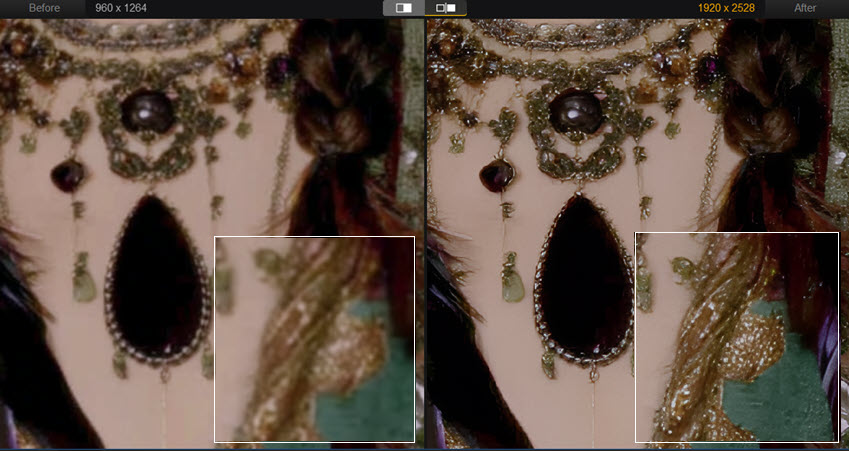
Aiarty Image Enhancer occupies a different position again. It is aimed more at straightforward denoising, detail reconstruction, and upscaling across mixed sources such as photographs, compressed web assets, low-resolution images, heavy crops, and AI-generated graphics.
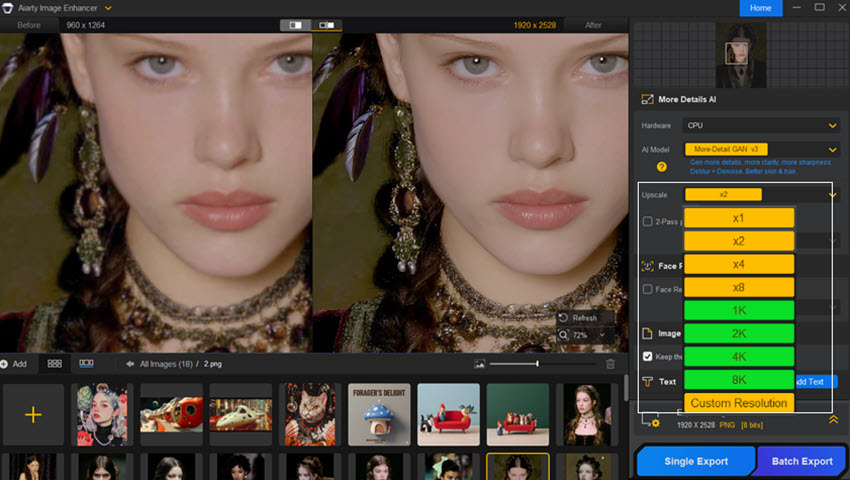
I would not use it to replace PhotoLab as a full professional RAW developer, and it does not need to imitate every specialized Topaz recovery model. Its attraction is a simpler enhancement and batch workflow when RAW catalog management is not the main requirement.
A useful way to separate the three is: DxO for RAW development and optical quality; Topaz for difficult-image recovery and upscaling; Aiarty for streamlined enhancement and reconstruction across mixed image sources.
>>You may also want to read: Aiarty Image Enhancer vs Topaz Photo AI
DxO vs Topaz: Final Verdict
There is no universal winner because DxO and Topaz solve different parts of the image-quality problem.
DxO is the stronger choice for extracting the best possible result from a technically sound RAW file. Its DeepPRIME pipeline, natural detail rendering, lens corrections, and RAW workflow are particularly convincing for high-ISO photography.
Topaz is more valuable when the capture itself is compromised. Missed focus, severe cropping, inadequate resolution, poorly resolved faces, and older rendered files are exactly where its reconstructive tools earn their place.
For a wildlife photographer returning with thousands of sharp but noisy RAW files, I would choose DxO first. For the one irreplaceable frame that is slightly soft or cropped too heavily, I would rather have Topaz available.
DxO makes a good RAW file better. Topaz gives a compromised file another chance.
You May Also Like


This post was written by Brenda Peng, a seasoned editor at Digiarty Software. With AI assistance for brainstorming and drafting, the post is reviewed for accuracy by our expert Abby Poole.
