



Best Photo Restoration Software to Restore Old Photos to Life



“Seeking Suggestions for Photo Restoration Software. I'm on the lookout for recommendations for old photo restoration software. While I'm aware that mainstream photo editors like Adobe Photoshop offer such features, I struggle with using them efficiently. I'm particularly interested in AI photo restorer for working with old photographs. Any suggestions? :)” –Reddit
I think that almost everyone have some faded, torn old photos that still hold priceless memories. But thanks to modern photo restoration software, those images no longer have to remain damaged or dull. Today there is software to restore old photos back to as new as just shot, with vivid color and crisp quality. In this post, we will help you find the best photo restoration software that deliver stunning results, without advanced editing skills needed.
Top 8 Best Photo Restoration Software
To effectively restore an old photo and achieve desirable results, the software must go beyond simple filters. There are several key features that must be included in any truly great old photo restorer. Below are the essential capabilities we look for when choosing the ultimate photo restoration software:
- AI inpainting and repair: Automatically fills missing areas and removes scratches.
- Color correction: Restores natural tones or adds color to grayscale photos.
- Noise reduction: Remove noise, grain, blurriness, distracting scratches, creases, and dust spots.
- Face enhancement: Keeps facial details lifelike and expressive.
- Upscale resolution: Upscale low-resolution old photos to 4K, 8K, or higher resolution for print or future-proof.
To evaluate each photo restoration software fairly, we used the same real-world old photograph throughout our testing process. The original image measured 564 × 546 pixels and exhibited several common issues found in aged photos, including noticeable blur, compression artifacts, faded details, and low overall resolution. When viewed at a larger size, facial features became heavily pixelated, making it difficult to distinguish important details.
This challenging test image allowed us to assess how effectively each AI photo restoration software could:
- Recover lost facial details
- Reduce blur and image artifacts
- Restore natural textures
- Improve overall clarity and upscale the photo without introducing unnatural AI artifacts
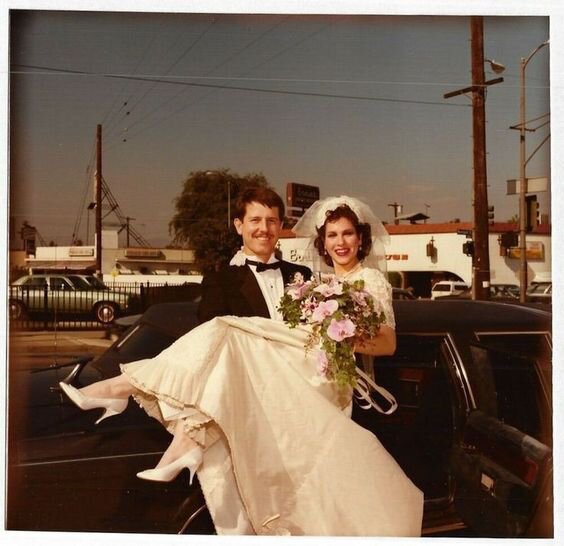
The results and rankings in this guide are based on each software's ability to restore this image while maintaining a natural and realistic appearance. Below we’ve summarized the top 8 best AI photo restorers below:
Aiarty Image Enhancer
Price: Free trial available. $99.00 for lifetime license, with unlimited free upgrade for 3 PCs.
Aiarty Image Enhancer stands out as a strong contender in the field of AI photo restoration software, especially for old photos suffering from low resolution, blurriness, or film grain. Unlike traditional editors, it uses advanced deep-learning algorithms to analyze image artifacts, reconstruct missing details, and restore clarity with impressive precision.
As a modern software to restore old photos, Aiarty doesn’t just upscale images. It intelligently enhances existing pixel to dramatically increase resolution and sharpen fine textures such as faces, fabrics, and backgrounds. Users can upscale vintage or scanned photos up to 32K resolution while maintaining remarkable naturalness and detail fidelity.
For old portraits and family photos, Aiarty also includes face restoration controls that allow users to adjust the restoration strength and selectively enhance individual faces. This helps recover facial details while maintaining a natural balance between enhanced features and the original appearance. Aiarty can also restore faded colors and revive more lifelike tones, helping turn dull, yellowed, or washed-out photographs into clearer, more vibrant images.
For photographers, Aiarty can automatically configure itself as a Lightroom external editor, making it easier to send photos from Lightroom to Aiarty for AI enhancement as part of an existing restoration workflow.
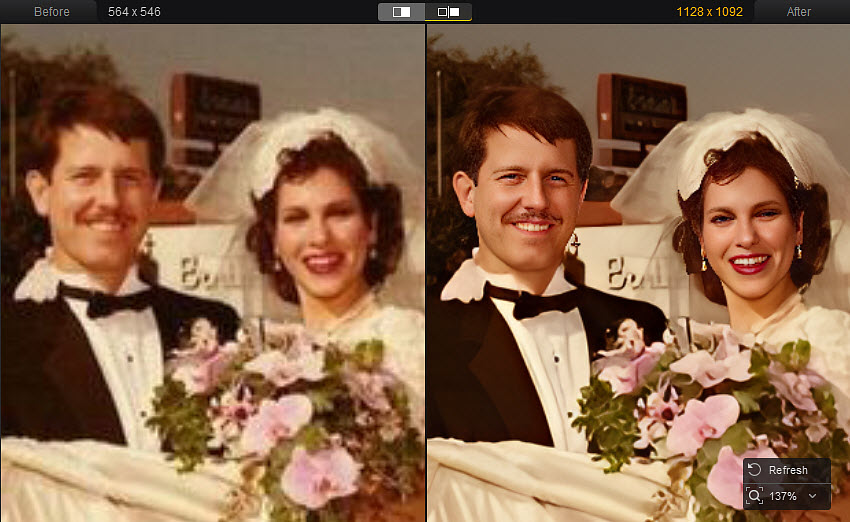
Aiarty Image Enhancer provides consistent and reliable results when restoring different kinds of old photos. There are several before-and-after comparisons that demonstrate how Aiarty effectively restores a wide range of old photographs, from grainy, time-worn images to severely faded or blurry shots. Each example highlights how the software brings forgotten memories back to life with clarity and natural color balance.
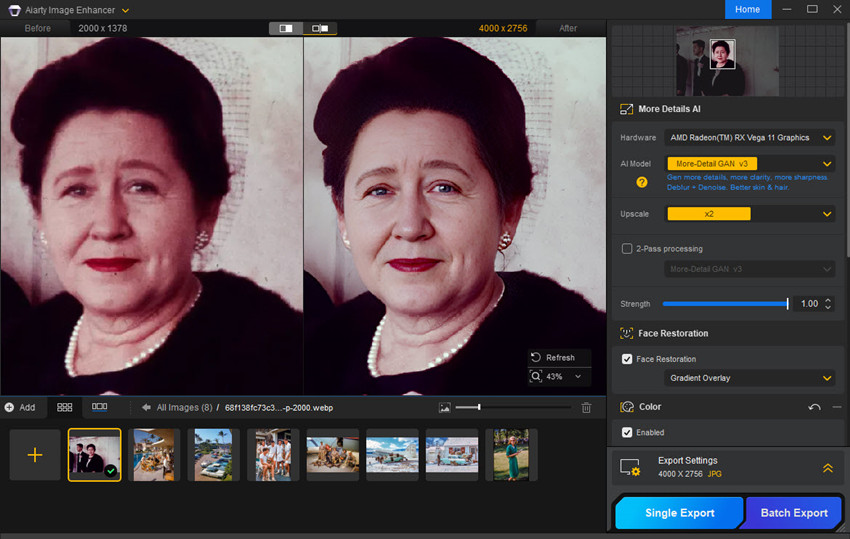
Here are more photo examples restored by Aiarty Image Enhancer:
What We Liked:
- Automatically remove blur, grain, and artifacts common in old photos with precision.
- Upscale and enlarge old photos to high-resolution output (up to 32K) for future-proofing.
- Restore natural tones and depth without oversaturation.
- No editing skills required; fast processing even on large images.
- Work well with scanned photos, digital archives, and portraits.
What We Didn't Like:
- Free version has limited export quality or watermark restrictions.
- It lacks manual editing tools found in advanced photo restoration software like Photoshop.
- Not the best for repainting seriously damaged photos.
Topaz Photo
Price: $252 for the non-cancellable commitment year
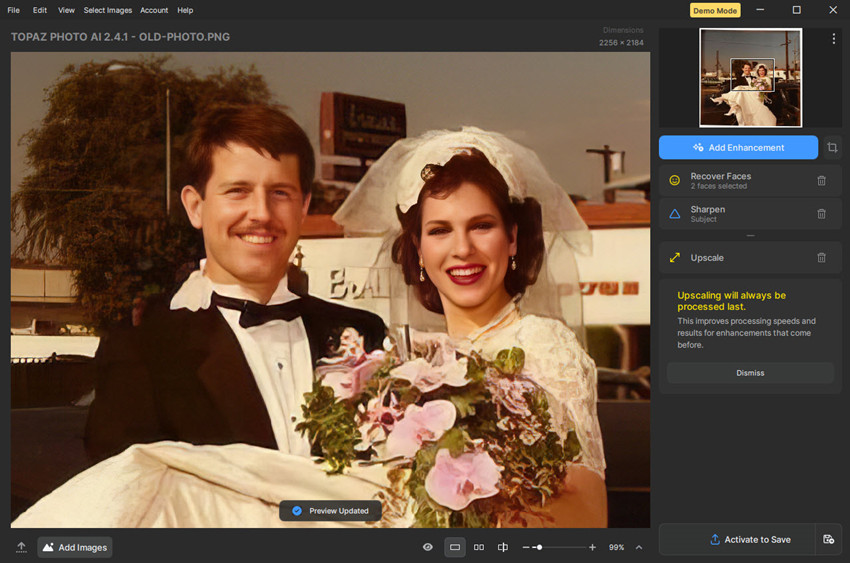
Topaz Photo is one of the most popular and advanced AI photo enhancement tools on the market, widely used by photographers and restoration specialists. Known for its ability to upscale, denoise, and sharpen images with remarkable accuracy, it offers a comprehensive AI photo restorer toolkit for old or damaged photos.
As a photo restoration software, Topaz Photo excels with its specialized AI models designed for different restoration needs. Features like Dust & Scratch Repair, Denoise, Recover Faces, and Balance Color allow users to fix common issues found in aged photographs, including major scratches, dust spots, fading, noise, blur, and loss of facial details. It also offers a degree of manual control to adjust the output quality. This makes Topaz Photo particularly effective for restoring scanned prints, film photos, and old family archives.
What We Liked:
- Multiple AI models for specific photo restoration tasks.
- High-quality upscaling up to 600% with excellent detail preservation.
- Natural color and texture restoration, suitable for both digital and scanned photos.
- Flexible workflow with automatic detection and manual adjustments.
What We Didn't Like:
- No free version available and high subscription cost.
- It’s high GPU demand and can be very slow on older systems.
- It requires manual tweak to get the best output.
Test Results:
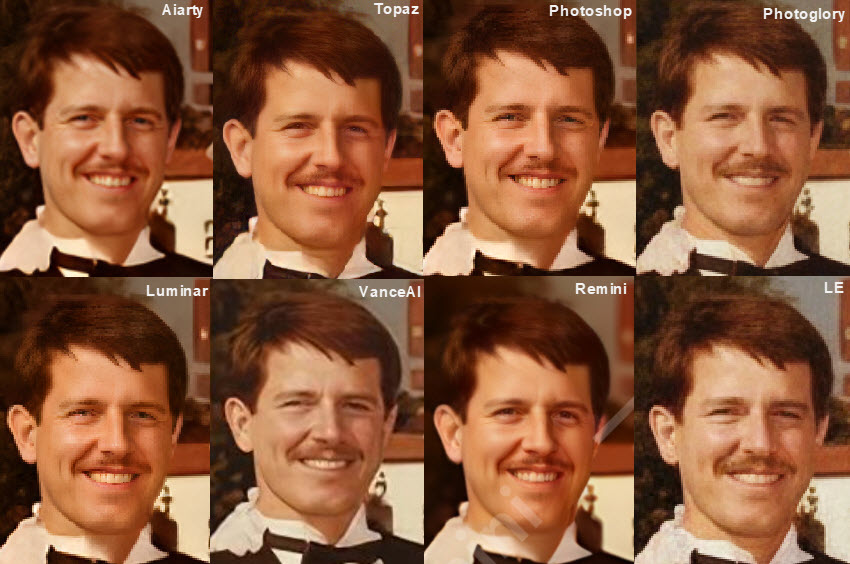
Topaz Photo Restore + Upscale shows a mixed result depending on the scaling level. At 2×, noticeable pixelation artifacts can appear on facial areas, giving a slightly blocky look. However, when increased to 4×, the image quality improves significantly, with better reconstructed facial details and fewer visible imperfections overall. Across all the photo restoration software tested, Topaz Photo AI stands out as one of the strongest performers, consistently delivering high-quality restorations and impressive detail recovery.
Adobe Photoshop
Price: Annual plan from Adobe, ~$263.88 per year for one desktop.
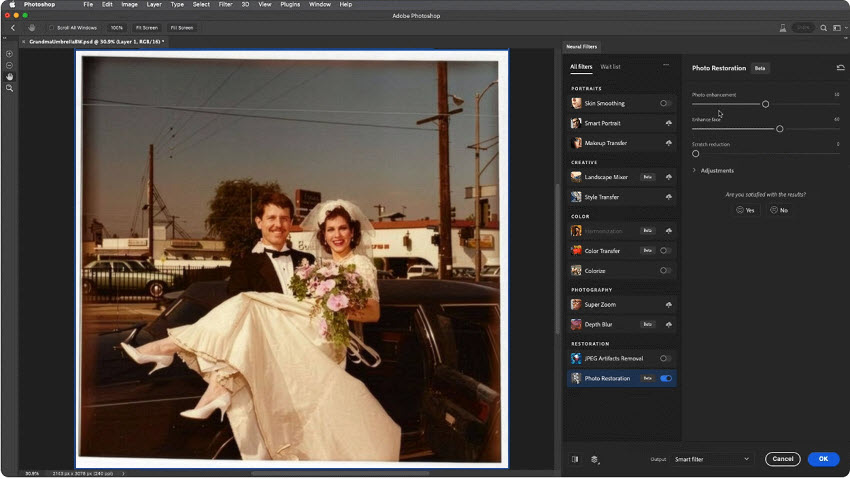
Photoshop remains the gold standard for digital imaging, and when used for old photo restoration, it offers unmatched control. With layers, masks, clone stamping, healing brushes, content-aware fill, plus newer Photo Restoration Neural Filters, it qualifies as high-end photo restoration software. It allows users to meticulously address every flaw, reduce grain, remove scanner tramlines, sharpen faces, etc. Meanwhile, there are plenty of tools and filters to help restore the color and quality of a faded old photo.
If you need professional-grade results and are willing to invest time and money, this is the solution. It is the ultimate reference point for old photo restoration Photoshop techniques. If you’re not sure about how to use Photoshop as an old photo restorer, check and learn Photoshop old photo restoration tutorials.
What We Liked:
- It offers full control, especially when manual correction is needed for tears, missing parts, color shifts...
- There is an extensive ecosystem of plugins that will help get professional restored photo quality.
- It offers high-quality AI photo restoration tools.
What We Didn't Like:
- It’s not as simple as one-click “AI photo restorer” tools.
- It will take time and effort to manually get the best restored photo quality.
- It can be slow or crash on a computer with less robust configuration.
- High subscription cost for regular users.
Test Results:
The Photoshop Neural Filters-based restoration delivers a natural-looking result, with adjustable controls such as “Enhance Face” allowing fine-tuning of the output. Facial features remain largely faithful to the original, maintaining good identity consistency. However, for image enlargement, additional Photoshop tools are required, as the Neural Filter itself does not handle high-quality upscaling.
PhotoGlory
Price: $39.20 for the Pro Version with 1-year free updates
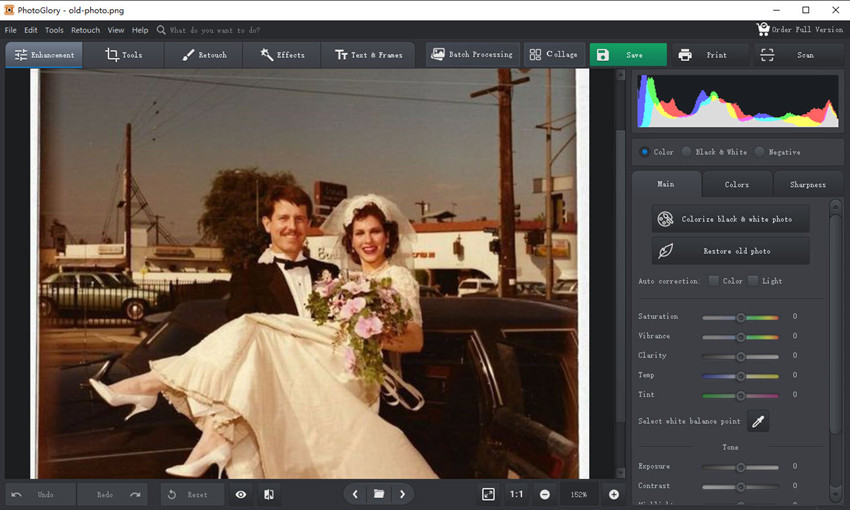
PhotoGlory markets itself as old photo restoration software for Windows, designed specifically to help restore vintage and damaged photos (e.g., scratches, dust, fading). It excels at removing scratches, creases, stains, tears, colorizing a black & white photo and restoring colors to faded & washed out images. One review remarks: “PhotoGlory really surprised me by its ability to restore old photos. It’s a fantastic program that can save you a lot of time from manually restoring old photographs.”
It’s intuitive enough for beginners but powerful enough for detailed work. Compared to other best software to restore old photos, PhotoGlory occupies a niche of simpler, dedicated restoration rather than full pro workflows.
What We Liked:
- Specifically designed for old photo restoration tasks: e.g., remove scratches, fix fading.
- It’s budget-friendly pricing.
What We Didn't Like:
- It works on Windows PC only.
- Some issues around licensing, version updates and customer support.
- Not as feature-rich or flexible as high-end editors like Photoshop + plugins.
Test Results:
The PhotoGlory restored image looks relatively natural overall, but there are noticeable changes in facial details compared to the original, and the colors appear slightly washed out. Since PhotoGlory does not perform AI upscaling and only resizes the image, the output remains relatively small, and when enlarged, visible pixelation becomes apparent.
Luminar Neo
Price: $159 lifetime license with one-year free updates
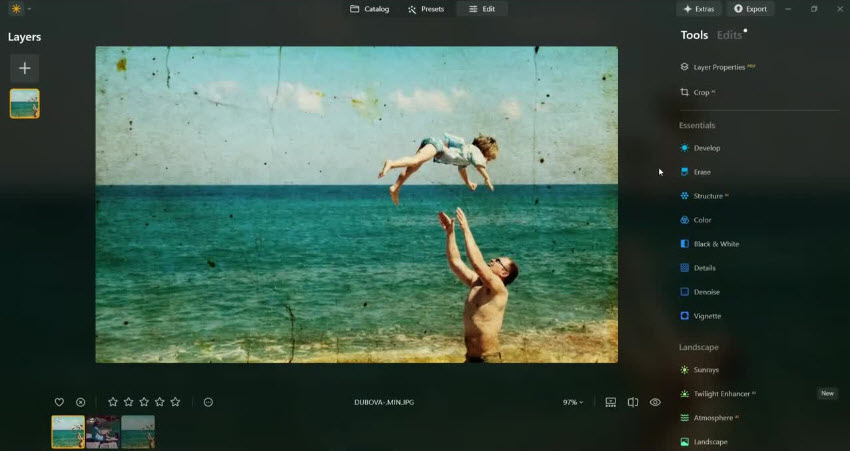
While Luminar Neo is best known as a creative image editor, its suite of advanced AI-driven tools also makes it an impressive photo restoration software for old and damaged photos. It’s particularly suited for users who want both artistic control and AI-assisted recovery in one platform.
With features like Enhance AI, Structure AI, and Relight AI, Luminar Neo can effectively restore clarity, contrast, and detail to faded or low-quality images. Its intelligent color correction tools can remove the yellow or sepia tints often found in aged prints, while the AI Denoise and Masking tools help reduce grain and selectively refine areas that need more attention. Compared to Photoshop, Luminar Neo delivers a much faster and more intuitive photo restoration experience, striking a perfect balance between automation and manual control.
What We Liked:
- Intuitive AI tools can effectively correct severe color casts or flat lighting in vintage photos.
- It offers more control than purely automated old photo restoration online, but much easier than Photoshop.
- Fast and smooth performance on modern hardware.
What We Didn't Like:
- It doesn’t contain highly specific tools for complex physical damage repair.
- It can accidentally apply effects that make the restored image look overly edited rather than authentically restored.
- Requires moderate system resources for best performance.
Test Results:
The Luminar Neo restored photo is highly faithful to the original, preserving details very well and delivering an overall strong restoration result. However, when zoomed in to inspect fine details, some pixelation becomes visible due to the enlargement. At 100% viewing size, though, the image appears clean and the restoration quality is very good.
VanceAI Photo Restorer (desktop/online)
Price: $ 99.90/year for 1 PC
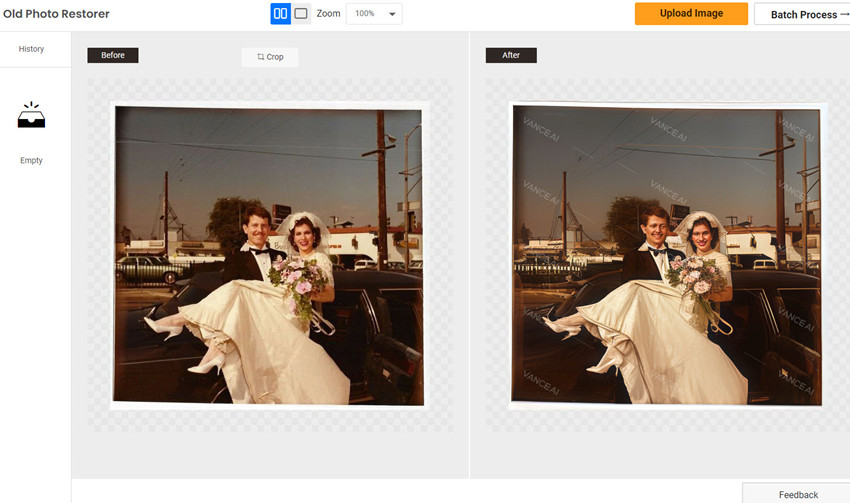
As its name suggests, VanceAI Photo Restorer is explicitly built for the task of repairing and restoring old, damaged photographs. It can remove scratches, stains, and tears, repair damaged textures, and even enhance facial details in old portraits. One of its standout features is AI Colorization, which allows users to add realistic colors to black-and-white photos automatically.
Available as both a desktop photo restoration software and an old photo restorer online, VanceAI offers flexibility for different users. Its cloud-based online platform provides a convenient way to restore old photos online for free (with limited credits), while the desktop version offers more advanced control and batch processing capabilities. It shines as a one-click AI photo restorer that combines convenience, quality, and speed.
What We Liked:
- It’s designed to remove scratches, stains, and tears in old photos.
- It will colorize black-and-white photos with natural tones.
- It offers both online and desktop versions for flexibility.
- Fast processing with minimal user input required.
What We Didn't Like:
- It can’t upscale old photos to higher resolutions.
- Online version has limited free credits and watermarks.
- Less manual control compared to professional editors like Photoshop.
- Results may vary on severely damaged or low-contrast images.
Test Results:
The photo restored by Vance AI shows a significant improvement in overall sharpness and clarity. However, the facial details are noticeably altered compared to the original, and there are visible color shifts across the image, with the result appearing somewhat washed out
Remini AI (online/mobile)
Price: $0.99 for 7 days, up to 20 photos/week
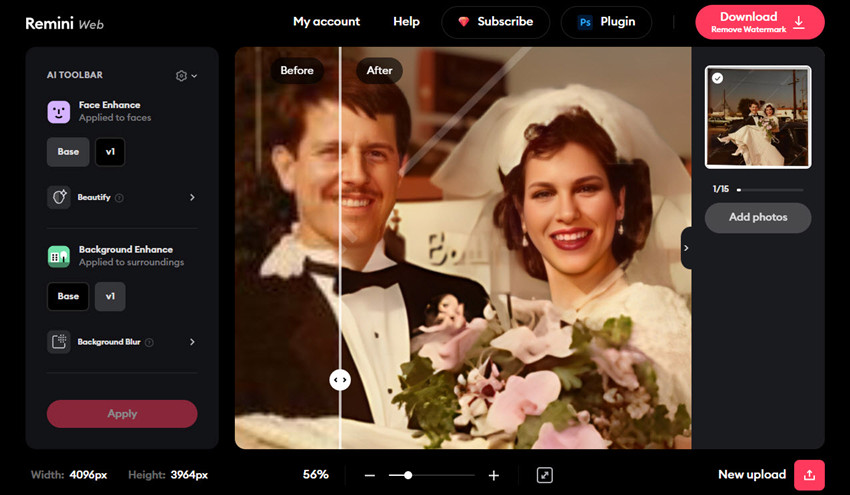
Remini is a highly popular AI photo restorer online and for mobile, designed for users who want to enhance old or low-quality photos quickly and effortlessly. Its core AI technology specializes in reconstructing facial details with remarkable accuracy, making it an ideal choice for reviving faded portraits and improving clarity in personal or historical photos.
Remini excels at intelligently rebuilding lost details in old photos, especially in facial features such as eyes, noses, and mouths. Many users describe the results as “magical,” as Remini can transform pixelated or blurry faces into sharp, natural-looking portraits within seconds. However, while Remini is exceptional for enhancing clarity and correcting focus, it’s not a full-scale photo restoration software. It performs best as a facial detail enhancer, rather than a tool for repairing physical damage such as scratches, tears, or creases.
What We Liked:
- It offers exceptional facial detail reconstruction using AI.
- It’s great at fixing blurriness, grain, and focus issues in old photos.
- It’s available both as a mobile app and online photo restorer.
What We Didn't Like:
- Focuses mainly on faces; limited ability to repair background or deep physical damage.
- Free version includes watermarks and limited daily credits.
- Less suitable for professional or large-scale restoration projects.
Test Results:
The result from Remini AI’s photo restoration is very impressive, with sharp and clearly recovered facial details that stay highly faithful to the original image. However, it tends to apply an automatic depth-of-field effect, making the background noticeably blurred. As a result, while the subject in the foreground is well preserved, most background elements lose detail and appear softened.
Let's Enhance (online)
Price: Free trial (5 credits), Subscription starts from ~$9.00/month.
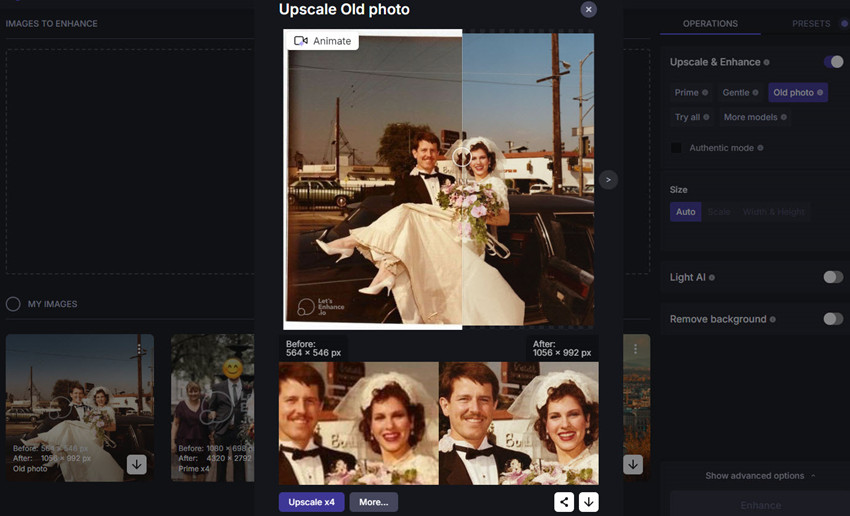
Let’s Enhance is a leading cloud-based AI image upscaler and restoration platform that has become a favorite among digital archivists and photography enthusiasts. For those looking to digitize old photos without heavy software installation, it offers an exceptionally powerful browser-based neural network. It specializes in two major pain points of vintage photography: heavy film grain and low resolution caused by early digital cameras or low-spec scanners.
Powered by its signature "Smart Enhance" and "Photo" AI models, Let’s Enhance goes beyond simple pixel duplication. It analyzes time-worn textures and intelligently reconstructs missing details, ensuring that skin textures, backgrounds, and clothes look sharp rather than smudged. If you have a bulk folder of scanned family memories, its robust batch processing workflow allows you to enhance dozens of images simultaneously in the cloud, saving you hours of manual rendering time
See: best photo enhancers online
What We Liked:
- Exceptional cloud-based upscaling up to 4K/8K without sacrificing natural textures.
- Excellent batch processing that allows users to restore multiple old photos at once.
- No high-end GPU or hardware setup required; works smoothly on any browser.
What We Didn't Like:
- Subscription-based credit model can become expensive for large archiving projects.
- Lacks dedicated brush tools for manual precision work on deep physical tears.
Test Results:
When using the “Old Photo” model in Let’s Enhance, the output not only restores the image but also applies automatic color adjustments, which can introduce noticeable color shifts compared to the original. In addition, a closer inspection shows that some facial features are subtly altered, with minor changes in details and structure rather than a fully faithful restoration.
Conclusion
Restoring old photos is no longer a task reserved for experts with advanced editing skills. Thanks to modern AI-powered tools, anyone can bring damaged, faded, or low-resolution images back to life with clarity, color, and emotional warmth. The best photo restoration software for you ultimately depends on your goals, skill level, and how much control you want during the process.
If you prefer one-click AI restoration with high-quality, consistent results across all types of old photos, Aiarty Image Enhancer stands out as a powerful choice. For users who want full manual control and professional precision, Photoshop remains the gold standard. Tools like Topaz Photo AI and Luminar Neo strike a balance between AI efficiency and manual fine-tuning, while more beginner-friendly options such as PhotoGlory, VanceAI, Remini, and Fotor make restoration accessible to anyone, whether on desktop or via old photo restoration online.
No matter which tool you choose, the most important thing is the memories you preserve. Each restored image becomes a piece of history passed forward. With the right software, those cherished moments, once faded or forgotten, can be revived with stunning clarity and shared for generations to come.
 FAQs
FAQs
For professional photo retouching, Adobe Photoshop remains the industry standard due to its precision tools, layers, masking, and AI-assisted features such as Generative Fill and Neural Filters. For AI-assisted retouching with less manual work, Topaz Photo AI and Luminar Neo are excellent alternatives, offering smart enhancements, skin retouching, and detail recovery with far less effort than traditional editing.
Yes. Tools like VanceAI’s online free mode, and Remini’s free version offer limited but effective old photo restoration online free options. These platforms allow scratch removal, color revival, and clarity enhancement at no cost, although high-resolution exports or advanced features may require upgrading.
Professionals typically combine manual retouching techniques with selective AI tools. They often use Photoshop for tasks such as repairing tears, reconstructing missing areas, color grading, and detail blending. Specialized AI tools like Topaz Photo AI or Aiarty Image Enhancer may be used to upscale, enhance fine details, or reduce noise before the final retouching is done manually for a natural finish.
For mobile users wanting quick fixes, Remini is one of the best apps for restoring clarity, especially in portraits. If you want both creative enhancement and restoration in one app, Luminar Neo provides a balanced mix of AI enhancement and artistic editing. For desktop users who need deeper restoration capabilities, Aiarty Image Enhancer and Topaz Photo AI offer more comprehensive results.
Aiarty Image Enhancer, Topaz Photo AI, and Adobe Photoshop are currently among the best photo restoration software options in 2026. Aiarty offers the best balance between restoration quality, AI upscaling, and ease of use, while Photoshop provides the most manual control.
You May Also Like


This post was written by Brenda Peng who is a seasoned editor at Digiarty Software who loves turning ordinary photos into extraordinary works of art. With AI assistance for brainstorming and drafting, the post is reviewed for accuracy by our expert Abby Poole for her expertise in this field.
