 Top Pick - Aiarty Video Enhancer



Many older videos, including DVD rips, home movies, camcorder recordings, and early online videos, are still limited to 480p. When viewed on today's 1080p or 4K displays, they often appear soft and lacking in detail. A 480p video contains only about one-sixth the number of pixels of a 1080p video, making the quality difference especially noticeable on modern high-resolution screens. That's why many people look for ways to upscale 480p videos to 1080p.
Modern AI video upscalers offer a more advanced approach than simple resizing. Instead of only enlarging pixels, they can analyze video frames and enhance visual details to create a cleaner and more natural-looking result. While AI cannot turn every low-quality source into native 1080p footage, it can significantly improve many types of 480p videos.
In this guide, you'll learn whether upscaling 480p to 1080p is worth it, which videos benefit most, what quality improvements you can realistically expect, and the best ways to complete the process.
Can You Really Upscale 480p to 1080p?
Yes, you can upscale a 480p SD video to 1080p HD, but increasing resolution does not automatically create the same detail as footage originally recorded in 1080p.
Traditional upscaling simply enlarges the existing pixels to fill a larger frame. Although the output resolution becomes 1920 × 1080, the original visual information remains unchanged, which can make the video look soft, blurry, or pixelated.
AI-powered upscaling works differently. AI models analyze each frame and use learned patterns to enhance missing visual information, improving areas such as edges, textures, and overall image clarity. This makes AI-based methods more effective than basic resizing when improving older low-resolution videos.
However, the results still depend on the source quality. Videos with cleaner images and fewer compression issues usually achieve better results than heavily damaged or extremely compressed footage.
For users who want to make 480p videos look better on modern TVs, monitors, or mobile devices, an AI video upscaler is generally the most effective option.
Which 480p Videos Benefit Most from AI Upscaling?
Not every 480p video improves equally after upscaling. The final result depends on the original recording quality, compression level, and how much usable visual information remains in the source file. In general, videos with clearer details and fewer artifacts are better candidates for AI enhancement.
What Quality Improvement Can You Expect?
Upscaling a 480p video to 1080p increases the resolution from 720 × 480 pixels to 1920 × 1080 pixels, but resolution alone does not determine the final quality. A good upscale should also improve how details, textures, and edges appear when viewed on modern displays.
With AI-powered upscaling, you can typically expect improvements in several areas:
- Sharper edges: AI can refine outlines around objects, faces, and text, making enlarged videos appear clearer.
- Improved textures: AI models can enhance fine details in areas such as hair, clothing, landscapes, and backgrounds.
- Reduced noise and compression artifacts: AI enhancement can minimize grain, blockiness, and other issues commonly found in older videos.
- Better facial details: For family videos, interviews, and older recordings, AI can make faces appear clearer and more natural.
- Better viewing experience: Upscaled videos generally look more comfortable on large TVs, high-resolution monitors, and mobile devices.
Keep in mind that AI upscaling enhances existing visual information rather than creating a perfect copy of native 1080p footage. Clean source videos can show noticeable improvements, while severely blurred, heavily compressed, or damaged footage may only see limited changes.
Best Ways to Upscale 480p to 1080p
There are several ways to upscale a 480p video to 1080p, depending on whether you want the highest possible quality, a simple workflow, or a free solution. AI-powered upscalers generally deliver the best results because they can enhance details and reduce quality issues, while traditional converters mainly increase resolution without improving the original image.
For most 480p videos, AI upscalers are the better choice because they can analyze frames and enhance details that traditional resizing methods cannot restore. They are especially useful for older footage such as DVDs, camcorder recordings, and personal videos that contain valuable visual information.
Traditional converters like HandBrake are still useful when your goal is simply to change resolution, codec, or file size. However, they do not add missing details or significantly improve blurry low-resolution footage.
Below, we'll show you how to upscale 480p videos to 1080p using AI-powered tools and traditional methods, so you can choose the approach that best fits your needs.
Method 1. Upscale 480p to 1080p with Aiarty Video Enhancer
Aiarty Video Enhancer goes beyond simple resizing. Instead of stretching frames from 480p to 1080p, it applies advanced AI models to improve the overall video quality. The software is capable of sharpening blurry footage, reducing noise, depixelating compressed videos, and removing artifacts that often appear in older recordings. These enhancements make it especially effective for restoring DVDs, VHS captures, or low-resolution digital clips.
- AI reconstruction adds missing details and makes videos visibly sharper
- Batch processing supported for handling multiple clips at once
- Allows for precise control over AI enhancement levels through a Strength slider, ensuring quality without sacrificing natural detail.
- Simple interface suitable for beginners
- Also supports adjusting color, converting SDR to HDR video, cropping, denoising audio, and AI frame interpolation.
- Fast on GPU, slower on CPU.
- HDR display needed for SDR-to-HDR viewing.
- Fully offline; no cloud support yet.
How to Use
Step 1: Install the software
Click the download button below to download and install Aiarty Video Enhancer. Once installed, open the program on your computer.
Step 2: Add your video
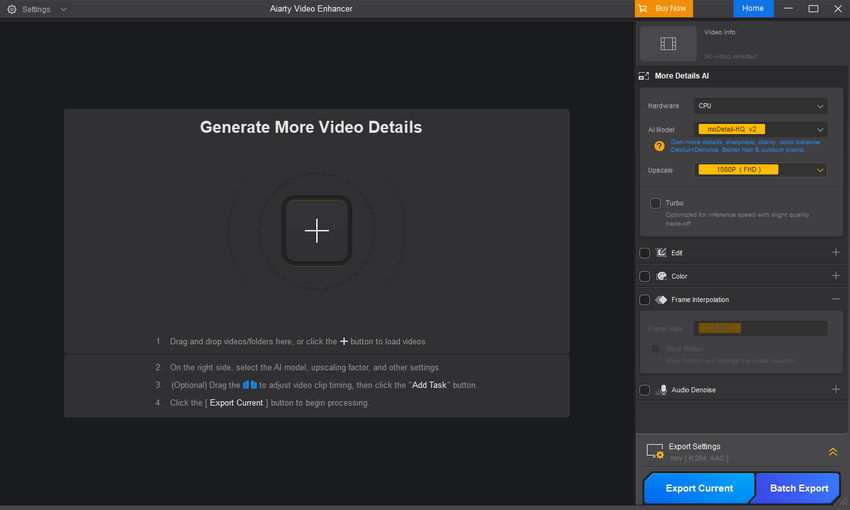
Drag your 480p file into the workspace. Multiple videos can be loaded if you want to run batch processing.
Step 3: Select an AI model
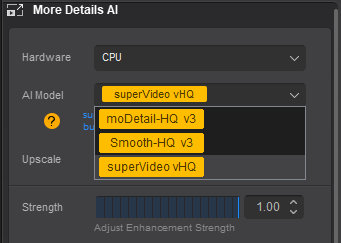
From the AI Model drop-down menu, pick the option that best fits your footage.
Step 4: Set target resolution
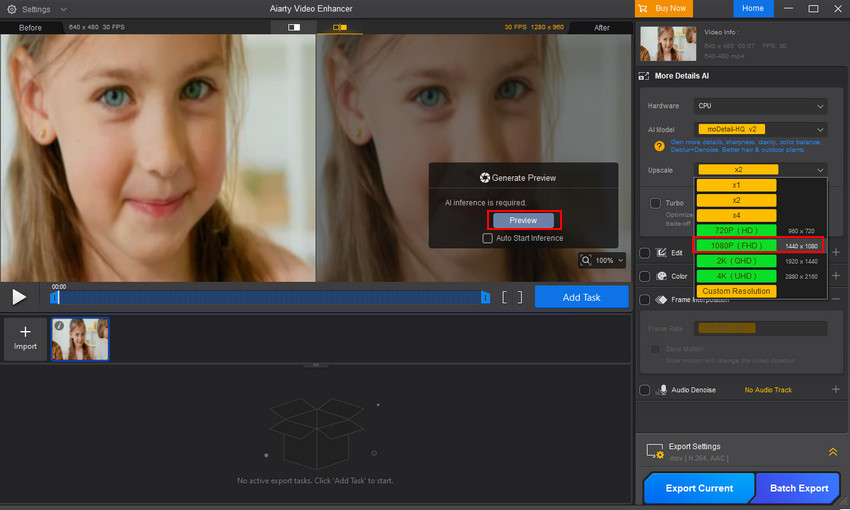
In the Upscale menu, choose 1080p (Full HD) as the output resolution.
Step 5: Preview before exporting
Click the Preview button to generate a sample of the upscaled video. This helps you confirm the effect without processing the entire file.
If you’re not satisfied with the result, try another AI model and adjust the Strength, and then preview again.
Step 6: Export your video
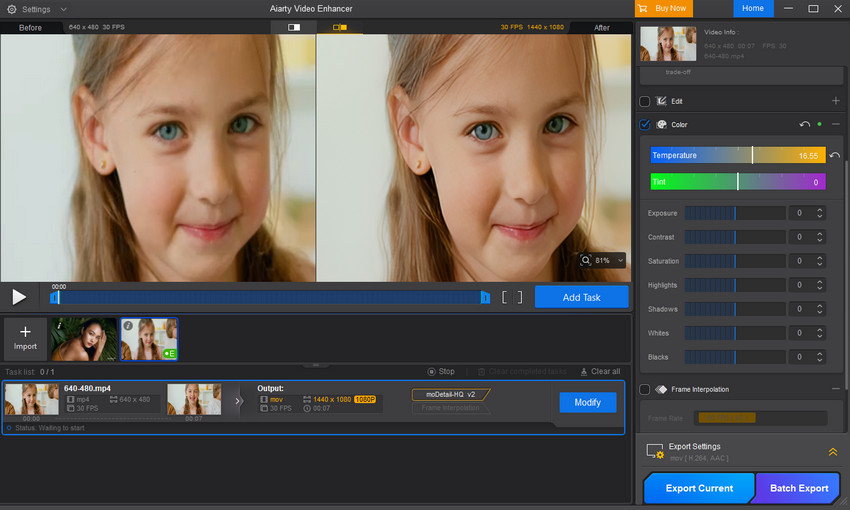
Once satisfied, add the task to the export list. You can choose Export Current for one clip or Batch Export for multiple files. The result will be a crisp 1080p version of your original 480p video.
Method 2. Upscale 480p to 1080p with Topaz Video AI
Topaz Video AI is widely recognized as a heavyweight in the industry. It is a professional-grade tool that offers granular control over the upscaling process. Unlike simple converters, Topaz utilizes temporal information from multiple frames to reconstruct high-quality 1080p footage from 480p sources.
It is particularly famous for its specialized AI models, such as Iris for face recovery and Proteus for general enhancement.
- Delivers good detail recovery and sharpness.
- Includes specific AI models.
- Allows users to manually adjust parameters like "Recover Detail", "Sharpen", and "Reduce Noise".
- It runs on a subscription model ($299/year for the Personal plan) and no longer offers a lifetime license.
- The interface is packed with settings and models that can be overwhelming for beginners.
- Requires a powerful GPU; processing speeds can be significantly slower than lighter alternatives.
If you're torn between Aiarty and Topaz, check out this comprehensive comparison of [Aiarty Video Enhancer vs. Topaz Video AI] to see which one best fits your needs.
How to Use
Step 1: Download and launch
Go to the Topaz Labs website to download the software. Note that the file size is quite large. Once installed, launch the program.
Step 2: Import your 480p video
Drag and drop your low-resolution video into the main window.
Step 3: Set output to 1080p
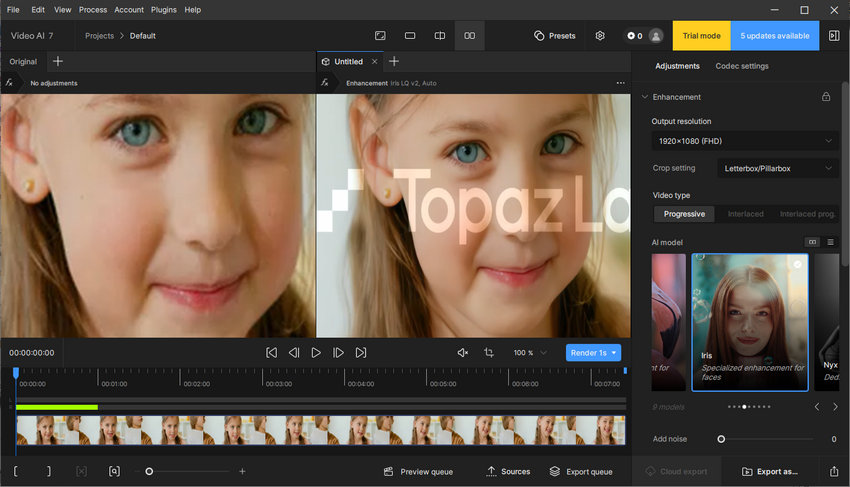
Under the Output Resolution dropdown menu, select 1920×1080 (FHD). You can also choose to crop or change the aspect ratio here if necessary.
Step 4: Choose an AI model
In the right-hand panel, expand Enhancement and select a model like Proteus (for general refinement) or Iris (if your video has many human faces).
Step 5: Preview and Export
Click the Render button to render a short clip (e.g., 5 seconds). Since Topaz renders slowly, this step is crucial to ensure you like the settings. If satisfied, click Export as to save the full 1080p video.
Method 3. Upscale 480p to 1080p with Video2X
If you want to free upscale 480p video to 1080p, you can consider Video2X. It is a free and open-source AI video upscaling tool that leverages advanced machine learning algorithms to enhance video resolution. Unlike traditional upscaling methods that merely stretch pixels, Video2X intelligently reconstructs details, resulting in sharper and more detailed videos. It supports multiple AI models, including waifu2x, Anime4K, Real-ESRGAN, and RIFE, making it particularly effective for improving anime, classic films, and low-resolution recordings.
- Free and open source, allowing modification and redistribution
- Supports multiple AI engines for different video types
- Works on Windows and Linux, with GUI and command-line options
- Requires decent hardware for smooth processing
- Setup and configuration can be complex for beginners
- Doesn’t run natively on macOS
How to Use
Step 1: Download and Install Video2X
- Windows Users: Download the latest version from the official GitHub repository or SourceForge. Follow the provided installation instructions to set up the software.
- Linux Users: Installation instructions for Linux are available in the GitHub repository. Users may need to compile the software from source or use package managers depending on their distribution.
Step 2: Launch Video2X
Open the Video2X application after installation. The main interface will allow you to add videos, select AI models, and configure output settings.
Step 3: Add Your 480p Video
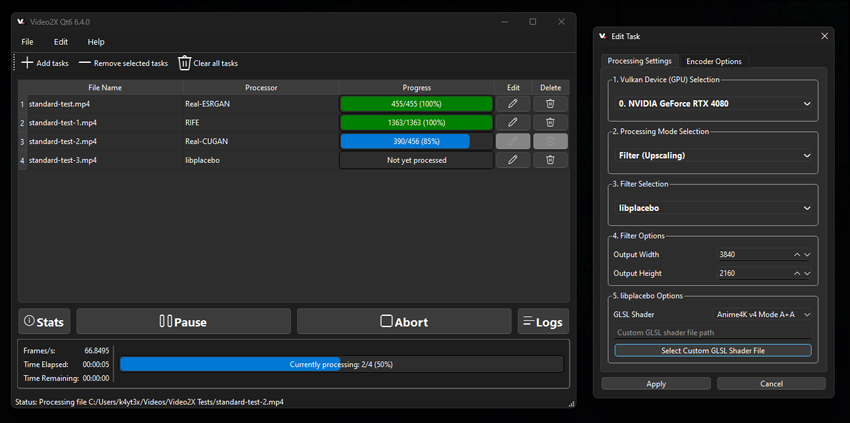
Click on the "Add tasks" button and select the 480p video file you wish to upscale. You can add multiple files if you wish to process them in batch.
Step 4: Edit task
Click the pen button and then you can edit the task. In the Processing Settings, you can:
- Choose the processing mode, such as Filter (Upscaling)
- Select filter (Real-ESRGAN, RIFE, Real-CUGAN, libplacebo…)
- Set filter options, including output width and height. To upscale your video to 1080p, set the output width to 1920 and the height to 1080.
Step 5: Start the Upscaling Process
Click on the "Start" button to begin the upscaling process. The time required will depend on the video's length, selected AI model, and your hardware specifications.
Step 6: Export the Upscaled Video
After the process is complete, the upscaled video will be saved to the specified output directory. You can now enjoy your enhanced 1080p video.
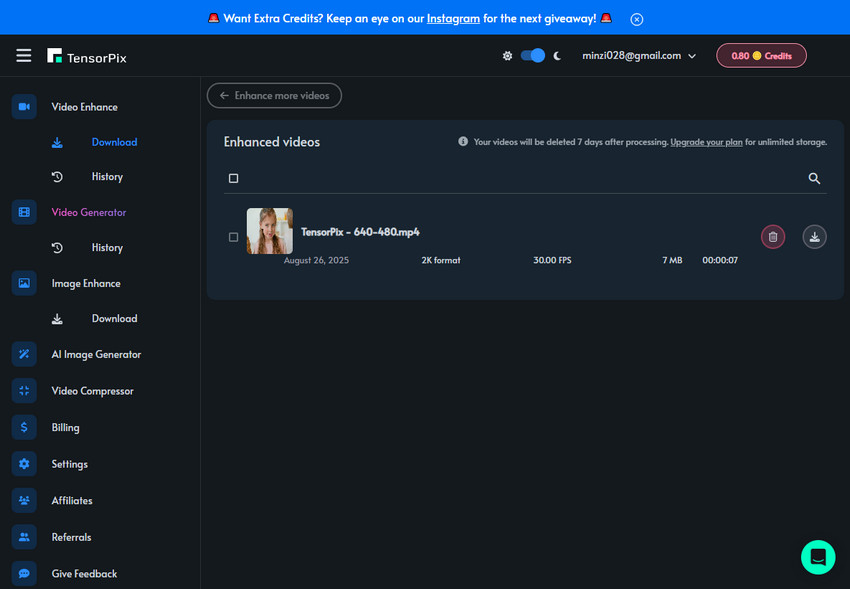
Method 4. Upscale 480p to 1080p Online with TensorPix
For those who want to avoid software downloads and rely on a convenient, browser-based solution, TensorPix is a strong contender. This online AI video enhancer uses cloud-based processing to transform low-resolution footage into high-quality videos. It's designed to be simple and requires no technical expertise, making it a great option for quick conversions.
- No software installation required—works directly in your browser.
- User-friendly interface is ideal for beginners.
- Cloud-based processing doesn't rely on your computer's hardware.
- The free version doesn’t allow preview before processing.
- Processing time depends on server load and your internet speed.
- Users on the free plan face a long wait in the processing queue.
How to Use
Step 1: Go to the TensorPix Website
Navigate to the official TensorPix website in your web browser. You'll need to create an account to get started. The service offers a limited free trial, which includes some credits to test the platform.
Step 2: Upload Your Video
Click the "Upload" button or simply drag and drop your 480p video file into the designated area on the webpage. Since it's a cloud service, the upload speed will depend on your internet connection.
Step 3: Select the AI Upscale Option
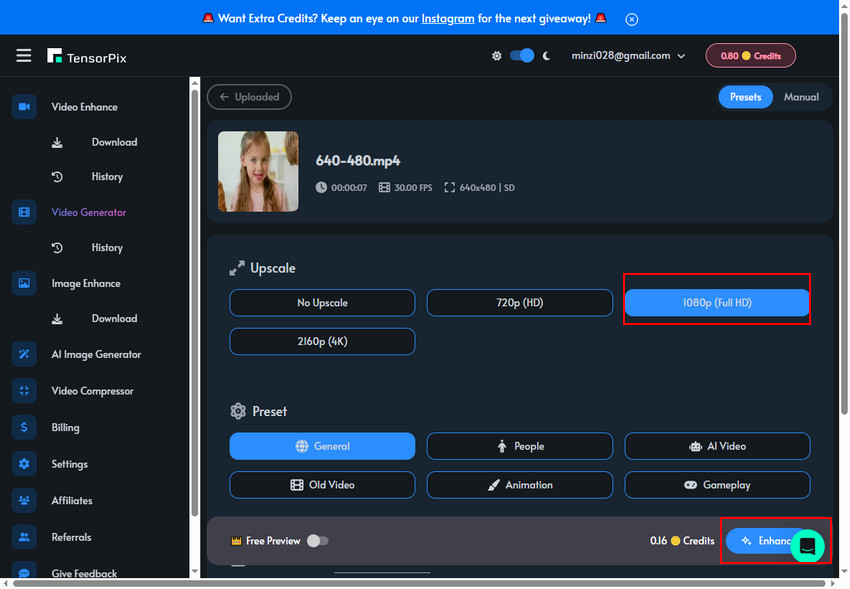
Once your video is uploaded, you'll be able to select from a range of AI filters. Choose the upscaling option and specify "1080p (Full HD)" as the target output resolution.
Step 4: Enhance the Video
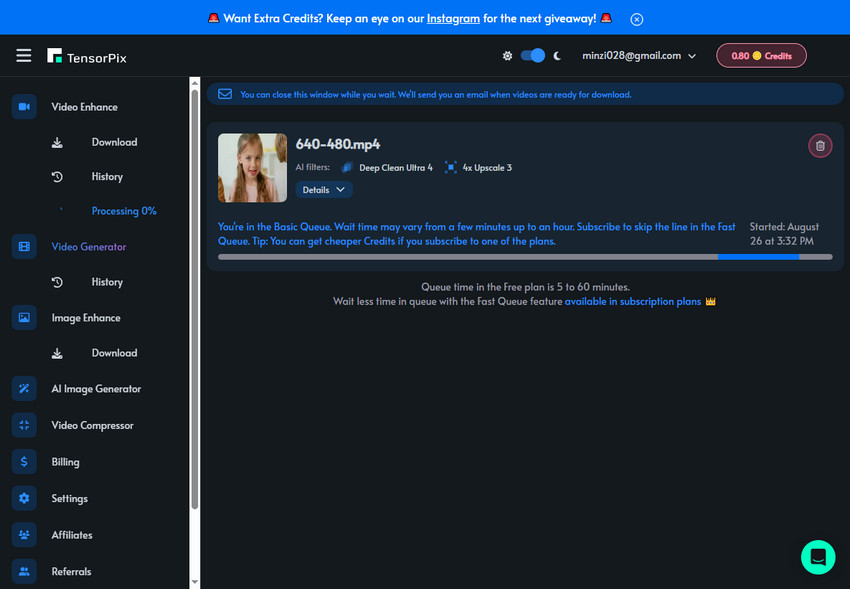
After you've finished all the settings, click the "Enhance" button at the bottom. Your task will then be placed in a processing queue. Please be aware that users on the free plan may have a waiting time of 5-60 minutes, depending on the current server load.
Step 5: Download Your 1080p Video
After the process is complete, you can click the download button to download the final 1080p video.
Method 5. Upscale 480p to 1080p with HandBrake
HandBrake is a popular, free, and open-source video transcoder that is widely used for converting video formats and compressing files. While it's not a dedicated AI upscaler like the first two methods, it offers a simple way to increase a video's resolution.
It's important to understand that HandBrake uses traditional scaling methods, meaning it stretches the existing pixels rather than intelligently reconstructing new details.
This method is best for users who simply need to change the resolution for compatibility with a specific device or platform (e.g., uploading to YouTube) and are not concerned with significant quality improvement.
- Completely free and open-source.
- Available on Windows, macOS, and Linux.
- Straightforward interface for basic conversions.
- Gives you control over a wide range of encoding settings.
- Does not add new detail or improve the visual quality of the source video.
- The upscaled video may appear soft or blurry because it's just stretching the original pixels.
- Can't fix issues like noise or artifacts from the source footage.
How to Use
Step 1: Download and Install HandBrake
Go to the official HandBrake website, download the appropriate version for your operating system, and install it on your computer.
Step 2: Load Your Video Source
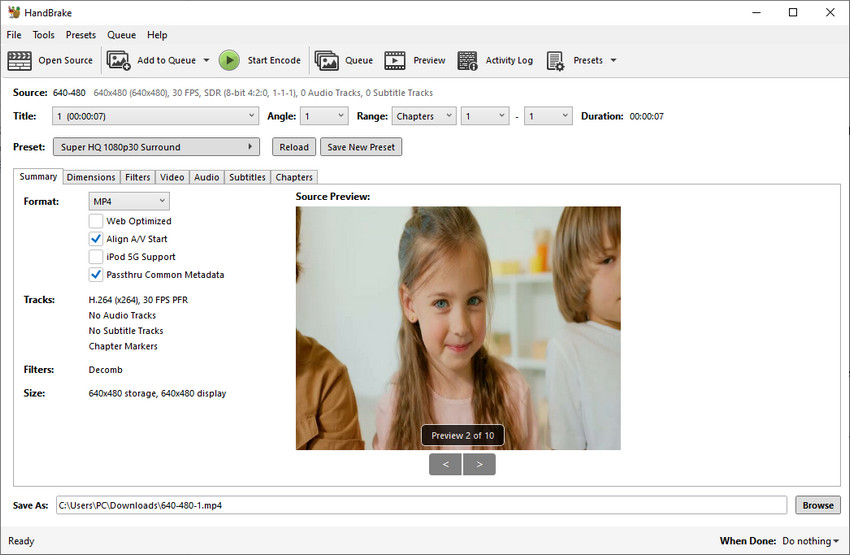
Open HandBrake and click the "Open Source" button in the top-left corner. Select your 480p video file to import it.
Step 3: Select a 1080p Preset
Click the Preset drop-down menu and select a 1080p preset.
Step 4: Specify a Path for the 1080p Output
Click the "Browse" button at the bottom to choose a destination and file name for your new video.
Step 5: Start the Conversion
Click the "Start Encode" button to begin the upscaling process. The time it takes will depend on your computer's speed and the length of the video.
Once finished, you will have a new 1080p video. While it won't have the added details of an AI-enhanced video, it will be in the desired resolution for your specific needs.
 FAQs
FAQs
Yes. 480p refers to video with about 480 lines in height, often found in formats like 640×480 (VGA, 4:3), 720×480 (NTSC DVD), or 854×480 (16:9). By comparison, 1080p is fixed at 1920×1080 pixels in a 16:9 aspect ratio. This gives Full HD more than five times the pixel count of standard 480p, resulting in sharper images and clearer details—especially noticeable on larger screens.
It depends on the source video and your viewing needs. Upscaling is usually worthwhile for DVDs, camcorder recordings, family videos, and other relatively clean 480p footage because it can make videos look sharper and more suitable for modern displays.
However, heavily compressed, severely blurred, or extremely low-quality videos may only see limited improvement because upscaling cannot recover details that were never captured.
Upscaling increases the resolution, but the degree of quality improvement depends on the method. Traditional converters like HandBrake simply resize pixels, so the video may look larger but not sharper. AI tools such as Aiarty or Video2X attempt to reconstruct details, reduce blur, and remove artifacts, making the video visibly clearer.
There are several free options:
- Video2X: An open-source AI tool that uses models like Real-ESRGAN or Anime4K to add details during upscaling.
- HandBrake: A free video converter that resizes videos to 1080p without AI enhancement.
- TensorPix (free plan): An online AI service that lets you upscale short videos in your browser.
While free tools can get the job done, AI-based upscalers generally deliver the best visual improvements compared to basic resizing.
If you prefer not to install software, several online video editors allow you to upscale videos directly in a browser. These tools are convenient for quick tasks, although they may have limitations in file size, processing speed, or output quality.
Some commonly used options include Kapwing and Clideo. Kapwing offers a browser-based video editor where you can upload a 480p video, adjust the canvas resolution to 1080p, and export the final file. Clideo also provides a simple video resizing tool that allows you to upscale resolution online, although compression may occur during export.
Some of the most popular AI video upscaling tools include Aiarty Video Enhancer, Topaz Video AI, and AVCLabs Video Enhancer AI.
These tools use deep learning models to analyze low-resolution footage and upscale it to higher resolutions such as 1080p or even 4K while improving clarity and reducing artifacts.
Yes, HandBrake allows you to resize video resolution during the encoding process. You can set the output resolution to 1080p when exporting a 480p video.
However, HandBrake uses traditional scaling methods rather than AI enhancement, so the improvement in visual quality may be limited compared to dedicated AI video upscalers.
VLC can play a 480p video on a 1080p or 4K display, but it does not perform AI upscaling or restore missing details. It mainly relies on basic video scaling, which enlarges the image without significantly improving clarity.
If you want to enhance the quality of a 480p video, a dedicated AI video upscaler is generally a better option.
For most DVD videos, upscaling to 1080p is usually the more practical choice. DVDs are typically stored at 480p resolution, and converting them to Full HD provides a noticeable improvement while keeping processing time and file size more manageable.
Upscaling DVDs to 4K can be useful for large 4K TVs or future-proofing your video library, but the improvement over 1080p may be less noticeable because the original DVD source contains limited detail.
You May Also Like


This post was written by Brenda Peng who is a seasoned editor at Digiarty Software who loves turning ordinary photos into extraordinary works of art. With AI assistance for brainstorming and drafting, the post is reviewed for accuracy by our expert Abby Poole for her expertise in this field.
