


Aiarty Video Enhancer Review 2026: Hands-On Tests, Pros & Cons



Aiarty Video Enhancer has evolved beyond a basic AI upscaler. The current V3.7 release combines 4K upscaling, denoising, deblurring, detail restoration, frame interpolation, audio cleanup, color controls, HDR conversion, and batch processing in one desktop workflow. The more important question for a review, however, is not how many features it lists, but how useful those features are on real footage.
For this review, I looked at the software across old low-resolution footage, compressed clips, portraits, animation/AIGC material, low-light scenes, and motion-heavy video. The visual examples below use the review's existing test samples and settings, while product specifications, pricing, model behavior, and hardware information have been updated against the current September 2026 version.
The short answer: Aiarty is strongest when you want a relatively simple local workflow for cleaning, restoring, and upscaling imperfect footage to 4K. It is less compelling if you need output beyond 4K, have limited GPU resources, or need the granular grading, audio, and finishing controls of dedicated post-production tools.
Aiarty Video Enhancer Review: Quick Verdict
- Best for: Creators restoring noisy, compressed, low-resolution, low-light, portrait, animation, or AIGC footage for HD/4K delivery.
- Strongest points: Three purpose-built AI models, adjustable enhancement strength, local processing, built-in batch export, audio denoise, frame interpolation, and a one-time lifetime license option.
- Main trade-offs: 4K output ceiling, only MP4/MOV output containers, heavier AI models can be demanding on older GPUs, and superVideo vHQ is limited to x2 upscaling.
Bottom line: Aiarty Video Enhancer is a practical all-in-one enhancer for creators who value natural-looking restoration, a straightforward interface, and offline processing. The results are most convincing when the source contains recoverable texture and the enhancement strength is kept appropriate to the footage. It should be viewed as an enhancement and restoration tool, not as a way to recreate detail that was never captured in the source.
Aiarty Video Enhancer Pros and Cons
- Three dedicated AI models cover detail recovery, faithful restoration, and difficult low-light/noisy footage.
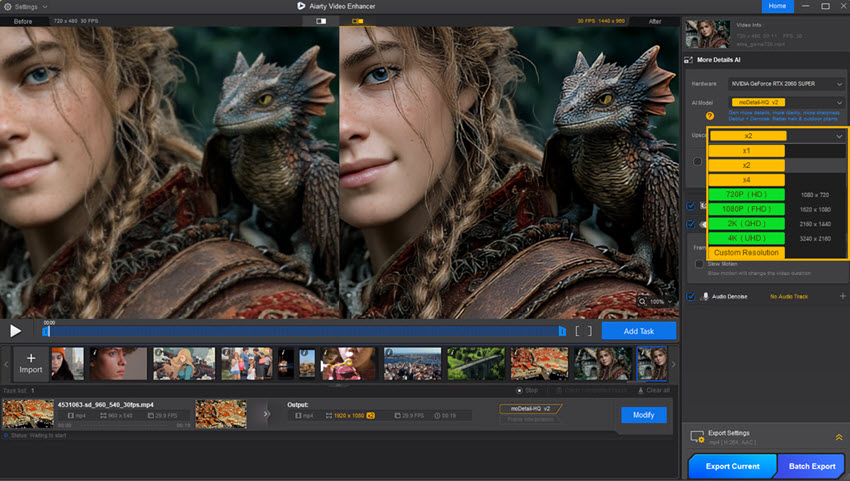
- Upscales and restores video up to 4K with x1, x2, x4, and direct-resolution options depending on the selected model.
- Strength Control makes it easier to balance naturalness against stronger sharpening and texture generation.
- Built-in frame interpolation, audio denoise, color controls, HDR conversion, and batch export reduce the need to move between multiple utility apps.
- AI enhancement runs locally, with GPU acceleration for NVIDIA, AMD, Intel, and Apple Silicon hardware.
- Lifetime licensing is available for users who prefer a one-time purchase over an ongoing subscription.
- Maximum enhancement output is 4K; users targeting 8K or higher need another workflow.
- Export containers are currently limited to MP4 and MOV, although H.264, H.265, ProRes, and AV1 output codecs are supported.
- superVideo vHQ is intended for difficult low-light/noisy footage but supports x2 upscaling only.
- High-resolution generative enhancement remains GPU-intensive; 8GB or more VRAM is recommended for dedicated Windows GPUs.
- The current HDR feature is still marked experimental, so it should be previewed carefully on an HDR-capable display before final export.
What Is Aiarty Video Enhancer
Aiarty Video Enhancer is a desktop AI video enhancement application for Windows and macOS. It is designed to improve imperfect footage through AI upscaling, denoising, deblurring, texture/detail restoration, and frame interpolation, while also providing audio denoise, color adjustment, SDR-to-HDR conversion, and basic edit tools.
The software currently uses three tailored AI models: moDetail-HQ v3 for stronger detail and texture recovery, Smooth-HQ v3 for more faithful general restoration, and superVideo vHQ for difficult grainy, dark, and low-light footage. moDetail-HQ v3 and superVideo vHQ use Diffusion+GAN architectures, while Smooth-HQ v3 uses a Diffusion architecture.
Input support is broad, including AVI, FLV, MP4, MKV, MOV, WebM, WMV, TS/M2TS/MTS, MXF, VOB, and other common video containers. Current exports are MP4 or MOV using H.264, H.265, ProRes, or AV1. AI enhancement is performed locally rather than by uploading footage to a cloud processing service.
Aiarty Video Enhancer Key Features
Rather than treating every feature as equally important, the most useful way to look at Aiarty is by the parts of the workflow that directly affect output quality, speed, and day-to-day usability.
4K Upscaling and Detail Recovery
Aiarty can upscale lower-resolution footage to 4K while using its AI models to restore edges, textures, and local definition. moDetail-HQ v3 is the most detail-forward model and is specifically positioned for hair, skin, foliage, fur, and other texture-rich subjects. Smooth-HQ v3 is the safer starting point when preserving the original look matters more than maximizing visible texture.
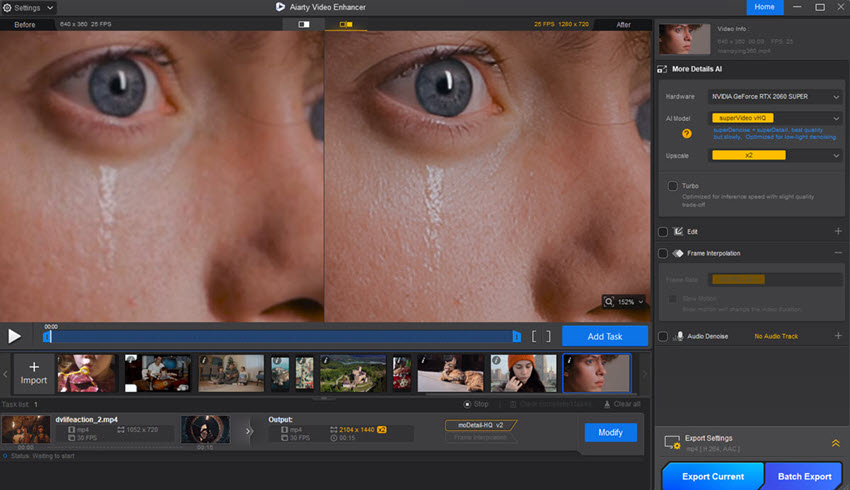
As with any generative enhancement system, sharper output does not mean every newly visible micro-detail is a literal recovery of information from the source. For very soft or heavily compressed footage, previewing at multiple Strength values is important.
Denoising and Deblurring
Aiarty combines video denoising, deblurring, sharpening, and detail recovery inside the same AI enhancement workflow. Smooth-HQ v3 is designed for general restoration with more restrained denoise/deblur behavior, while superVideo vHQ targets the harder cases: extreme noise, low-light footage, and dark interiors.



Frame Interpolation and Slow Motion
Aiarty includes AI frame interpolation for increasing frame rate and creating smoother slow-motion playback. The current version supports high-FPS workflows including 90 fps and 120 fps. This is a separate task from upscaling: a sharper still frame can demonstrate detail recovery, but interpolation quality should be judged during playback, especially around overlapping motion, fast pans, and object boundaries.
Color, HDR, and Audio Denoise
Aiarty's color panel provides manual controls for white balance, exposure, contrast, saturation, highlights, shadows, and related adjustments. It can also convert 8-bit SDR footage to 10-bit HDR using Neutral, Bright, or Graded modes, with an HDR Strength slider for controlling the effect. The current V3.7 product page still labels HDR as experimental, so HDR output is best treated as a feature to preview rather than a one-click replacement for dedicated HDR grading.
The built-in Audio Denoise module targets microphone noise, environmental noise, wind noise, hiss, and other distracting background sound while improving vocal clarity. It is useful for quick cleanup of vlogs, lectures, family recordings, and casual productions, although specialist audio restoration software still provides deeper control.
Strength Control, Turbo, and Step Mode
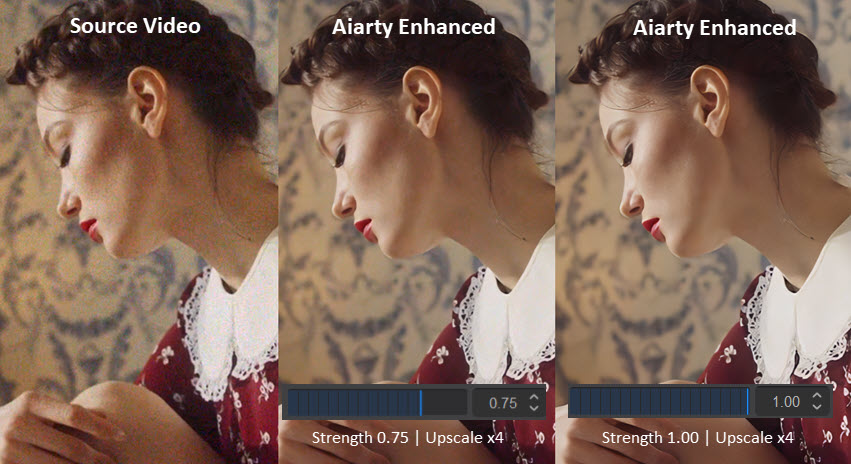
Strength Control adjusts how strongly the selected AI model changes the footage. Lower values are useful when the source is already fairly clean and you want to avoid an over-processed look; higher values push clarity, texture, and restoration more aggressively.
Turbo Mode is optimized for faster AI inference and is the practical choice for routine jobs and longer clips. Step Mode uses tiled AI inference to reduce VRAM use and prioritize visual quality on demanding or high-resolution footage, but the trade-off is slower processing. That distinction matters more than simply calling one mode "better": Turbo favors throughput, while Step favors quality and lower memory pressure.
Offline Processing, Batch Export, and GPU Acceleration
AI enhancement is processed directly on the computer, which is useful for private footage and avoids cloud-upload time. Local video upscaling is accelerated on supported NVIDIA, AMD, Intel, and Apple Silicon hardware. The licensed version also supports batch export: users can apply the same settings to multiple videos or configure individual tasks and export the queue together.
Which Aiarty AI Model Should You Use?
There is no single best Aiarty model for every clip. The current three-model setup is useful precisely because the models make different trade-offs between detail generation, faithful restoration, and heavy cleanup.
Practical starting point: try Smooth-HQ v3 first when you mainly want cleanup without noticeably changing the character of the footage. Move to moDetail-HQ v3 when texture recovery is the priority. Use superVideo vHQ for the difficult low-light/noisy clips it is designed for. For faces and already-clean sources, compare several Strength values before committing to a long export.
Hands-On Testing and Real-World Evaluation
The visual tests below use the review's existing sample set and settings. This page has been updated to reflect the current V3.7 features and specifications, but I have not invented new benchmark numbers for tests where a standardized export time was not originally recorded.
Test Setup:
- System: Windows 10, NVIDIA RTX 3070 GPU, 32GB RAM, Intel i7-10700 CPU
- Footage tested:
- Old home videos (480p, low-light conditions)
- Compressed online videos (720p)
- Smartphone recordings (1080p, handheld)
- Animated sequences and CGI/AIGC clips
- Portrait and motion-heavy footage
- Settings: AI model and upscale factor are listed for each sample below; Turbo Mode was used for longer clips where faster inference was preferred.
Overall observation: the strongest improvements appeared on footage with a clear problem to solve: visible noise, soft edges, compression, or insufficient resolution. Texture-rich subjects such as hair, skin, foliage, and fine surfaces benefited most from careful model selection. The important caveat is that aggressive enhancement can move from restoration toward reconstruction, so the best-looking result was not always the strongest setting.
Test 1. Archival/Low-Resolution Video
Model used: moDetail-HQ v3 | Upscale: x4
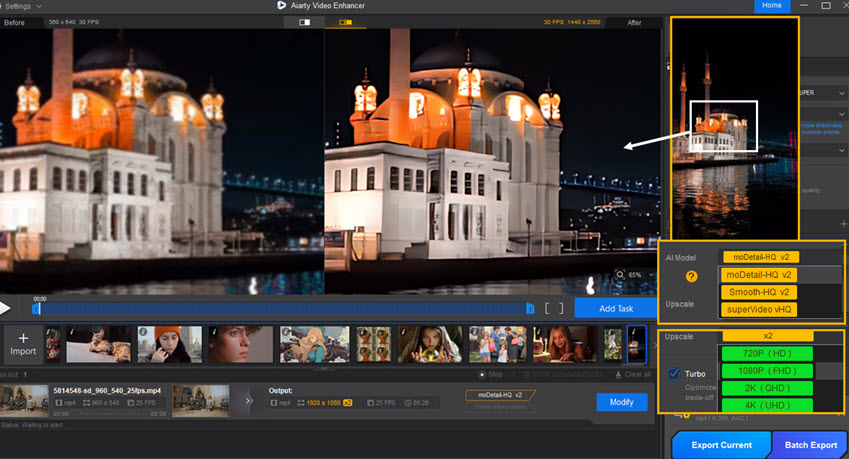
On older low-resolution footage, the most useful improvement is the combination of cleanup and stronger local definition rather than resolution alone. Grain and softness become less distracting, while edges and textures read more clearly on a modern display. The limitation is source information: x4 output can look much cleaner, but it cannot turn genuinely missing detail into forensic truth.
Test 2. Animation/AIGC Video
Model used: moDetail-HQ v3 | Upscale: x4

Animation and AI-generated clips are a good match when the composition is already correct but the render is soft, compressed, or too small for delivery. moDetail-HQ v3 strengthens fine edges and texture without requiring the clip to be regenerated. If the problem is incorrect anatomy, geometry, or motion generated in the source, enhancement is not a substitute for regenerating or re-editing the shot.
Test 3. Portrait/People Video
Model used: moDetail-HQ v3 | Upscale: x4
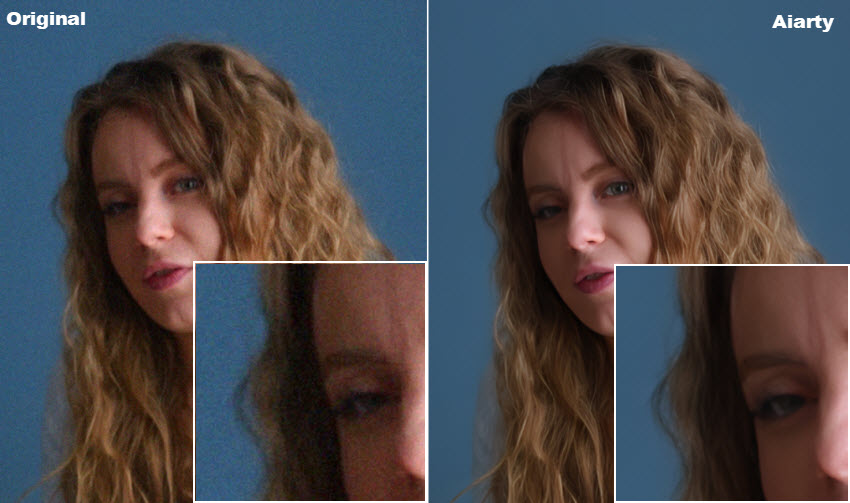
Portrait footage benefits from the model's ability to separate skin, hair, and facial contours from noise. This is also where Strength Control matters most: on an already-clean face, pushing enhancement too far can make pores or hair texture look reconstructed rather than naturally captured. A lower Strength value is often the safer starting point.
Test 4. Low-Light/Compression Stress Test
Model used: superVideo vHQ | Upscale: x2
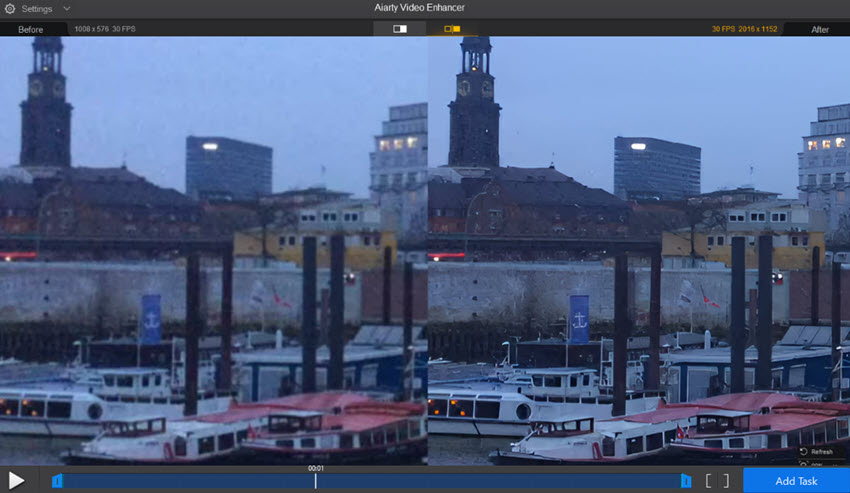
This is the type of footage superVideo vHQ is designed for: dark scenes with heavy grain and difficult detail separation. It applies a stronger restoration approach than the two general models, but the current version limits superVideo vHQ to x2. That makes it a specialist model rather than the default choice for every upscale.
Test 5. Motion/Zoom Video
Model used: moDetail-HQ v3 | Upscale: x4
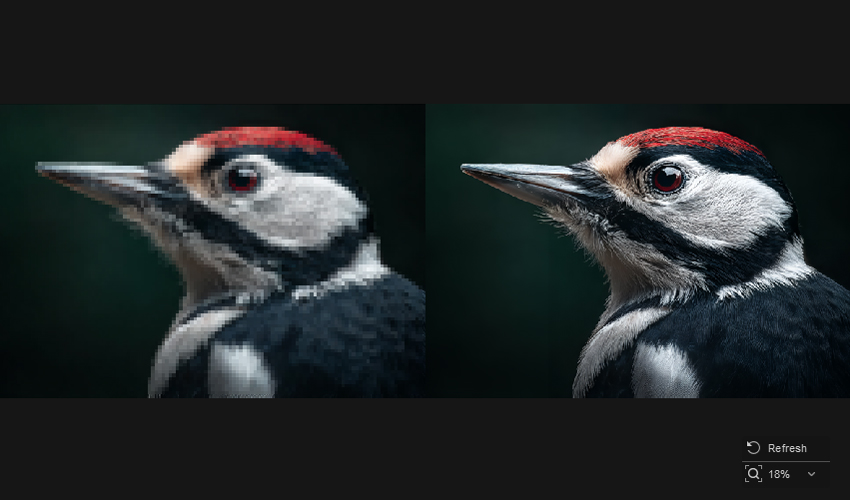
The still comparison can show whether detail survives a crop or zoom, but it cannot by itself prove frame-interpolation quality. For motion work, preview the actual sequence and inspect fast edges, occlusions, pans, and overlapping subjects. Upscaling and interpolation solve different problems and should be judged separately.
Performance and Hardware Requirements
AI video enhancement is highly dependent on source resolution, output resolution, model, Strength, frame rate, codec, and GPU. On the RTX 3070 review system, Turbo Mode made longer jobs more practical, but the original test set did not record a standardized export time for every clip. For that reason, this review does not present a universal FPS figure that would imply the same speed on different hardware.
For a long high-resolution project, choose Turbo when throughput matters most. If VRAM is the constraint or the footage benefits from a more quality-focused inference path, Step Mode reduces memory pressure through tiled processing but will take longer.
Where Aiarty Video Enhancer Struggles
A useful review should be clear about the boundaries of the software. Aiarty can substantially improve many flawed clips, but several limitations matter depending on the workflow.
- 4K is the enhancement ceiling: current output is designed around HD/4K delivery. A 4K source can be enhanced at x1 for cleanup, but it is not intended for an 8K or 16K upscale workflow.
- Export containers are limited: the current version exports MP4 and MOV. Users who need another delivery container may need a separate transcode or remux step.
- Very damaged sources remain difficult: severe motion smear, tiny faces, blocked shadows, and missing detail can be improved, but AI may have to reconstruct rather than recover information. Stronger is not always more accurate.
- Older or low-memory GPUs can slow the workflow: generative video enhancement is compute-heavy. Step Mode helps reduce VRAM demand, but it does so by trading speed for lower memory usage and quality-focused processing.
- superVideo vHQ has a narrower role: it is useful on very noisy, dark footage, but currently supports x2 only and is not necessary for cleaner material.
- HDR still needs judgment: the current HDR feature is marked experimental. Accurate evaluation also requires an HDR-capable display with HDR enabled.
- It is not a full post-production suite: professional colorists, sound engineers, and editors who need advanced timelines, masks, tracking, mixing, or mastering will still use dedicated software alongside Aiarty.
Aiarty Video Enhancer Pricing: Is It Worth It?
Aiarty Video Enhancer offers a free trial, an annual Standard License, and a Lifetime License. The prices below reflect the standard purchase page checked for this September 2026 update; temporary campaign pricing can be lower and may change.
Is it worth it? The Lifetime License makes the most sense for users who expect to enhance video regularly and want to avoid an ongoing subscription. The annual option is easier to justify for a short-term project or for users who prefer a lower upfront cost. In either case, the free trial is worth using first because real-world speed and model behavior depend heavily on your own footage and GPU.
Aiarty Video Enhancer vs Topaz Video, SeedVR2, and Real-ESRGAN
The most useful comparison is not a checklist of who has the most green ticks. These tools target different users: Aiarty emphasizes an integrated desktop workflow, Topaz Video offers a broader high-end model/output ecosystem, while SeedVR2 and Real-ESRGAN appeal more to users comfortable with open-source or node/script-based workflows.
Key takeaways:
- Aiarty Video Enhancer is the easiest fit when you want denoise, deblur, detail recovery, interpolation, audio cleanup, color/HDR, and batch processing in one local desktop app without committing to a subscription-only licensing model.
- Topaz Video remains the stronger fit for users who prioritize a wide range of specialist AI models, very high-resolution output, and deeper tuning. Importantly, current Topaz Video does support batch rendering, so older comparisons stating otherwise are no longer accurate.
- SeedVR2 is a substantially more advanced open-source option than a simple x4 upscaler. Current ComfyUI implementations support temporal consistency controls, chunking, VRAM-management options, and several color-correction methods, but setup and workflow complexity are much higher than a consumer desktop application.
- Real-ESRGAN remains useful for practical image/video restoration, including anime-focused models and scripted video inference, but it does not provide Aiarty's integrated interpolation, audio cleanup, or color/HDR workflow.
Who Should (or Should Not) Use Aiarty Video Enhancer
Aiarty is most useful when its workflow matches the problem you actually have. It is not automatically the best choice simply because a video is low resolution.
- Creators and YouTubers: especially those working with compressed downloads, older B-roll, smartphone clips, or footage that needs cleanup before editing and publishing.
- Videographers restoring old or low-resolution footage: the combination of denoise, deblur, detail recovery, and 4K upscaling addresses the common problems found in older digital and home-video sources.
- Animation and AIGC creators: useful when a generated clip is fundamentally correct but needs cleaner edges, higher resolution, smoother motion, or less compression.
- Users handling multiple clips: batch export and per-task settings are useful for repetitive restoration jobs.
- Privacy-conscious users: footage is enhanced locally instead of being uploaded for cloud AI processing.
- Users who prefer one-time licensing: the current Lifetime License includes ongoing updates without requiring an annual subscription.
- Editors who need 8K/16K delivery: Aiarty currently tops out at 4K enhancement output.
- Users with older or low-memory GPUs: the software can still run on supported hardware, but generative enhancement may be too slow for frequent long-form work.
- Professional colorists and audio engineers: Aiarty's color and audio tools are useful utilities, not replacements for dedicated grading and sound-restoration suites.
- Users expecting forensic reconstruction: AI can improve perceived detail, but it cannot guarantee that generated texture exactly matches information that was never captured.
- Users only enhancing still images: Aiarty Image Enhancer or another image-specific tool is more appropriate.
Verdict: Is Aiarty Video Enhancer Worth Using in 2026?
Aiarty Video Enhancer V3.7 is strongest as a practical restoration tool rather than a showcase of one isolated AI feature. Its three-model approach gives users a meaningful choice between texture recovery, faithful cleanup, and difficult low-light restoration, while Strength Control makes it easier to avoid the "maximum setting is best" trap that can make AI-enhanced footage look artificial.
The broader workflow is also a real advantage: 4K upscaling, denoise/deblur, interpolation, audio cleanup, color/HDR controls, offline processing, and batch export are available in one application. The trade-offs are equally clear. Output stops at 4K, MP4/MOV are the only export containers, superVideo vHQ is x2 only, and high-quality AI processing still rewards a capable GPU.
For creators restoring imperfect video for web, social, archive, or 4K delivery, Aiarty offers a strong balance of image quality, workflow simplicity, and licensing flexibility. Users who need ultra-high-resolution output, extensive model tuning, or full professional finishing should compare it directly with Topaz Video or use Aiarty alongside a dedicated NLE, color, and audio workflow.
 FAQs
They suit different priorities. Aiarty is simpler if you want a local all-in-one workflow with 4K enhancement, audio denoise, batch export, frame interpolation, color/HDR tools, and a Lifetime License option. Topaz Video offers a broader set of specialist AI models, batch rendering, optional cloud export, and higher-resolution local output, but it now uses subscription-based pricing. For a detailed comparison, see our Aiarty vs Topaz comparison.
AI video enhancement is processed locally on your computer, so your footage does not need to be uploaded to a cloud AI service for enhancement. An internet connection is still needed for tasks such as downloading, activating, and updating the software.
Aiarty is paid software with a free trial. The current trial does not support batch export, limits processing to 120 seconds, and adds a watermark to exported videos. Purchasing a full license removes those restrictions. You can also check the official Aiarty free-license and campaign options.
There is no universal best model. Use moDetail-HQ v3 for stronger texture/detail recovery, Smooth-HQ v3 for more faithful general restoration and color consistency, and superVideo vHQ for extremely noisy or low-light footage. superVideo vHQ currently supports x2 only, while the other two models support x1, x2, x4, 1K, 2K, and 4K options.
Aiarty supports many common input formats, including MP4, MOV, MKV, AVI, WebM, WMV, TS/MTS/M2TS, MXF, VOB, and others. Current export containers are MP4 and MOV, with H.264, H.265, ProRes, and AV1 codecs available. The maximum imported resolution is 4K; a 4K source can be enhanced at x1 rather than upscaled further.
For a dedicated Windows GPU, the current minimum is 4GB VRAM and 8GB or more is recommended. System RAM starts at 8GB, with 16GB or more recommended. Actual speed depends on the model, source resolution, output resolution, frame rate, and whether you use Turbo or Step Mode.
Yes. The AI enhancement itself runs locally, so an internet connection is not required to upload and process each video. You will still need internet access for installation downloads, license activation, and software updates.

This post was written by Brenda Peng, a seasoned editor at Digiarty Software who covers AI-assisted image and video enhancement, restoration, and media workflows. With AI assistance for brainstorming and drafting, the post is reviewed for accuracy by our expert Abby Poole for her expertise in this field.
