


Wink Video Enhancer Review: Features, Real Tests & Alternatives



Blurry or low-quality videos can instantly reduce the impact of your content. Wink Video Enhancer claims to fix this with AI-powered enhancement tools designed for fast, one-click improvement. In this review, we test Wink Video Enhancer in real scenarios to see how well it actually performs, what its limitations are, and whether it is worth using compared to other AI video enhancement tools.
To showcase how well Wink Video Enhancer performs, we’ve compared the original footage with the upscaled result side-by-side, along with its top-tier alternative - Aiarty Video Enhancer. The difference in clarity, sharpness, and overall visual quality speaks for itself.
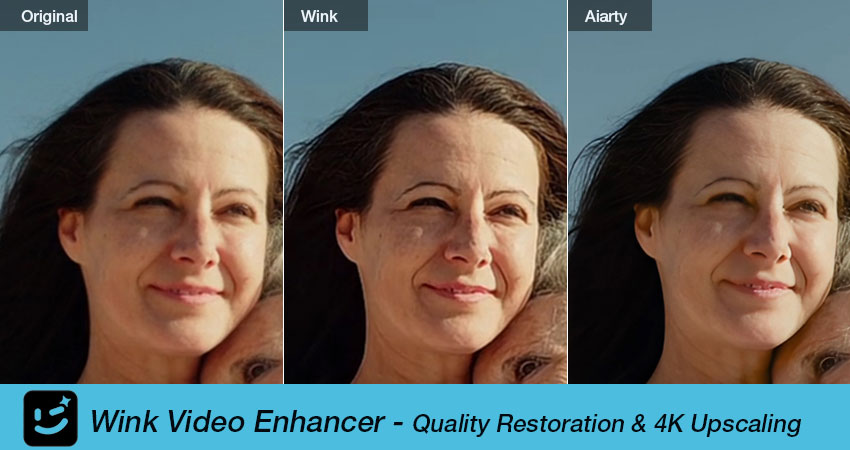
Wink Video Enhancer - Your Go-to App to Restore & Enhance Video Quality
Wink Video Enhancer delivers noticeable improvements in clarity, resolution, and noise reduction with minimal effort. It’s especially handy on mobile for quick fixes, though its ability to recover fine details from very low-quality footage is limited.
Need Pro-Level Restoration? Try Aiarty Video Enhancer
If you're after flawless output or working with high-value, detail-rich footage, Wink Video Enhancer may not deliver the precision you need. A more advanced solution like Aiarty Video Enhancer is built for the job—restoring video quality and upscaling to 1080P/4K while carefully recovering fine details such as hair strands, fabric textures, and complex backgrounds.
Overview of Wink Video Enhancer
Wink Video Enhancer is a lightweight, AI-powered tool that sharpens video quality by removing noise, correcting artifacts, and refining brightness, contrast, and sharpness—all while preserving the original resolution. Available on PC, web, and mobile, it also offers AutoCut, custom templates, AI captions, facial enhancement, and beauty retouching for fast, polished, high-definition results across platforms.
Is Wink Video Enhancer Legit & Safe?
Yes. Based on our testing, Wink Video Enhancer appears to be a legitimate and safe AI video enhancer. We found no signs of malware, suspicious behavior, or unusual permission requests during installation and use.
While it can noticeably improve video clarity, its enhancement quality varies depending on the source footage and may be limited when restoring heavily compressed or very low-quality videos.
Wink Video Enhancer Key Features
- AI Video Upscaling: Boost your video quality to 1080p or 4K using advanced AI for smart deblurring and denoising, ensuring clearer and sharper results.
- Aesthetic Effects: Customize your appearance with AI-powered tools to retouch face and body, such as adjusting face shape, makeup, skin tone, body proportions, and more for a polished, cinematic look.
- AI Subtitle Generation: Automatically generate accurate subtitles in seconds, saving time and effort while improving accessibility and viewer engagement.
- Video Stabilization: Eliminate shakiness with built-in anti-shake technology that ensures smoother, more professional-looking footage.
- Cross-Platform Access: Available on PC, Web, and Mobile , Wink Video Enhancer offers a seamless experience across devices for flexible editing anytime, anywhere.
Wink Video Enhancer Pricing
Wink Video Enhancer offers both free and premium versions, making it accessible for casual users while still providing advanced features for paid subscribers.
Free Version: Wink's free version includes basic AI video enhancement features and is suitable for trying out the tool before upgrading. However, depending on the platform and version, exports may be limited to lower resolutions, watermarks may be applied, and batch processing capabilities can be restricted.
Premium Subscription Pricing Plans
- Monthly: $19.99/month for 300 credits
- Yearly: $99.99/year for 300 credits per month
For occasional users, credit-based purchases offer flexibility:
Subscription Benefits:
- Full-resolution exports (including HD/4K options)
- Watermark-free output
- Faster processing and priority rendering
- Access to advanced AI enhancement features
Is it worth upgrading?
For casual social media users, the free version is often enough. However, if you frequently process multiple videos or need cleaner exports for professional use, the paid version provides a noticeably smoother workflow and higher output consistency.
Pros and Cons of Wink Video Enhancer
With its rich set of AI-powered features, Wink offers a versatile solution for both casual and professional users. But like any tool, it comes with its strengths and limitations. Here's a quick look at the pros and cons:
- Fast, one-click enhancement with impressive results
- Noticeable visual improvements for everyday footage like vlogs, tutorials, and home videos
- Seamlessly works across desktop software, web interface, and mobile video enhancer app
- User-friendly design makes it ideal for social media creators and beginners
- Watermark-free exports available in the premium version for clean final videos
- Lacks fine-tuning controls for advanced users
- Enhancement quality may vary for extremely low-resolution or heavily compressed videos
- Some export formats are not available on the mobile version
How to Enhance Video Quality in Wink Video Enhancer (PC/Web/Mobile)
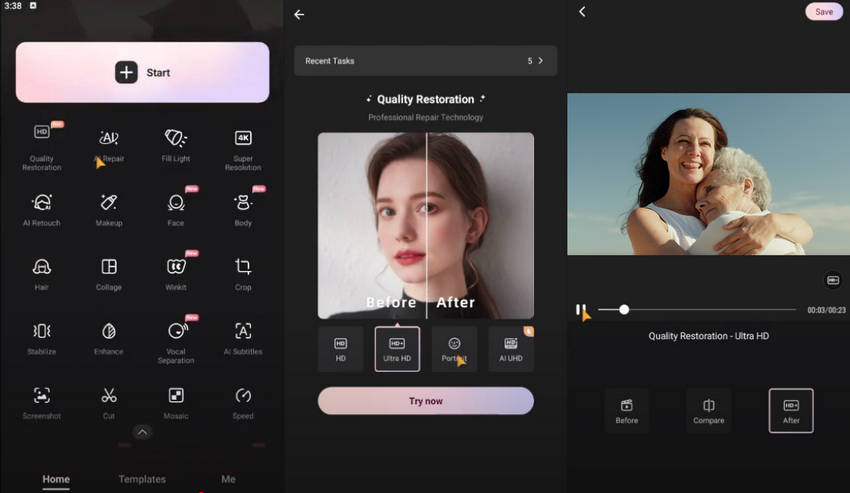
How to increase video quality in Wink Video Enhancer? Wink is available across desktop, browser, and mobile, ensuring a seamless editing experience wherever you are. Here’s how it performs and what you can expect for video restoration and upscaling:
Quality Restoration:
Step 1. Import your video
Free download Wink setup installer and install it. Open it, you can find the "Quality Restoration" option, click on it to get access of video enhancement. Then, drag and drop to import your video clips.
Step 2. Choose the enhance settings.
At the left panel, choose HD, UHD, Portrait or AI UHD based on your need. Then tap Get started to let AI do the rest.
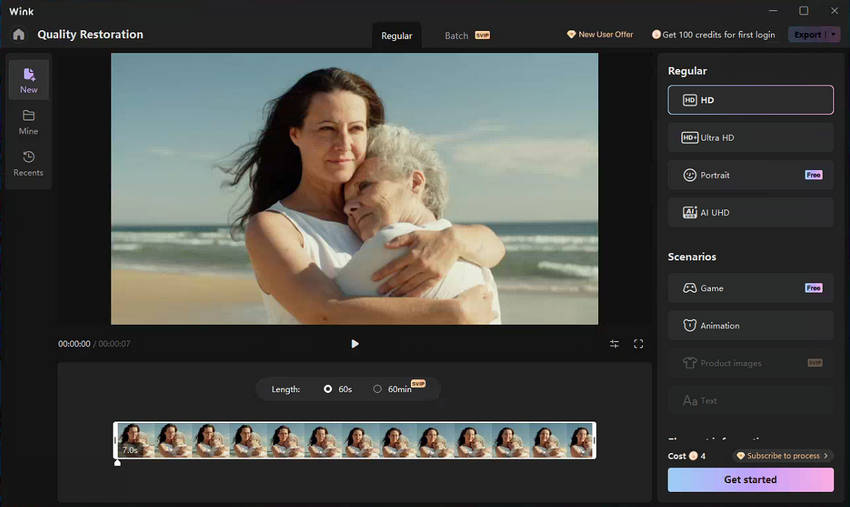
Step 3. Preview the result and export.
When done, you can see the preview of the original and enhanced video. When you're satisfied, click on the Export option at the right corner to export your quality restored video clip.
Video Upscaling:
If you want to increase the resolution of your video in Wink Video Enhancer, just walk through the following steps (Take the Web version as an example):
Step 1. Go to the site at https://wink.ai/. and tap the "For Web" option at the navigation. It will redirect you to Wink AI editor.
Step 2. To upscale videos, find the 4K Upscaling at the left tool bar, click on it. Drag and drop your video from local computer to the window.
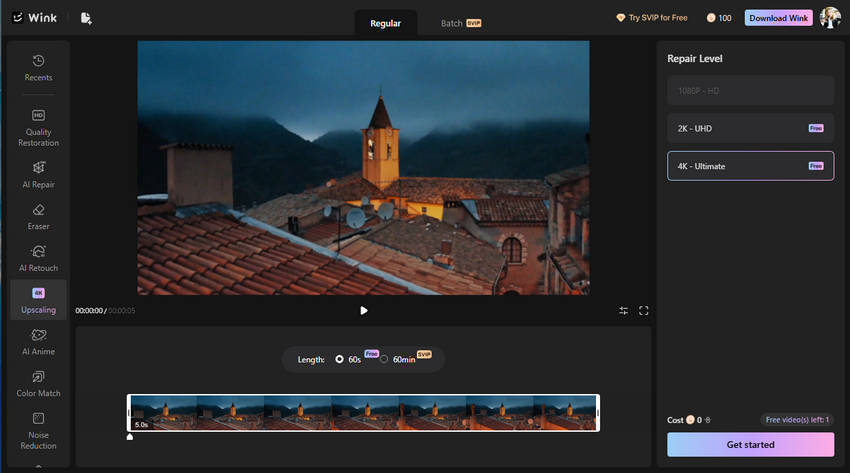
Step 3. At the left panel, choose the Repaire level, including 1080p HD, 2K UHD and 4K UHD according to your needs.
Step 4. Click on the Get started button to upscling your video now. When it done, click on the Export button to download the final video. After then, you can directly share the video on TikTok, YouTube, Instagram, etc.

BTW, the mobile and web version go the similar steps for Quality Restoration and 4K Upscaling. Just enter the corresponding video enhancing section, import your video, click Get stared to let Wink do the rest, then export and share it directly to social platforms.
Real-World Tests: How Well Does Wink Video Enhancer Work?
Is Wink any good? Now you know how easy it is to improve video quality in Wink, but how about its performance? The below section presents real-world examples of video quality enhancement. You’ll see clear before-and-after comparisons that demonstrate how effectively the tool improves resolution and detail of different videos.
Example 1: Family Video (720p → 720p enhanced)
- It's a video about a middle aged woman hugging her mother.
- 720p, which is a little bit blur for the part with rich details like hair, and eyes.
- Video source: Download the original video for test.

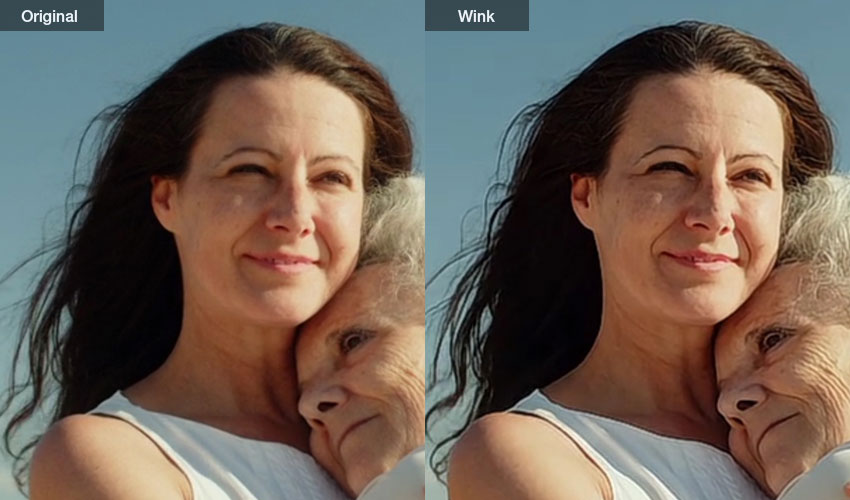
This family video got a serious quality boost with Wink Video Enhancer’s restoration feature—the clarity is noticeably better. Fine facial textures, like subtle skin tones, now look sharper and more lifelike.
Example 2: City Night Drone Footage (1080p → 4K)
- It's a city night video recorded in drone view, in 1080p.
- Though it's in 1080p HD resolution, it still looks blur and grain as it's captured in low light.
- Video source: Download the original video for test.

As we can see, after boosting the video to 4K with Wink Video Enhancer, the clarity improves only to a certain extent. Some flaws, like blur and noise, are still there because the tool can’t fully bring back fine details that were missing or badly distorted in the original footage.

Where Wink Video Enhancer Falls Short
Our tests showed that Wink Video Enhancer can noticeably improve video quality with minimal effort. However, like many lightweight AI enhancers, it also has several limitations that become more apparent when working with challenging footage.
Limited detail recovery. While Wink can make videos appear sharper, it often struggles to reconstruct fine details that were lost in the original footage. Elements such as hair strands, fabric textures, and distant objects may remain soft after enhancement.
Over-sharpening in some scenes. In low-light videos or footage with rich textures, the enhancement can occasionally introduce artificial-looking edges or a slightly processed appearance.
Inconsistent results across different video types. Performance varies depending on the source material. Videos with heavy compression, motion blur, or significant noise typically benefit less from Wink's enhancement algorithms.
For casual content creation, these limitations may not be a major concern. However, if your goal is to recover more detail from blurry, noisy, or low-resolution footage, a more advanced AI restoration tool may deliver better results.
Looking for a More Effective Alternative to Wink Video Enhancer?
While Wink Video Enhancer is excellent for quick and easy improvements—delivering fast, noticeable upgrades in clarity and resolution with minimal setup—Aiarty Video Enhancer stands out when your footage demands a higher level of precision.
Aiarty Video Enhancer is built for scenarios where preserving intricate details is critical, such as restoring fine hair strands, delicate fabric textures, or complex background patterns. With more advanced enhancement algorithms and customizable controls, Aiarty is better equipped to handle challenging material, including remove bluriness and artifacts in heavily compressed footage, fix noise of low-light, or restore archival footage, making it a go-to choice for professional or detail-oriented projects.
Rather than relying on specifications alone, we tested several popular AI video enhancers using the same footage to evaluate their real-world performance. Below, you'll see how Wink Video Enhancer compares with Aiarty Video Enhancer and Topaz Video AI in terms of detail recovery, sharpness, and overall video quality.
Wink vs Aiarty Video Enhancer: Side-by-Side Results
Here’s a side-by-side comparison to visually highlight the upscaled quality using Wink Video Enhancer, and Aiarty Video Enhancer.
When restoring a video of a woman hugging her mom, Aiarty Video Enhancer delivered visibly richer and more natural detail than Wink Video Enhancer, with skin texture, individual hair strands, and facial features appearing sharper and more lifelike. Wink also produced a clearer result than the original, but some artifacts and slight unnatural edges were noticeable.

When upscaling the blurry building video to 4K, Aiarty Video Enhancer maintains remarkably sharp edges while preserving fine details. However, Wink doesn’t improve clarity much, and blur and noise are still noticeable.

How Does Topaz Video AI Compare?
Besdies, we briefly compared Aiarty and Wink with Topaz Video AI, a popular tool among professionals. While Topaz offers excellent results, it’s slower and more complex to use. In our tests, Aiarty matched or outperformed Topaz in both quality and usability—especially when restoring old or low-resolution footage.

If you're choosing between Wink vs Aiarty Video Enhancer vs Topaz Video AI, the decision is clear:
- For fast, simple enhancements with minimal hassle, Wink is the go-to.
- For the highest quality, and greater detail recovery, Aiarty Video Enhancer stands out.
- For professional users willing to invest time in advanced features and who don’t mind slower processing, Topaz Video AI remains a strong option.
Related Search: Topaz Video AI Review — Is This $299 Video Enhancer Really Worth Your Investment?
Conclusion
Wink Video Enhancer is a fantastic tool for users who want fast, AI-powered video improvement without a learning curve. Whether you're fixing old family footage or preparing clips for social media, Wink helps you achieve better visual results with almost zero editing experience.
However, if your needs go beyond basic enhancement—like restoring detail in low-quality or high-motion footage—Aiarty Video Enhancer provides more depth, better AI precision, and professional-grade output.
Free download Aiarty Video Enhancer now for sharper, more detailed video enhancement.
 FAQs
FAQs
It offers a free version with limited features. Paid plans unlock full resolution, batch export, and watermark-free output.
Yes, Wink can upscale videos to 4K resolution. However, the quality improvement depends heavily on the original footage, and it may not fully restore fine details in heavily compressed or low-quality videos.
Not exactly. Wink is better for quick, one-click enhancements and mobile editing, while Topaz Video AI delivers higher-quality results with more advanced controls but requires more time and processing power.
Yes, Wink allows users to enhance multiple videos simultaneously, though batch features may be limited on mobile versions.
For users who need more advanced video restoration and detail recovery, tools like Aiarty Video Enhancer are better suited, especially for blurry, noisy, or low-resolution footage.
You May Also Like


This post was written by Brenda Peng who is a seasoned editor at Digiarty Software who loves turning ordinary photos into extraordinary works of art. With AI assistance for brainstorming and drafting, the post is reviewed for accuracy by our expert Abby Poole for her expertise in this field.
