


Buying used camera gear is one of the most practical ways to build a better photography kit without paying new-equipment prices. A lens that was out of reach at launch may become affordable a few years later, while an older professional camera body can still be more capable than a newer entry-level model.
The harder question is where to buy it.
Used camera equipment is sold everywhere from specialist dealers and major photography retailers to eBay, local camera shops, and private marketplaces. The same lens can appear on several of them at very different prices, but price alone rarely tells the full story. Inspection standards, condition grading, return rights, warranty coverage, seller history, and the quality of the listing all matter.
For buyers who want the lowest-risk route, established used-gear specialists such as KEH and MPB are usually the first places worth checking. B&H and Adorama are strong alternatives if you prefer buying through a large photography retailer. eBay becomes particularly useful for hard-to-find, discontinued, and vintage gear, while local stores and marketplaces make more sense when inspecting the equipment in person is a priority.
There is no single best place to buy used camera lenses for every photographer. The better approach is to choose the marketplace that fits the type of gear you are buying and the amount of risk you are comfortable accepting.
Best Places to Buy Used Cameras and Lenses: Quick Comparison
The table below gives a useful starting point before getting into the details.
| Store or Marketplace | Particularly Good For | Professional Inspection | Warranty/Buyer Protection | Exact-Item Photos | Typical Risk Level |
|---|---|---|---|---|---|
| KEH | Dedicated used camera gear | Yes | 180-day warranty on eligible grades | Varies | Low |
| MPB | Comparing individual copies | Yes | 6-month limited warranty | Yes | Low |
| B&H Used | Buying through a major retailer | Yes | 90-day parts and labor warranty | Varies | Low |
| Adorama Used | Broad photography selection | Yes | Up to 180 days on standard used photo grades | Varies | Low |
| UsedPhotoPro | Used cameras and lenses from an established camera retailer | Yes | Varies by listing/policy | Often | Low–Medium |
| LensRentals Keeper | Tested former rental equipment | Yes | Coverage varies by item/value | Varies | Low–Medium |
| eBay | Rare, vintage and discontinued equipment | Seller-dependent | eBay Money Back Guarantee on eligible transactions | Usually | Medium |
| Facebook Marketplace | Local deals and in-person buying | No | Limited/transaction-dependent | Seller-dependent | High |
| Photography communities | Enthusiast-owned equipment | No standardized system | Platform-dependent | Seller-dependent | Medium–High |
| Local camera stores | Inspecting equipment before paying | Usually | Store-dependent | In person | Low–Medium |
Store policies change, so check the individual listing and current policy before placing an order. As of September 2026, KEH advertises a 180-day warranty on eligible used grades and a 21-day return window. MPB US provides a six-month limited warranty and a 14-day return period, while B&H's Used Department lists a 90-day parts-and-labor warranty and 30-day returns.
10 Best Places to Buy Used Cameras and Lenses
1. KEH Camera - A Strong All-Round Choice for Used Camera Equipment
KEH has been associated with used photography equipment for decades and remains one of the first places many photographers check when buying a second-hand camera or lens.
Its biggest advantage is consistency. Rather than relying on an individual seller's interpretation of phrases such as "excellent condition," KEH uses its own grading system and puts equipment through a multi-point inspection process. That makes it easier to compare one lens with another without having to decode wildly different seller descriptions.
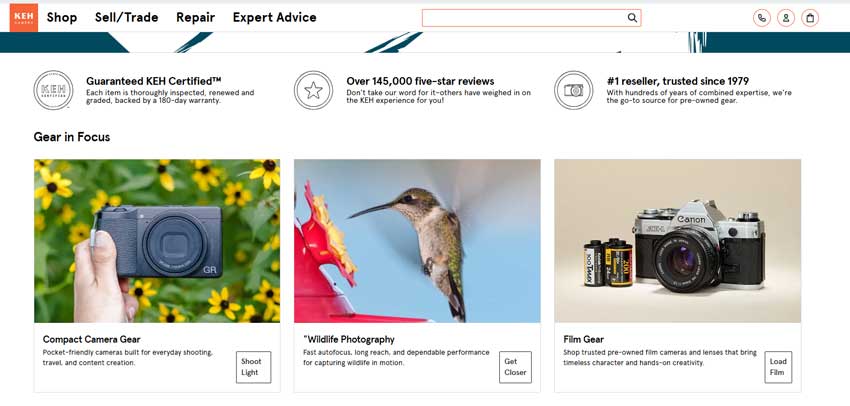
The catalog extends well beyond current mirrorless bodies and lenses. Depending on inventory, shoppers can find DSLRs, film cameras, medium-format systems, flashes, accessories and older optics that are no longer sold new.
KEH's current warranty is another reason it suits buyers who are uneasy about purchasing second-hand gear. Eligible grades including Like New, Like New Minus, Excellent Plus, Excellent and Bargain receive a 180-day warranty. Ugly and As-Is items are excluded, which makes reading the grade important before checking out.
Its 21-day return period is shorter than the 30-day windows offered by some major retailers, but it still gives a buyer time to check autofocus, lens stabilization, controls and general operation after delivery.
KEH makes the most sense when condition consistency and after-sale protection matter more than finding the absolute cheapest example on the internet.
2. MPB - Excellent When You Want to See the Exact Item
MPB approaches used photography equipment slightly differently, and one feature is particularly valuable when buying online: individual items are photographed. If several copies of the same camera are available, shoppers can compare the actual units rather than looking at a generic stock photograph. MPB states that the product shown is the exact item the customer will receive. Its listings also specify condition, included accessories and, for many camera bodies, shutter count.
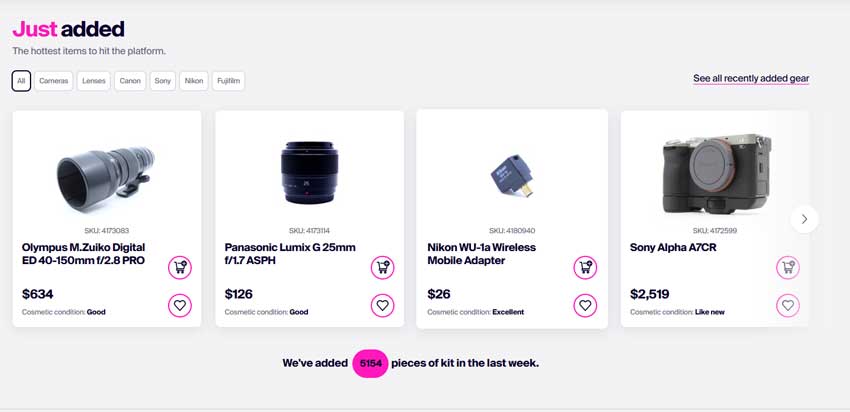
That degree of transparency matters more than it might seem. Two lenses can receive the same broad cosmetic rating while having noticeably different barrel wear, hood marks or mount condition. Seeing the actual copy allows buyers to decide whether a lower-priced, more visibly used example is worth the saving. MPB also evaluates equipment before resale and currently includes a six-month limited warranty with eligible purchases in the United States. For someone searching for the best site for used cameras and wanting to compare several examples of the same model, MPB is particularly convenient. It is also useful when buying older DSLRs because shutter counts appear on many individual listings rather than being left for the buyer to request.
3. B&H Used - Best Suited to Buyers Who Already Shop at B&H
B&H is better known as one of the largest photography retailers in the United States, but its Used Department carries a substantial inventory of pre-owned cameras, lenses, video equipment, lighting and related gear.
The appeal here is familiarity. Photographers who already buy memory cards, filters, lighting or new camera equipment from B&H can shop used gear through the same retailer rather than opening an account with a dedicated second-hand platform. More importantly, B&H says used equipment is tested for both functionality and appearance before it is listed. Its condition ratings are primarily cosmetic; the retailer states that the equipment it sells through the Used Department has been tested and found to be in working order.
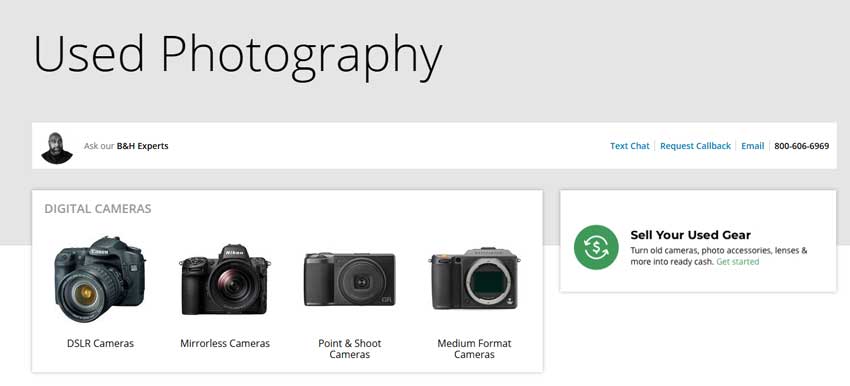
Current used purchases include a 90-day parts-and-labor warranty, along with a 30-day return period subject to the retailer's terms. B&H is especially worth checking when shopping for relatively common professional equipment. Prices may not always be the lowest available, but for buyers who value a well-established retailer, straightforward returns and a physical New York store, it remains one of the more practical options.
4. Adorama Used - A Broad Source of Used Photography Equipment
Adorama is another major photography retailer with a significant used department, covering camera bodies and lenses as well as lighting, video, audio and other production equipment. Its used products are physically examined before being accepted for resale and receive condition ratings. This makes Adorama useful not only for photographers looking for another body or lens but also for creators assembling a broader studio or video kit.
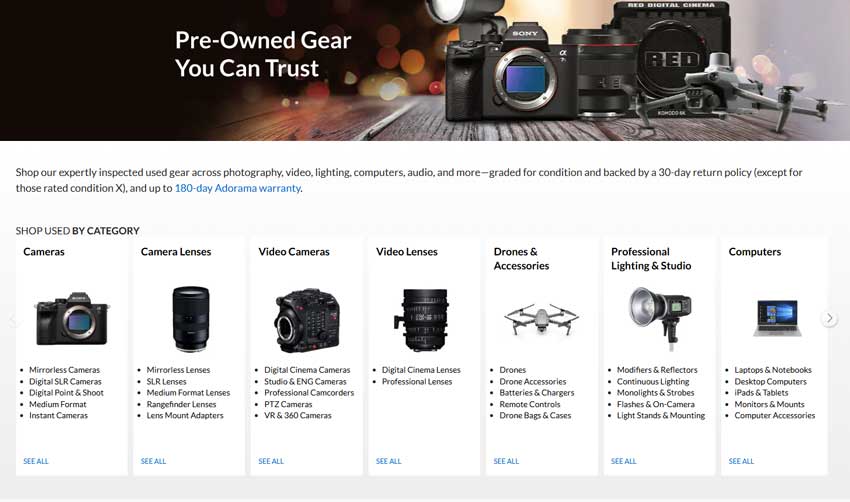
For used cameras, lenses and camcorders, Adorama's current warranty varies by condition. Open-box equipment receives a one-year warranty, while standard used grades including Mint, Excellent+, Excellent, Average, Well-Used and Heavily Used receive a 180-day warranty. Flawed items have different terms, while items explicitly sold "For Parts" are sold as-is. Most used equipment can currently be returned within 30 days, provided it is returned in the required condition with included accessories. If you are searching for used photography equipment rather than only cameras and lenses, Adorama is worth checking because its inventory spans more of the production chain.
5. UsedPhotoPro - Worth Checking for Individual Used-Gear Listings
UsedPhotoPro is the used-equipment operation associated with Indianapolis retailer Roberts Camera. It does not always receive the same attention as KEH or MPB, but it is worth adding to a serious used-gear search rather than comparing prices on only two or three sites. One of its more useful characteristics is the emphasis on photographing individual pieces of equipment rather than relying solely on stock imagery. This is particularly helpful with older camera bodies and lenses where cosmetic condition can vary substantially from copy to copy. The inventory regularly includes equipment from Canon, Nikon, Sony, Fujifilm, Olympus/OM System and other established manufacturers, alongside older and less common products.
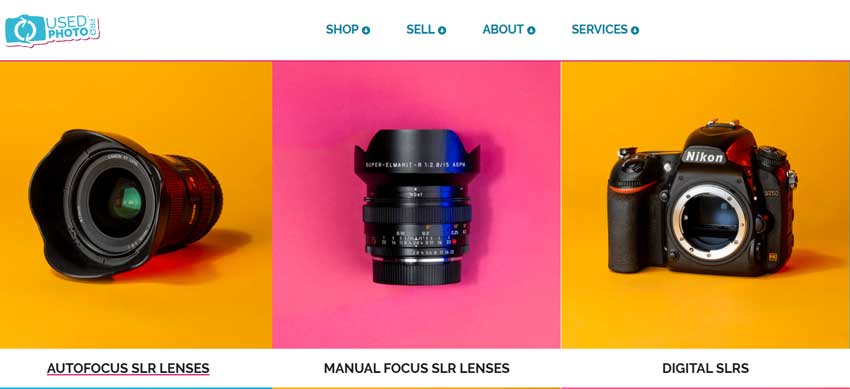
For buyers prepared to comparison-shop, UsedPhotoPro can occasionally turn up a particular condition or configuration that is unavailable through larger competitors. That becomes more important with discontinued lenses, older DSLR bodies and equipment for systems with declining new inventory. Because warranty and return details can change, the current terms shown on the specific listing should be checked before purchase rather than assumed from previous UsedPhotoPro policies.
6. LensRentals Keeper - An Interesting Route for Tested Used Gear
Rental equipment makes some photographers nervous because it may have seen heavier use than privately owned gear. That concern is understandable, but rental companies also inspect and maintain equipment far more regularly than the average private owner. LensRentals' Keeper program makes selected gear available for purchase and offers an unusual option: eligible equipment can be rented before the buyer decides whether to keep it. LensRentals says Keeper equipment is tested and rated for cosmetic condition, performance and glass quality. Its Keeper Test Drive option allows eligible rental customers to purchase the copy already in their possession, with up to seven days of rental fees credited toward the purchase price.
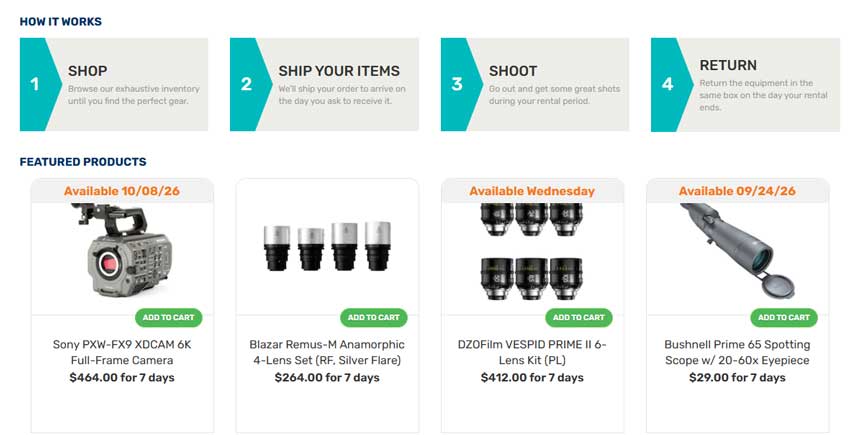
That can be particularly useful for expensive lenses. A specification sheet cannot tell you whether a 70-200mm zoom balances comfortably on your camera, whether you like a particular focus-by-wire implementation, or whether a large prime will actually make it into your camera bag. Trying the exact equipment before committing removes much of that uncertainty. Warranty terms depend on the purchase. LensRentals currently states that Keeper items valued at $1,000 or more include a 90-day limited warranty.
7. eBay - One of the Best Places for Rare and Vintage Camera Gear
For sheer variety, eBay remains difficult to ignore. It is particularly useful when searching for discontinued equipment: older DSLR lenses, manual-focus glass, uncommon accessories, film bodies, vintage rangefinder lenses, battery grips for cameras that have been out of production for years, or specific regional variants. The trade-off is consistency. Unlike a specialist dealer, eBay is a marketplace. One listing may come from an experienced camera retailer with detailed photographs, shutter count and a precise condition description; the next may come from a casual seller who writes only "works fine."
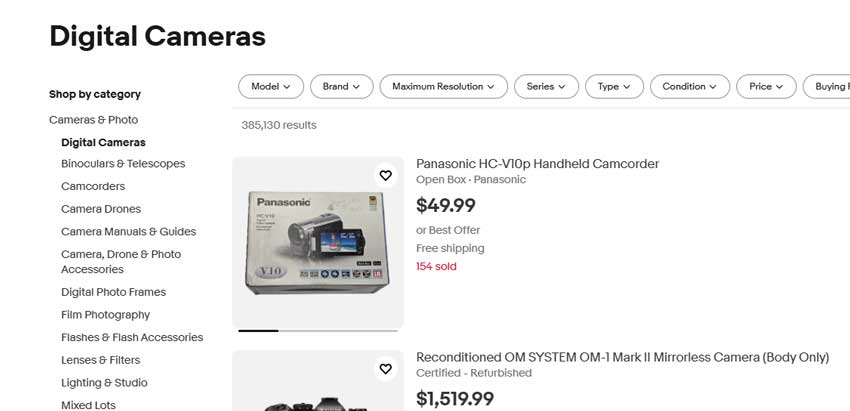
That means buying well on eBay depends heavily on evaluating the seller rather than the platform alone. Look closely at feedback history, listing photography, serial numbers where appropriate, the description of optical defects and whether the seller appears familiar with camera equipment. Eligible transactions receive eBay Money Back Guarantee coverage. Under the current policy, buyers may be covered when an item does not arrive, arrives faulty or damaged, or materially fails to match the listing. Importantly, that protection is not the same as a product warranty.
For rare equipment, eBay may be the first place to search. For a common lens available at roughly the same price from a specialist dealer with a six-month warranty, the specialist usually presents less uncertainty.
8. Facebook Marketplace - Useful for Local Deals, but Inspect Carefully
Facebook Marketplace can produce excellent local deals, particularly when somebody is selling an entire photography kit rather than individual pieces.
A photographer moving systems may list a camera body, two lenses, batteries and accessories together at a price that a professional reseller could not match. Local buying also creates an important advantage: you may be able to inspect the equipment before handing over money. The downside is the absence of standardized grading and professional testing.
Treat every claim about condition as something to verify rather than something to assume. A lens described as "mint" may have internal dust; a camera described as "barely used" may have a much higher shutter count than expected.
For an in-person transaction, bring a compatible camera body if buying a lens and a known-good lens if buying a body. Check autofocus, aperture control, stabilization, card writing, buttons, screens and ports. Photographing a plain bright surface can help reveal major sensor contamination, while shooting detailed subjects at several apertures can expose obvious optical problems. Avoid moving payment outside protected channels solely because a seller asks you to. A bargain stops being a bargain very quickly when there is no practical recourse after the transaction.
9. Photography Communities and Specialist Marketplaces
Photography communities can be surprisingly good places to find used equipment, particularly among experienced enthusiasts who regularly rotate gear.
Dedicated buy-and-sell forums and communities such as Fred Miranda, along with photography-focused marketplace groups and communities such as Reddit's r/photomarket, often contain equipment that has been described more carefully than a typical general-classified listing. The advantage is that photographers tend to know what other photographers want to see. Listings are more likely to mention shutter count, sensor condition, optical dust, decentering, autofocus performance, original packaging and exact accessories. The disadvantage is that the protections offered by a specialist retailer are usually absent.
Reputation therefore matters. Account age, transaction history, previous feedback and the payment method are more important than a polished description. If a seller suddenly insists on a payment method with no buyer protection to save a small fee, that saving is rarely worth the additional risk. These communities are particularly useful for niche equipment, enthusiast lenses and products that tend to circulate among experienced photographers rather than casual consumers.
10. Local Camera Stores - Still One of the Smartest Ways to Buy Used Gear
Online shopping has made used equipment easier to find, but a good local camera store still offers something no website can fully reproduce: the opportunity to handle and test the actual piece of equipment before buying it. For lenses, that means checking focus-ring feel, zoom creep, aperture operation, autofocus and stabilization on your own camera. With bodies, you can inspect controls, EVF and LCD condition, card slots, hot shoe, sensor condition and general handling. A knowledgeable store can also be useful when buying into an unfamiliar system. Compatibility is not always as straightforward as matching the brand name on a lens and camera body. Older mounts, electronic limitations, third-party lens firmware and adapter combinations can complicate things.
Local stores may charge slightly more than a private seller because they have overhead and need a margin on trade-ins. In return, many provide some form of testing, return period or store warranty.
For buyers who are not yet comfortable evaluating used equipment, that premium can be money well spent.
Which Used Camera Store Is Right for You?
The answer depends less on which retailer is universally "best" and more on what you are buying.
If reducing risk is the priority, start with specialist dealers and established camera retailers. KEH, MPB, B&H and Adorama all inspect used equipment and currently provide defined warranty coverage for eligible purchases.
If the exact cosmetic condition matters, MPB is especially convenient because individual copies are photographed. This is useful when several versions of the same lens are available at different prices.
If you are hunting for discontinued, collectible or unusual gear, eBay and specialist photography communities open up a much larger pool of inventory.
For photographers buying an expensive lens they have never used before, LensRentals' try-before-you-keep approach offers a different advantage: the chance to learn whether the equipment actually works for your photography before committing.
And if you are uncomfortable buying a used camera without touching it first, a reputable local camera store is still difficult to beat.
Price should be part of the decision, but it should not be the entire decision. Paying $40 less for a $1,500 lens is not much of a saving if the cheaper option eliminates a meaningful return policy or warranty.
What to Check Before Buying Used Camera Equipment
A good retailer reduces risk, but it does not eliminate the need to inspect your purchase. Test used equipment as soon as it arrives, preferably while the return period is still comfortably open.
Used Camera Body Checklist
| What to Check | What to Look For |
|---|---|
| Shutter count | Compare it with the expected life and age of the model |
| Sensor | Scratches, heavy contamination or unusual marks |
| Autofocus | Consistent focus with a known-good lens |
| LCD and EVF | Dead pixels, discoloration, flickering or damage |
| Buttons and dials | Every control should respond normally |
| Card slots | Reliable reading, writing and formatting |
| Ports | USB, HDMI, microphone and headphone ports where applicable |
| Hot shoe | Damage, corrosion or unreliable flash triggering |
| Battery | Excessive swelling, poor fit or unusually short runtime |
| Body condition | Cracks, impact marks, loose rubber or signs of water exposure |
| Serial number | Should match the listing or documentation where provided |
Do not obsess over superficial wear if the camera is priced accordingly. A polished corner or scratched baseplate often has no effect on image quality. A malfunctioning control dial or unreliable card slot is a different matter.
Used Camera Lens Checklist
| What to Check | What to Look For |
|---|---|
| Front and rear elements | Deep scratches, coating damage or chips |
| Internal optics | Fungus, significant haze or excessive debris |
| Autofocus | Speed, accuracy and unusual motor noise |
| Manual focus ring | Smooth movement without excessive play |
| Zoom ring | Smooth travel and acceptable zoom creep |
| Aperture | Correct electronic or mechanical operation |
| Image stabilization | Normal activation without abnormal noise |
| Lens mount | Excessive wear, bent contacts or looseness |
| Filter thread | Damage that prevents filters from mounting properly |
| Sharpness | Consistency across the frame |
| Decentering | One side or corner substantially softer than the other |
A small amount of internal dust is common in used lenses and often has no practical effect on photographs. Fungus, substantial haze, damaged coatings and severe decentering deserve far more attention.
When judging image quality, use original files whenever possible. Heavily processed JPEGs can hide noise, sharpening problems and some optical flaws. Image-enhancement software is useful after the evaluation stage, not as a substitute for it.
For example, Aiarty Image Enhancer can be useful once you are actually working with photographs from an older camera-particularly when dealing with noise, low-resolution files or images that need enlargement. But if you are evaluating a seller's lens sample, an untouched RAW file or minimally processed image tells you far more about the lens itself than an aggressively enhanced sample.

Used Camera Store vs. Marketplace: Which Is Safer?
Buying from a professional used-camera store generally costs more because the retailer is doing work that a private marketplace does not.
That work may include acquiring the equipment, inspecting it, assigning a condition grade, photographing or cataloging it, handling payments, accepting returns and standing behind a warranty.
| Factor | Specialist Used Store | General Marketplace | Local Private Seller |
|---|---|---|---|
| Professional inspection | Usually | No | No |
| Standardized condition grade | Usually | Rarely | No |
| Warranty | Often | Seller/platform-dependent | Rare |
| Return option | Usually | Varies | Usually limited |
| Selection | High | Very high | Local inventory only |
| Rare equipment | Good | Excellent | Unpredictable |
| Price | Moderate | Low to moderate | Often lowest |
| Ability to inspect before paying | Usually no | Sometimes | Often |
| Buyer effort required | Low | High | High |
Neither model is automatically right or wrong.
A $250 lens from a careful local photographer may be a better purchase than the same lens at $320 from a dealer. At $2,500, however, many buyers will reasonably place much more value on professional inspection, return rights and warranty coverage.
The more expensive or difficult an item is to repair, the more valuable those protections become.
Final Thoughts
The used camera market is large enough that there is rarely a reason to buy from the first listing you find.
Start with specialist retailers such as KEH and MPB when inspection, grading and warranty coverage are priorities. Check B&H and Adorama for additional inventory and retailer-backed purchases. Look at LensRentals when trying equipment before buying would be valuable, and expand the search to eBay or enthusiast communities when the item is rare or discontinued.
For local purchases, use the opportunity to test the camera or lens properly before paying.
Most importantly, separate cosmetic condition from functional condition. A lens with worn paint can still produce superb images. A spotless lens with fungus, unreliable autofocus or optical decentering is a much worse purchase.
Used photography equipment rewards buyers who know what matters, compare more than one source and test their gear promptly. Do that, and buying used stops feeling like a compromise. It becomes one of the smartest ways to put more of the photography budget into equipment that actually changes what you can shoot.
You May Also Like


Brenda Peng is a seasoned editor at Digiarty Software who loves turning ordinary photos into extraordinary works of art. With years of experience behind the lens and in front of the computer, Brenda shares her passion for photography, image enhancement, and editing through easy-to-follow tutorials.
