


Is Video2X Worth It? In-Depth Review [2026]



Video2X is one of the most famous free, open-source AI video upscaler on GitHub. By integrating powerful neural network engines like Waifu2x, Real-CUGAN, and SRMD, it provides a versatile framework for increasing video resolution and frame rates. In 2026, the project remains highly relevant for users who prefer a granular, "build-your-own" approach to video enhancement.
While Video2X offers unparalleled control over specific models and command-line parameters, it also presents a steep learning curve and high hardware dependency for long-duration renders. This guide evaluates the latest Video2X 6.x features, its performance on modern GPUs, and how it compares to streamlined AI upscaling engines in terms of processing speed and sub-pixel accuracy.
What is Video2X
Video2X is a free, open-source video enhancer and frame interpolation framework hosted on GitHub. Rather than being a single AI model, it acts as a powerful multi-engine wrapper that integrates several state-of-the-art neural network algorithms into a unified interface.
Originally developed by K4YT3X, the project has evolved into a robust C++ based architecture in its 6.x versions, moving away from its Python-based legacy to improve execution efficiency and memory management. Its primary function is to increase the resolution of low-quality videos—such as 480p anime or old home movies—into 4K or higher, while simultaneously increasing the frame rate (FPS) for smoother motion.
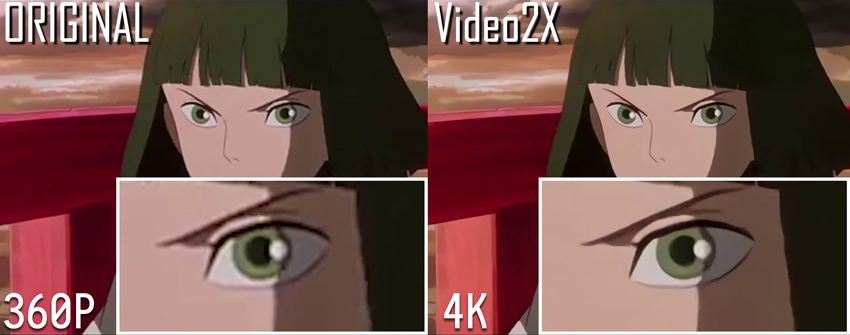
Key Engines Integrated in Video2X:
- Real-CUGAN: The current industry standard for high-quality anime upscaling, offering superior noise reduction and edge sharpening without artifacts.
- Waifu2x (NCNN-Vulkan): The classic engine optimized for 2D illustrations and manga-style content.
- SRMD/Real-ESRGAN: General-purpose models designed for real-world photo and video restoration, focusing on texture preservation.
- RIFE (Real-Time Intermediate Flow Estimation): A leading algorithm for AI frame interpolation, used to turn 24/30 FPS footage into fluid 60 FPS or 120 FPS.
Unlike commercial software that often uses proprietary, "black-box" models, Video2X allows users to swap, configure, and fine-tune these open-source engines via its Qt6-based GUI or a command-line interface (CLI). This makes it a preferred choice for tech-savvy creators who require granular control over the upscaling process.
Key Features of Video2X
In its latestiteration, Video2X 6.x has evolved from a simple script into a sophisticated framework. Its feature set is designed for users who want complete transparency and control over each stage of the AI enhancement pipeline.
1. Hybrid Upscaling & Interpolation Pipeline
Video2X is unique in its ability to perform simultaneous enhancement. Users can increase resolution (e.g., from 1080p to 4K) while concurrently applying AI Frame Interpolation. This "dual-pass" workflow allows for converting standard 24fps cinematic footage into ultra-fluid 60fps or 120fps outputs in a single render task.
2. Advanced Task & Queue Management
The modern Qt6-based GUI introduces a robust batch-processing system.
- Multi-File Queuing: Users can drop dozens of clips into the interface, assigning different AI models and output settings to each file individually.
- Pause & Resume: Unlike earlier versions, the current architecture supports pausing long-duration renders, a critical feature for users processing high-bitrate 4K content on consumer-grade hardware.
3. Optimized "In-Memory" Frame Piping
One of the most significant technical upgrades in the latest iteration is the refined FFmpeg integration. Older versions required extracting every video frame as a temporary PNG file, often consuming hundreds of gigabytes. The current version pipes frames directly through the AI engine in-memory, drastically reducing SSD wear and saving massive amounts of storage space.
4. Universal Hardware Acceleration
Video2X maintains its commitment to hardware neutrality. By utilizing the Vulkan API, it unlocks AI processing power across a wide spectrum of hardware:
- Native Support: Full acceleration for NVIDIA (CUDA), AMD (ROCm), and even Intel Arc GPUs.
- Denoising levels: Control the intensity of noise reduction, balancing between cleaning up grainy footage and preserving natural textures.
- Low-End Compatibility: Its efficient memory management allows for successful upscaling even on integrated graphics and older mobile GPUs, provided the sub-pixel precision is adjusted accordingly.

5. Deep FFmpeg Customization
For professionals, Video2X acts as a visual bridge to FFmpeg. Users have granular control over:
- Modern Codecs: Full support for H.265 (HEVC), VP9, and the royalty-free AV1 codec.
- Audio Preservation: Options to copy original audio streams directly or re-encode them into lossless formats like FLAC or Opus without losing sync.
Pros and Cons of Video2X
To decide if Video2X fits your workflow, it’s essential to balance its high-end flexibility against its technical demands. Here is a breakdown based on the current 6.x performance standards.
- As a GPL-licensed open-source project, it provides full access to AI upscaling and interpolation without subscriptions, watermarks, or credit limits.
- Acts as a universal bridge, allowing users to swap between Real-CUGAN for anime or RIFE for 120fps motion smoothing based on specific content needs.
- Thanks to its Vulkan/NCNN backend, it runs efficiently on AMD Radeon, Intel Arc, and NVIDIA GPUs, offering an escape from proprietary ecosystems.
- All processing occurs locally on your machine, ensuring 100% data privacy.
- Deep integration with FFmpeg enables advanced tasks like custom AV1 encoding, audio mapping, and subtitle preservation in a single workflow.
- Remains difficult to run on Apple Silicon (M-series) natively, often requiring complex Docker setups or virtualization.
- Despite improvements, users may still encounter "dependency hell" with Python environments or FFmpeg paths, which can be daunting for non-technical users.
- Lacks the deep optimization of commercial engines, often resulting in higher VRAM usage and 2-3x longer render times for 4K content.
- The interface lacks modern features like real-time "before/after" split-screen previews, making it a "guess-and-check" process for many users.
- Focuses on pixel upscaling rather than "generative detail," lacking the ability to reconstruct missing textures like realistic skin or hair found in specialized AI tools.
Video2X Download and 2026 Usage Tutorial
While Video2X 6.x has significantly streamlined its workflow, a successful upscale still depends on proper environment mapping. Here is the updated professional guide for deploying and using the latest version.
Step 1: Download & Platform Selection
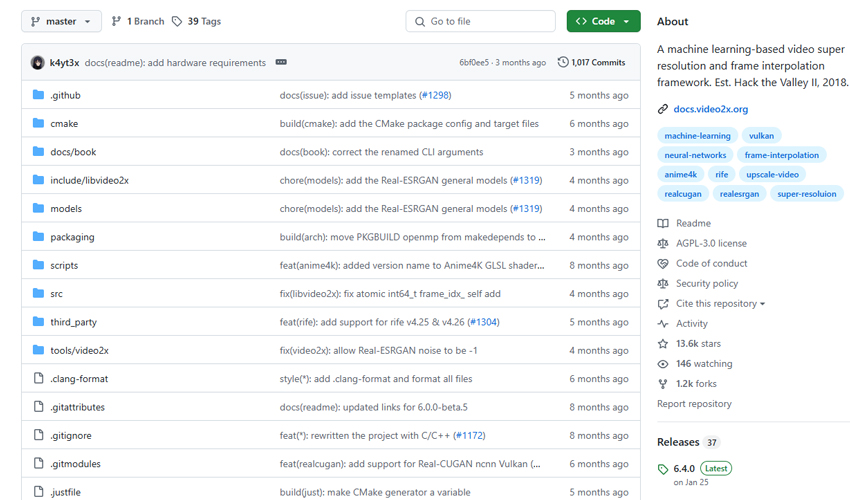
Video2X has moved toward a more self-contained architecture. Visit the official GitHub releases to find the binary that matches your hardware:
- Windows (Recommended): Download video2x-qt6-windows-x86_64.zip. The 6.x versions are now primarily C++ based, offering much better stability than the legacy Python scripts.
- Linux: The .AppImage remains the gold standard for Linux distributions (Ubuntu, Fedora, Arch), providing a sandboxed environment with all dependencies pre-bundled.
For macOS & Cloud Users:
Native Apple Silicon support is still in development. If you are on a Mac, your best options are:
- Docker Containers: This is the most stable method for macOS users to access the Vulkan-based backend without "dependency hell."
- Google Colab: Ideal if you lack a high-end local GPU (8GB+ VRAM). You can leverage remote Tesla T4 or A100 GPUs to process your queue for free.
Note on macOS Efficiency: For Mac users seeking a native, Metal-accelerated experience without the complexity of Docker, Aiarty Video Enhancer provides a seamless "one-click" solution optimized specifically for M1/M2/M3/M4 chips.
Step 2: Environment Calibration (Simplified)
The Video2X GUI version bundles most core components. However, ensuring your system environment is ready is still key:
- Driver Check: Ensure your GPU drivers support Vulkan 1.2+. This is essential for the NCNN-based engines to function correctly.
- FFmpeg Integration: While bundled, pointing Video2X to a custom FFmpeg build can unlock advanced codecs like AV1 or ProRes for professional mastering.
- VRAM Management: In the settings, adjust the "Thread Count" based on your VRAM. For a 12GB card, 2-3 threads are usually optimal for 4K upscaling.
Step 3: Executing Your First AI Upscale
The workflow in the 6.x GUI is designed for batch processing. Follow these steps for the best results:
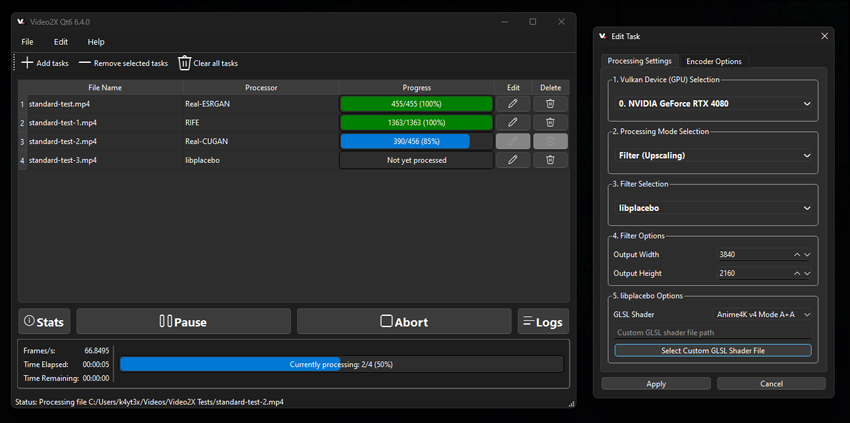
- Import & Queue: Drag and drop your files. You can now set different output resolutions for each video in the same batch.
- Select the Right Engine:
– Use Real-CUGAN for 2D/Anime (highest quality).
– Use Real-ESRGAN for real-world footage with complex textures.
– Use RIFE if your goal is to increase FPS (e.g., 30fps to 60fps). - Configure Output Scale: Common ratios are 2x and 4x. For 2026 standards, we recommend upscaling to 4K (3840x2160) to ensure future-proof clarity.
- In-Memory Processing: Ensure the "Process in Memory" option is checked to prevent excessive SSD wear and save disk space.
- Start & Monitor: Click "Start." Use the real-time log to monitor GPU temperature and frame-per-second (FPS) processing speed.
If you find the technical configuration of Video2X too time-consuming, Aiarty Video Enhancer offers a streamlined alternative that automates model selection and hardware optimization, delivering professional-grade results with zero setup.
Our Verdict
Video2X remains the definitive benchmark for open-source video enhancement. Its greatest strength lies in its transparency and versatility—acting as a robust framework that bridges specialized AI models like Real-CUGAN and RIFE into a single pipeline. For power users and technical enthusiasts who demand granular control over every paramete, Video2X offers a level of freedom that commercial alternatives simply cannot match, all without the burden of subscription fees.
However, that freedom comes with a "technical tax." Despite the leap to version 6.x, Video2X is still characterized by a steep learning curve and a lack of the deep hardware-software optimization found in professional suites. The absence of native Apple Silicon (Metal) support and the reliance on pixel-stretching models rather than Generative Reconstruction means it often falls behind in processing speed and the ability to restore high-frequency textures like human skin or hair.
The Bottom Line: Video2X is an exceptional tool for hobbyists and curators of anime or retro content who have the time to experiment. But for professionals and Mac users who prioritize rendering efficiency, generative detail, and a "zero-setup" workflow, exploring a dedicated solution like Aiarty Video Enhancer is a more strategic choice for high-volume production.
Best Video2X Alternative: Aiarty Video Enhancer
While Video2X delivers impressive results, its steep learning curve, lack of official macOS support, and slow processing time can be frustrating - especially for users who want fast, high-quality upscaling without complex setup. That's where the next-generation Aiarty Video Enhancer comes in.
Aiarty Video Enhancer is a powerful, user-friendly alternative built for simplicity and efficiency. It leverages advanced, pre-integrated AI models to upscale your videos with stunning clarity, sharpness, and vivid detail. Unlike Video2X, it requires absolutely no technical setup or command-line knowledge. Just import your video, select your desired resolution (up to 8K), and let the software handle the rest.
Performance and Ease of Use: A Direct Comparison
The defining difference lies in speed. Video2X's meticulous frame-by-frame process can take several hours for a short video, making it resource-heavy and slow. Aiarty directly solves this bottleneck: By utilizing highly optimized GPU acceleration and offering native support for modern hardware (including Apple Silicon and advanced NVIDIA/AMD GPUs), Aiarty can dramatically reduce processing time by a factor of 3 to 5 times compared to the open-source tool.
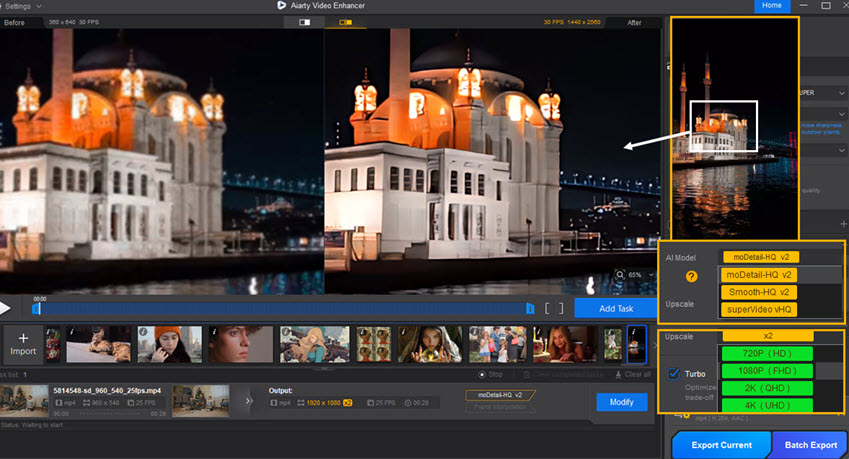
Video2X vs Aiarty Video Enhancer
Whether you're restoring old footage, enhancing animations, or preparing videos for social media or professional use, Aiarty offers faster rendering, true macOS compatibility, and stunning results—all with just a few clicks. It is the definitive solution for users prioritizing quality, speed, and ease of use over complex, technical setups
 FAQs
FAQs
Yes, Video2X is completely free and open-source. You can download, use, and even modify the software without paying anything.
Yes, Video2X is safe to use as long as you download it from the official GitHub repository. Since it is open-source enhancer software, its code is publicly available for review, minimizing the risk of malware. However, always be cautious when downloading dependencies like FFmpeg or Python from their official sources to ensure security.
The best alternative to Video2X is Aiarty Video Enhancer. It offers easy-to-use AI-powered video upscaling with native support for both Windows and macOS. Unlike Video2X, Aiarty requires no complicated setup or command-line use. It delivers fast processing speeds, supports batch upscaling, and produces high-quality results suitable for a wide range of video content.
Also read: Video2X vs Topaz: Free vs Professional AI Video Enhancer Compared

This post was written by Brenda Peng who is a seasoned editor at Digiarty Software who loves turning ordinary photos into extraordinary works of art. With AI assistance for brainstorming and drafting, the post is reviewed for accuracy by our expert Abby Poole for her expertise in this field.
