


Flixier Review 2026: Is This Online AI Video Editor Worth It?



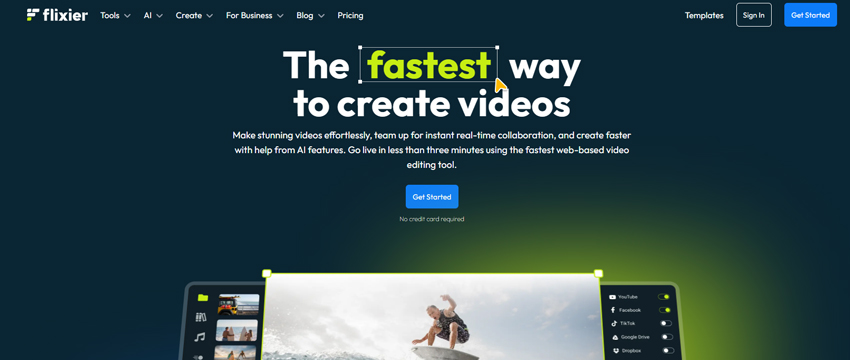
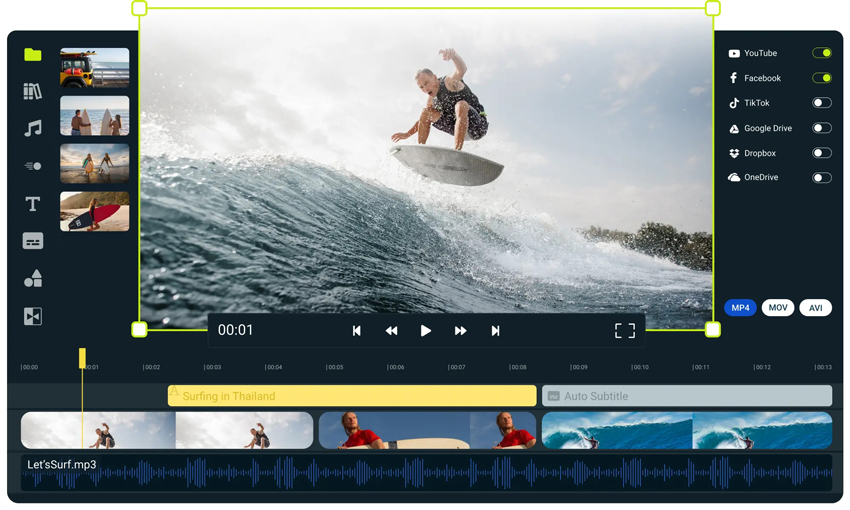
Flixier has evolved from a lightweight cloud video editor into a broader AI-assisted creation platform. In 2026, it combines browser-based timeline editing with AI video generation, automatic subtitles, transcript-based editing, voice tools, collaboration, and AI video enhancement in one workflow.
That makes Flixier attractive for creators who want to make and publish videos without installing demanding desktop software. But is Flixier actually worth paying for? Is Flixier free? Can it export in 4K? And how capable is its AI Video Enhancer compared with a dedicated AI video enhancer? This Flixier review covers its current features, pricing, limitations, and the type of user it makes the most sense for.
Flixier Review: Quick Verdict
Bottom line: Flixier is strongest as an all-in-one online video creation workflow. It is particularly convenient for social creators, marketers, educators, and teams that want AI generation and editing in the same place. If your priority is restoring noisy, blurry, compressed, or low-resolution footage, however, a dedicated video enhancement tool provides a more specialized workflow.
What Is Flixier?
Flixier is a cloud-based video editor that works directly in a web browser. Instead of relying primarily on your local computer for video processing, it uses a cloud-oriented workflow designed to make editing accessible on Windows, Mac, Chromebook, and lower-spec computers.
The current Flixier goes beyond basic trimming and timeline editing. Users can combine recorded footage with AI-generated media, add subtitles and voiceovers, edit videos through transcripts, enhance footage, collaborate with other users, and export finished projects from the same workspace.
This makes Flixier especially relevant to creators who value speed and accessibility more than the highly technical controls found in traditional desktop editors.
What's New in Flixier in 2026?
Flixier has increasingly shifted from being simply a cloud video editor toward an AI-first video creation and editing platform.
One of its biggest additions in 2026 is Eva, Flixier's AI video editing assistant. Eva can analyze a transcript, identify mistakes, silences, and filler words, propose edits, resize content for social formats, generate captions, and apply approved changes directly to the timeline.
Flixier has also expanded AI video generation inside the editor. Its current AI workflow gives users access to model families including Kling, Veo, Wan, and Seedance, with options such as Kling 3.0 Pro, Veo 3.1, and Seedance 2.0. Flixier's current pricing page also highlights models such as Kling 3.0, Veo 3.1, and Sora 2.
Key 2026 Flixier updates:
- Eva AI video editing assistant
- AI video generation directly inside the timeline
- Kling 3.0 / Kling 3.0 Pro support
- Veo 3.1 and Veo 3.1 Fast
- Seedance 2.0 and Seedance 2.0 Fast
- Edit by Transcript
- AI B-roll and AI Clips tools on higher plans
- Expanded AI enhancement and voice workflows
These changes matter because they reduce the need to generate clips in one service, download them, and then import them into a separate editor. Flixier increasingly aims to keep the entire workflow—from generation to final export—inside one browser tab.
Key Features of Flixier
1. Browser-Based Video Editing
Flixier's browser-based workflow remains one of its strongest selling points. There is no large desktop application to install, and much of the heavy processing is handled through the cloud rather than depending entirely on your local GPU.
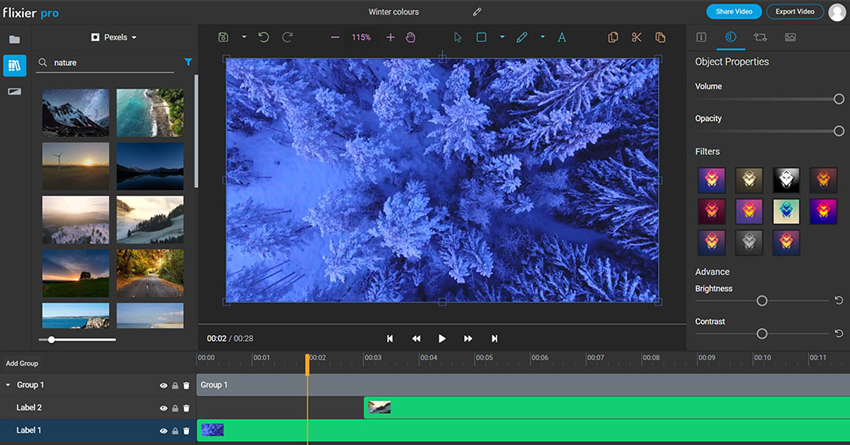
The editor includes a multi-track timeline for combining video, audio, text, images, transitions, and graphics. This makes it suitable for common workflows such as YouTube videos, tutorials, presentations, interviews, short-form social content, and marketing videos.
The main tradeoff is internet dependence. Uploading large source files and working with cloud processing naturally makes connection speed and stability more important than with an offline editor.
2. AI Video Generation Inside the Timeline
AI video generation is now one of the biggest differences between current Flixier and older versions of the platform.
Instead of generating an AI video elsewhere and manually moving the file into an editor, Flixier lets users generate clips and continue working with them directly on the timeline. Current model options include technologies from Kling, Veo, Wan, Seedance, and other generative AI providers.
This workflow is especially useful for ads, social videos, explainers, AI-assisted B-roll, and short-form content because generated shots can be immediately combined with existing footage, captions, audio, graphics, and transitions.
3. Eva AI Assistant and Edit by Transcript
Flixier's Eva assistant is designed to automate part of the first-cut editing process. It can work with a video's transcript, identify unnecessary sections, propose cuts, and apply the approved changes to the timeline.
Flixier also offers Edit by Transcript, allowing dialogue-heavy videos to be edited more like a document. This is particularly useful for interviews, tutorials, podcasts, webinars, talking-head videos, and educational content where cuts often correspond directly to spoken words.
The conventional timeline is still available afterward, so creators can refine Eva's changes manually rather than giving up control of the final edit.
4. Flixier AI Video Enhancer
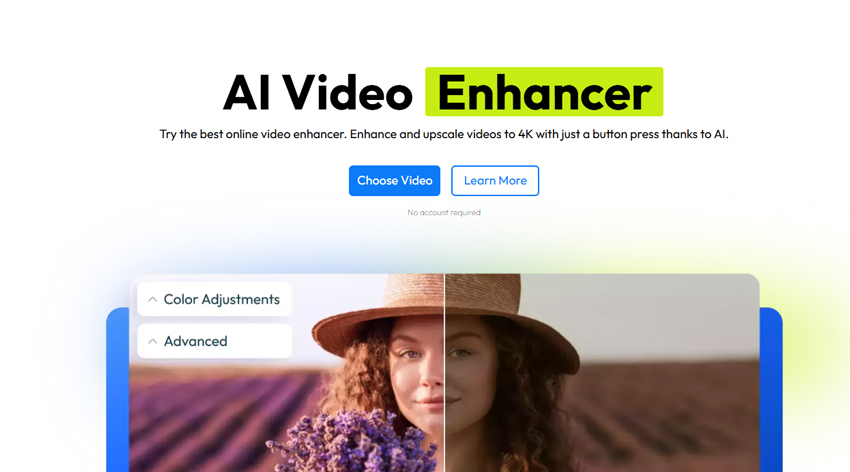
Flixier includes an AI Video Enhancer aimed at footage that looks soft, grainy, compressed, or lacking in detail.
The current enhancer provides four presets:
- High Quality — a general-purpose option for most footage.
- Pro Detail — stronger edge definition for soft or slightly out-of-focus footage.
- Natural Look — designed to preserve more natural textures and avoid excessive sharpening.
- Fast Real-Time — prioritizes processing speed for longer files or faster workflows.
Flixier says the enhancer can sharpen soft footage, reduce grain and blocky compression artifacts, and improve visible detail. A major convenience is that the enhanced clip can then be edited, captioned, and published without leaving Flixier.
How to Enhance Video Quality with Flixier
Step 1. Upload an MP4, MOV, AVI, or WebM video to Flixier Video Enhancer.
Step 2. Choose High Quality, Pro Detail, Natural Look, or Fast Real-Time according to your footage.
Step 3. Preview the enhanced result and compare the presets before deciding which output looks best.
Step 4. Export the enhanced video or continue editing it in Flixier.
Note: Flixier lets users preview enhancement results before export. Exporting the finished enhanced video requires a Flixier plan.
5. Automatic Subtitles and Voice Tools
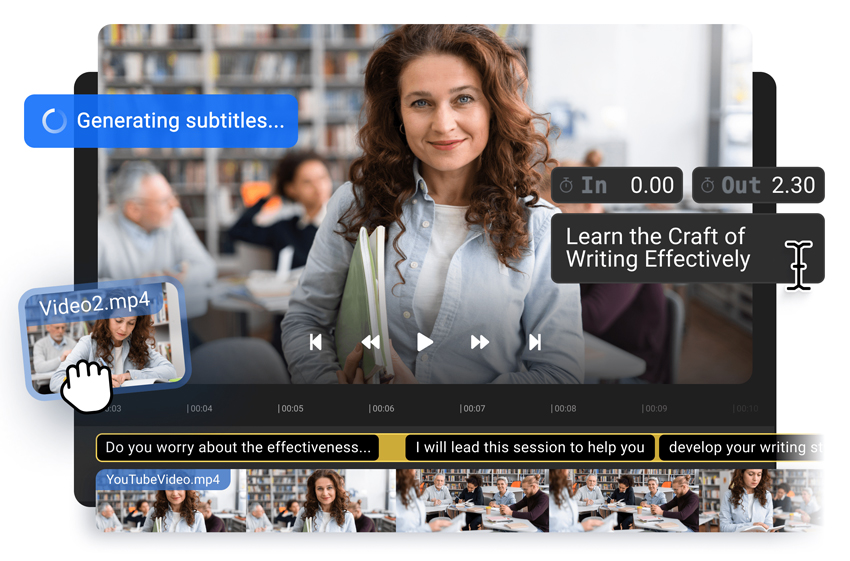
Flixier includes automatic subtitle generation and transcription tools for creators who regularly publish talking-head, educational, interview, or social videos.
Subtitle allowances vary significantly by plan. The Free plan currently includes 5 minutes of subtitles per month, Starter includes 120 minutes, Creator includes 1,500 minutes, and Business offers unlimited subtitle exports.
Flixier also provides AI voice and audio tools, making it possible to handle captions, narration, and basic audio enhancement without moving the project into another editor.
6. Collaboration and Cloud Workflow
Flixier is also designed around collaborative workflows. Users can share projects and media, leave feedback, and work across devices without repeatedly sending large project files back and forth.
Cloud storage increases as you move through the plans, from 2 GB on Free to 20 GB on Starter and 250 GB on Creator, while the Business plan currently includes unlimited storage.
This makes Flixier particularly practical for remote marketing teams, social media teams, educators, agencies, and creators who frequently review content with clients or collaborators.
Flixier Video Enhancer: What It Can and Cannot Do
A key point in any Flixier Video Enhancer review is understanding the difference between video enhancement, video upscaling, and 4K export.
Flixier itself describes its Video Enhancer as a tool for improving the quality already present in footage. It focuses on areas such as sharpness, grain, compression damage, and visible detail. Flixier separately defines upscaling as increasing the actual pixel dimensions of a video.
What Flixier Video Enhancer is designed to do:
- Sharpen soft footage.
- Reduce grain and compression artifacts.
- Improve edge and texture visibility.
- Improve mildly degraded low-light footage.
- Preview multiple enhancement presets quickly.
- Continue editing the enhanced clip in the same browser timeline.
Where its limits become more noticeable:
- Severe motion blur cannot be perfectly reconstructed if the original information was never captured.
- Extremely dark footage may still lack recoverable detail.
- The Video Enhancer itself should not be confused with dedicated AI super-resolution.
- Advanced restoration and frame interpolation are not the core purpose of the Video Enhancer.
Flixier does list a separate Video Upscaler among the advanced tools available with its Creator plan. However, this is different from saying that every file processed through Flixier Video Enhancer is automatically reconstructed through dedicated AI super-resolution.
Similarly, Flixier's Creator and Business plans can export projects at up to 4K, but export resolution and AI enhancement are separate concepts. Exporting a project as 4K does not by itself mean that missing source detail has been reconstructed.
This distinction matters if you are comparing Flixier with dedicated AI video upscalers designed specifically for low-resolution restoration.
Flixier Pricing 2026: Is Flixier Free?
Yes. Flixier has a free plan, but its export resolution, watermark, AI credits, and monthly limits make the paid tiers more relevant for regular creators.
Flixier pricing checked on August 12, 2026:
*Flixier describes Creator and Business exports as unlimited, meaning there is no preset monthly cap, although very large or consecutive exports may enter a processing queue during peak usage.
The Free plan is useful for testing the editor, but the 720p maximum resolution and Flixier watermark make it restrictive for finished professional or social media work.
Starter removes the watermark and increases output to Full HD 1080p. It is better suited to occasional editors who do not need 4K or Flixier's complete AI workflow.
Creator is where the platform becomes significantly more capable. It adds 4K resolution, unlimited video exports, 10,000 AI credits, AI video generation inside the timeline, Edit by Transcript, Eva editing, Brand Kit, and a much larger stock library.
Business is aimed at teams and heavier workflows, increasing AI credits to 30,000 while adding unlimited storage and subtitle exports plus priority support.
Flixier also offers annual billing, with the exact discount displayed on its current pricing page. Because pricing and plan limits can change, checking the official Flixier pricing page before subscribing is recommended.
Are 500 Free Flixier AI Credits Enough?
It depends heavily on which AI feature or generation model you use.
AI video generation can consume credits quickly. For example, Flixier's current pricing page lists a 4-second Kling 3.0 generation at 4,800 AI credits and a 5-second generation at 6,000 credits.
That means the 500 AI credits included with the Free plan are useful for exploring some AI functionality, but they are not enough to generate even one 4-second Kling 3.0 clip at the currently listed rate.
If generative AI is the main reason you are considering Flixier, AI-credit consumption should therefore be included in the real cost of the subscription.
Flixier Pros and Cons
- Runs directly in a web browser with no large desktop installation.
- Combines AI video generation and editing in one timeline.
- Supports modern AI video models such as Kling and Veo.
- Eva can automate parts of the first-cut editing workflow.
- Edit by Transcript is useful for interviews and talking-head content.
- Built-in AI video enhancement for soft, grainy, and compressed footage.
- Automatic subtitles, voice tools, and cloud collaboration.
- 4K exports available on Creator and Business plans.
- Suitable for lower-spec devices because much of the workflow is cloud-based.
- Requires a reliable internet connection.
- Free exports are limited to 720p and include a watermark.
- AI video generation can consume credits quickly.
- Large source files still need to be uploaded before cloud processing.
- Less specialized for deep video restoration than dedicated AI enhancement software.
- Advanced desktop editors still provide deeper manual post-production control.
- Video enhancement and 4K export should not be confused with dedicated AI super-resolution.
Flixier Performance and Workflow: Who Should Use It?
Flixier's biggest performance advantage comes from its cloud-first design rather than from requiring a powerful local workstation. This can make editing more accessible on laptops and lower-spec computers, especially for users who do not want to maintain a large desktop editing application.
However, cloud processing changes where the bottleneck occurs. Upload speed, connection stability, source-file size, project complexity, and server availability can all affect the overall workflow. For that reason, it is better to think of Flixier as reducing dependence on local hardware rather than eliminating performance constraints entirely.
Its workflow is particularly well suited to:
- Social media creators making TikTok, Reels, Shorts, and other short-form content.
- Marketers producing ads, product videos, promos, and campaign assets.
- Educators working with tutorials, screen recordings, presentations, and online courses.
- Talking-head creators who can benefit from transcript-based editing and automatic captions.
- Remote teams that need cloud collaboration and shared project access.
- AI creators who want to generate clips and immediately edit them on a conventional timeline.
- Users with lower-spec computers who want to reduce dependence on local rendering hardware.
Flixier is less likely to replace a full desktop post-production workflow for users who need complex compositing, advanced color grading, highly precise timeline control, or intensive restoration of badly degraded footage.
Best Flixier Alternative for AI Video Enhancement: Aiarty Video Enhancer
Flixier and Aiarty Video Enhancer overlap in video enhancement, but they are built around different priorities.
Flixier is primarily an online AI video editor. Its strength is taking footage or AI-generated media and turning it into a complete video using timeline editing, captions, voice tools, collaboration, enhancement, and publishing features.
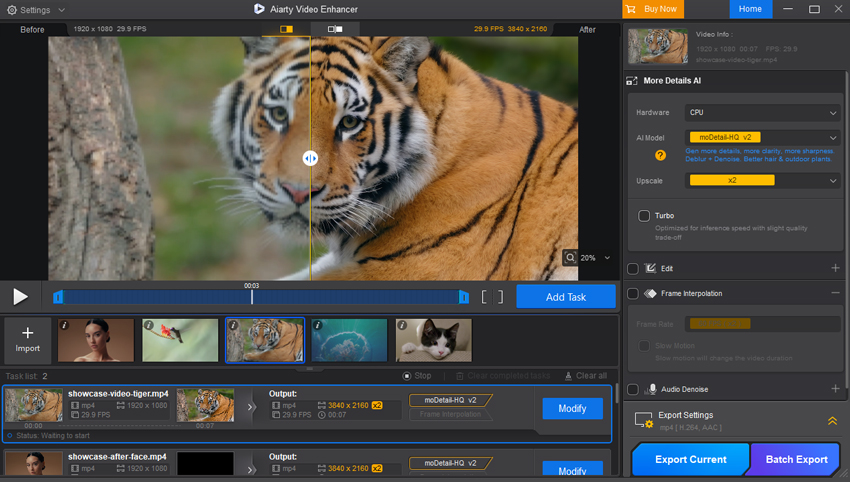
Aiarty Video Enhancer is primarily a dedicated desktop video enhancement and restoration tool. Its focus is improving the underlying quality of existing footage through AI upscaling, denoising, deblurring, detail reconstruction, frame interpolation, audio denoise, and local GPU processing.
Aiarty currently includes three specialized enhancement models. moDetail-HQ v3 prioritizes detail and sharpness in areas such as hair, skin, plants, and textures; Smooth-HQ v3 focuses on faithful restoration and natural denoising/deblurring; and superVideo vHQ targets difficult grainy, low-light, and blurry footage.
Depending on the model, Aiarty supports x1, x2, x4, 1K, 2K, and 4K video enhancement. It also supports frame interpolation for higher frame rates and slow motion, batch export, and local offline processing.
Flixier vs Aiarty Video Enhancer
Verdict: Choosing between Flixier and Aiarty depends more on the workflow than on which product is universally "better." Flixier is the stronger choice when you need an all-in-one browser editor with AI generation, captions, collaboration, and publishing tools. Aiarty Video Enhancer makes more sense when your primary goal is to improve the visual quality of existing footage through dedicated AI restoration and upscaling.
Flixier Review Verdict: Is Flixier Worth It in 2026?
Flixier is much more capable in 2026 than a basic online video editor. Its biggest strength is bringing AI video generation, timeline editing, Eva, transcript-based editing, enhancement, subtitles, voice tools, and cloud collaboration into one workflow.
The Free plan is enough to explore the interface, but its 720p limit, watermark, 10 minutes of monthly export time, and 500 AI credits make it restrictive for serious use. Creator is likely to be the more meaningful tier for regular content creators because it adds 4K, unlimited video exports, 10,000 AI credits, AI generation inside the timeline, and deeper AI editing functionality.
For social videos, tutorials, marketing content, talking-head videos, and AI-assisted content creation, Flixier is worth considering.
For users whose main priority is repairing noisy footage, restoring fine details, upscaling low-resolution videos, or smoothing motion through frame interpolation, a dedicated video enhancer such as Aiarty Video Enhancer offers a more focused workflow.
 FAQs
FAQs
Yes. Flixier currently offers a Free plan with 500 AI credits, 10 minutes of video exports per month, 5 minutes of subtitles, 720p resolution, and 2 GB of cloud storage. Videos exported on the Free plan include a Flixier watermark.
Yes. Videos exported with the Flixier Free plan include a watermark. Starter, Creator, and Business plans remove the Flixier watermark.
Yes. Flixier Creator and Business plans currently support up to 4K 2160p output. Starter supports up to 1080p, while the Free plan is limited to 720p.
Flixier distinguishes video enhancement from video upscaling. Its Video Enhancer primarily improves sharpness, grain, compression damage, and visible detail, while upscaling increases the actual pixel dimensions. Flixier also lists a separate Video Upscaler among advanced Creator tools, and Creator and Business plans can export projects at up to 4K.
Flixier Video Enhancer can improve mildly blurry, grainy, or compressed footage. Its Pro Detail preset emphasizes edge definition, while Natural Look is designed to preserve more natural textures. Very dark footage or severe motion blur may still have limited recoverable detail.
No. Flixier is designed around browser-based and cloud processing, so an internet connection is central to the workflow. Users who need fully local video processing should consider desktop software instead.
Flixier is an established cloud-based video editing service. Because videos are uploaded and processed through an online workflow, users handling confidential or sensitive footage should review Flixier's current privacy policy and data-handling terms before uploading their files.
The best alternative depends on what you need. If you want another online editing workflow, look for a browser-based video editor that matches your preferred collaboration and AI tools. If your priority is AI video upscaling, denoising, deblurring, frame interpolation, and restoring low-quality footage, Aiarty Video Enhancer is a more specialized alternative.
You May Also Like


This post was written by Brenda Peng, a seasoned editor at Digiarty Software who focuses on AI-powered video enhancement, restoration, and creative workflows. With AI assistance for brainstorming and drafting, the post is reviewed for accuracy by our expert Abby Poole.
