


TikTok Video Blurry After Upload? Why It Happens and How to Fix It



Your TikTok video looks sharp in your camera roll, clear in your editor, and completely fine before posting. But after upload, it suddenly looks soft, pixelated, or blurry. This is one of the most common TikTok video quality problems, and it usually happens because TikTok compresses your video during upload.
The good news is that blurry TikTok videos are often fixable. In most cases, you just need better export settings, a stable upload connection, Upload HD enabled, and a clean source video. This guide explains why your TikTok videos get blurry after posting and how to upload clearer, sharper videos with fewer quality losses.
Why Your TikTok Video Gets Blurry After Upload
If your TikTok video looks fine before upload but blurry after posting, the problem is usually not one single setting. It is often a mix of compression, low bitrate, wrong aspect ratio, unstable upload conditions, or a low-quality original file.

1. TikTok Compresses Videos After Upload
TikTok compresses uploaded videos so they can load quickly on different devices and network conditions. This compression can reduce bitrate, soften textures, blur small details, and make fast-moving clips look blocky. That is why a video can look perfect in your editor but lose quality after posting.
2. Your Source Video Is Already Low Quality
If the original video is low resolution, noisy, dark, shaky, or over-compressed, TikTok's upload compression will make those issues more visible. A 720p video shot in poor lighting may look acceptable on your phone, but once TikTok processes it, it can become noticeably blurry or grainy.
3. Your Export Settings Are Not Optimized for TikTok
Wrong export settings are a major reason TikTok videos lose quality. If you export with a low bitrate, unusual frame rate, unsupported codec, or non-vertical format, TikTok may reprocess the file more aggressively. For best results, export your video as MP4, H.264, 1080×1920, 9:16, and 30fps or 60fps.
4. Data Saver or Mobile Upload Reduces Quality
TikTok's Data Saver mode is designed to reduce data usage, but it can also make videos appear lower quality. Uploading over mobile data may also cause quality loss, especially when your signal is weak or unstable. If your TikTok video becomes blurry after posting, Data Saver should be one of the first settings you check.
5. Your Internet Connection Is Slow or Unstable
A weak Wi-Fi signal or unstable mobile connection can interrupt the upload process. Even if the video eventually posts, TikTok may process it in a lower-quality version to make the upload complete faster. A stable Wi-Fi connection gives your video a better chance of keeping more detail.
6. The Aspect Ratio Is Incorrect
TikTok is built for vertical 9:16 videos. If you upload a horizontal, square, stretched, or heavily cropped video, the platform may resize it, add black bars, or soften the image. For the cleanest result, edit and export your video directly in 1080×1920 vertical format.
7. Heavy Filters, Effects, or Re-Edits Soften the Video
Too many filters, beauty effects, transitions, or repeated exports can reduce video clarity. Some filters intentionally soften skin or lower texture detail, which may look even blurrier after TikTok compression. Try to keep your edit clean and avoid exporting the same video multiple times before uploading.
How to Fix Blurry TikTok Videos
Before you re-upload the same video again, go through the fixes below. These steps target the most common reasons TikTok videos look blurry after uploading.

1. Turn Off Data Saver Mode
Data Saver can lower playback and upload quality to reduce data usage. If your TikTok videos look blurry, turn it off before posting.
- Open TikTok and go to your Profile.
- Tap the menu icon in the top-right corner.
- Go to Settings and Privacy.
- Find Data Saver under Cache & Cellular or a similar section.
- Toggle Data Saver off.
After turning it off, close and reopen TikTok before uploading your video again.
2. Enable Upload HD Before Posting
TikTok has an Upload HD or Allow high-quality uploads option on the posting screen. If this option is off, your video may be posted at a lower quality.
- Tap + to create a new TikTok post.
- Select your video and tap Next.
- On the posting screen, open More options.
- Turn on Upload HD or Allow high-quality uploads.
- Post the video after the setting is enabled.
Note: TikTok settings may look slightly different depending on your app version, region, and device. If you do not see Upload HD, update the app and check the posting screen again.
3. Export Your Video with TikTok-Friendly Settings
If your video is blurry after posting, your export settings may be too low or not suitable for TikTok. Use a 9:16 vertical project and export in 1080×1920 MP4 with H.264. Avoid exporting in a very low bitrate, because TikTok will compress it again after upload.
For a detailed format checklist, see the recommended TikTok export settings below.
4. Upload Over a Stable Wi-Fi Connection
Uploading over unstable mobile data can increase the chance of quality loss. Before posting, connect to strong Wi-Fi and avoid uploading while switching networks.
- Use Wi-Fi instead of mobile data whenever possible.
- Do not upload while the network signal is weak.
- Avoid running large downloads or backups during upload.
- Wait until the upload fully finishes before closing the app.
5. Upload from a PC If Mobile Uploads Look Soft
If your video always looks worse when uploaded from your phone, try uploading from a desktop browser. A PC upload can be useful for edited videos exported from Premiere Pro, CapCut, DaVinci Resolve, Final Cut Pro, or other desktop editors.
- Go to TikTok.com on your computer.
- Log in to your account.
- Click Upload.
- Select your exported MP4 file.
- Check available quality options before posting.
6. Clear the TikTok App Cache
A messy app cache usually does not destroy the original video, but it can cause preview glitches, loading issues, or app performance problems. Clearing the cache is a quick fix worth trying.
- Open TikTok and go to Profile.
- Tap Settings and Privacy.
- Go to Free Up Space or Cache & Cellular.
- Tap Clear Cache.
Then restart the app and try posting the video again.
Best Export Settings for TikTok Videos
The easiest way to reduce TikTok quality loss is to upload a file that already matches TikTok's preferred format. Use the settings below when exporting from CapCut, Premiere Pro, DaVinci Resolve, Final Cut Pro, or any other video editor.
Should you upload 4K videos to TikTok? You can record in 4K if your phone supports it, but for upload, a clean 1080×1920 export is usually safer. TikTok may compress oversized 4K files heavily, which can make them look softer after posting. A sharp 1080p export with a good bitrate often performs better than a huge 4K file that TikTok has to shrink.
Related article: How to Resize Your Videos to Look Perfect on TikTok
How to Improve a Blurry TikTok Video Before Uploading
If your source video is already blurry, changing TikTok settings alone may not be enough. Upload HD can help preserve quality, but it cannot rebuild details that were never clear in the original file. In that case, enhance the video before uploading it to TikTok.
1. Record in better lighting
Low light creates noise, and noise becomes more obvious after TikTok compression. Use natural light, a ring light, or a brighter filming setup whenever possible.
2. Keep the camera steady
Motion blur and shaky footage are hard to fix after recording. Use a tripod, phone stand, or stabilizer to keep details sharper.
3. Avoid repeated exports
Each time you export and re-import a compressed video, it loses a little more detail. Edit from the original file and export only once when possible.
4. Sharpen and denoise before uploading
If your video is old, low-resolution, noisy, or slightly out of focus, an AI video enhancer can help make it cleaner before TikTok compresses it.
For a faster workflow, Aiarty Video Enhancer can help improve blurry TikTok videos before upload. It uses AI-powered enhancement to sharpen details, reduce noise, upscale low-resolution footage, and make videos look cleaner for social platforms.
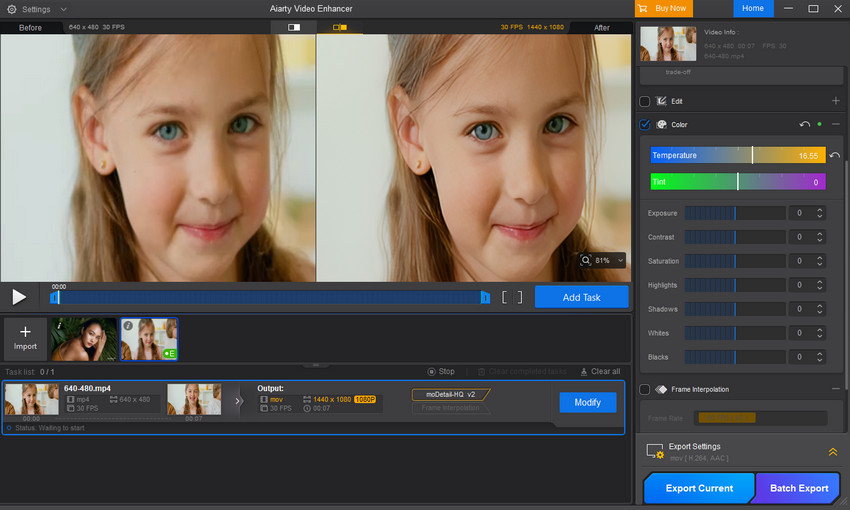
- Upscale low-resolution videos to a clearer 1080p or higher-quality version.
- Reduce noise and grain from low-light phone videos.
- Recover sharper facial details, textures, and edges.
- Improve color, brightness, and visual clarity before posting.
This is especially useful when you want to repost older clips, improve low-quality phone footage, or prepare clearer short videos for TikTok, Instagram Reels, YouTube Shorts, and other vertical video platforms.
After enhancing the video, export it in 1080×1920 MP4, turn on Upload HD, and post it over a stable Wi-Fi connection. This gives TikTok a cleaner source file and helps reduce quality loss after upload.
 FAQs
FAQs
Your TikTok video is usually blurry after posting because TikTok compresses the uploaded file. Low bitrate, weak internet, Data Saver mode, wrong export settings, and a low-quality source video can make the compression look worse.
Before upload, you are viewing the original file on your device. After posting, TikTok shows a compressed version. Fine details, text, hair, skin texture, fast motion, and low-light areas may look softer after compression.
You cannot fully stop TikTok from compressing videos, but you can reduce quality loss. Export your video as 1080×1920 MP4 with H.264, use a good bitrate, turn on Upload HD, turn off Data Saver, upload over stable Wi-Fi, and avoid repeated exports.
For most TikTok videos, 1080×1920 is the safer upload resolution. You can record in 4K for more editing flexibility, but exporting a clean 1080p vertical file usually reduces the chance of heavy platform compression.
Use 1080×1920 resolution, 9:16 aspect ratio, MP4 format, H.264 codec, 30fps or 60fps, AAC audio, and around 8–15 Mbps bitrate for most 1080p TikTok videos.
You cannot replace the uploaded TikTok file with a sharper version after posting. The best option is to enhance the original video, export it with better settings, and re-upload it. Tools like Aiarty Video Enhancer can help sharpen, denoise, and upscale the source video before posting.
Sometimes, yes. Desktop upload can be more stable, especially for edited videos exported from professional software. If mobile uploads keep looking blurry, try uploading the same MP4 file from TikTok.com on a computer.
Drafts may show a local preview or a less-compressed version of the video. Once the video is posted, TikTok processes and compresses it for delivery, which can make the final public version look softer than the draft.

This post was written by Brenda Peng who is a seasoned editor at Digiarty Software who loves turning ordinary photos into extraordinary works of art. With AI assistance for brainstorming and drafting, the post is reviewed for accuracy by our expert Abby Poole for her expertise in this field.
