


TensorPix Review 2026: Is It Worth It? Pricing, Performance & Alternatives



TensorPix is a cloud-based AI platform for enhancing, upscaling, restoring, and generating video and image content. Its Video Enhancer can upscale footage to 4K, reduce noise and blur, increase frame rates, stabilize shaky clips, and process media online without requiring a powerful local GPU.
But is TensorPix actually worth paying for in 2026? In this updated TensorPix review, we look at its current features, credit-based pricing, free-plan limits, practical strengths and weaknesses, privacy considerations, and how it compares with a local desktop alternative such as Aiarty Video Enhancer.
TensorPix Review: Quick Verdict
Our Verdict: TensorPix is a convenient choice for occasional video enhancement if you want a browser-based workflow and do not have a strong local GPU. Its biggest trade-offs are cloud uploads, credit usage, and less hands-on control than a desktop enhancer. Frequent long-form processing or private client footage may be better suited to a local workflow.
- Best for: Short clips, occasional enhancement, browser-first users, and computers without powerful GPUs.
- Main strengths: No installation, cloud processing, 4K enhancement, multiple restoration filters, and free credits for testing.
- Main drawbacks: Credit-based usage, 720p input limit on the Free plan, upload dependency, and fewer manual enhancement controls.
What Is TensorPix in 2026
TensorPix started primarily as an online AI video and image enhancer, but its product range has expanded. In 2026, the platform includes an AI Video Quality Enhancer, image enhancement, TensorShots for short-form content creation, a Real Estate Video Maker, AI video and image generation, an online video compressor, and an enhancement API.
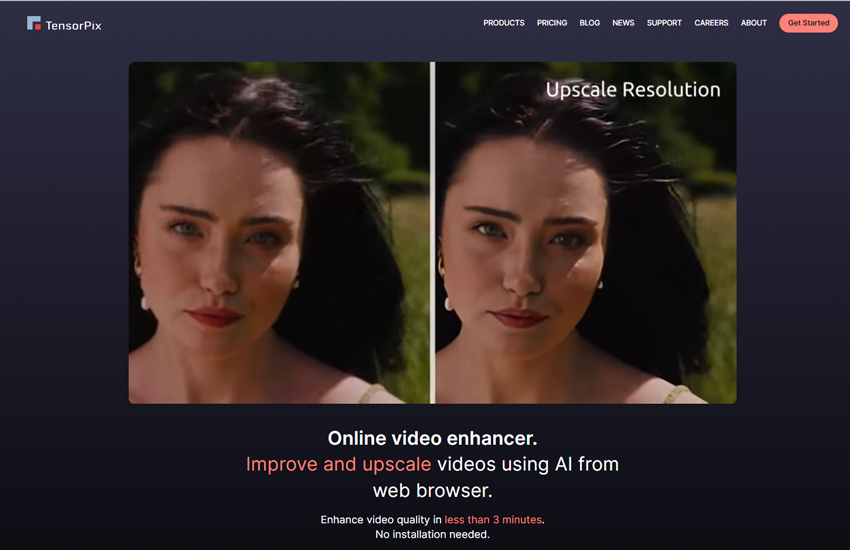
For users comparing AI video enhancers, the biggest distinction is that TensorPix processes footage on cloud servers. You upload the source file, select AI filters, choose output settings, and let TensorPix handle the GPU-intensive work remotely. This removes the need for high-end local hardware, but it also means upload speed, storage limits, cloud processing, and credits become part of the workflow.
TensorPix Video Enhancer Features
TensorPix offers several AI filters for improving low-quality video. The most useful features depend on what is wrong with the source: low resolution, compression, noise, unstable motion, or low frame rate.
1. AI Video Upscaling to 4K
TensorPix can upscale low-resolution video toward HD, Full HD, 2K, or 4K output. Its newer restoration models include 2x Upscale Ultra 4, which TensorPix positions for heavily degraded footage such as old SD archives.
This is most useful for old family videos, compressed social media clips, older phone recordings, AI-generated videos, and footage intended for larger displays. As with any AI upscaler, the quality of the source still matters: enhancement can improve visible detail and structure, but cannot perfectly recover information that was never captured.

2. Deep Clean, Denoise and Deblur
TensorPix includes AI cleaning tools designed to reduce noise, compression artifacts, softness, and blur. These filters are particularly relevant for low-light footage, old digital video, re-encoded social media clips, webcam recordings, and archive material.
For very noisy or compressed footage, the key trade-off is artifact reduction versus texture retention. Strong cleaning can make the image look smoother and clearer, but users should still inspect fine details such as hair, skin, fabric, foliage, text, and thin edges before committing to a full render.
3. FPS Boosting and Slow Motion
TensorPix uses AI frame interpolation to create intermediate frames and increase video frame rate. This can help lower-FPS footage look smoother and can also be used for slow-motion workflows.
Frame interpolation is most useful for camera movement, gaming footage, sports, and AI-generated clips. More difficult motion—such as fast limbs, overlapping people, thin objects, or sudden scene changes—can be harder for any interpolation model and should be previewed carefully.
4. AI Stabilization
TensorPix includes AI stabilization for reducing unwanted camera movement and jitter. This can improve handheld recordings without requiring a full video-editing application.
Stabilization can correct framing movement, but it cannot always repair motion blur that was baked into the original frames when the camera shook during capture.

5. AI Image Enhancement
TensorPix also supports AI image enhancement, including upscaling, denoising, and sharpening. This can be convenient for users who work with both still images and video and prefer to keep both workflows inside one browser-based platform.

6. More TensorPix AI Tools
TensorPix is now broader than a video upscaler. Its current platform also includes:
- TensorShots: Turns photos, clips, listings, and brand assets into short-form social content.
- Real Estate Video Maker: Creates property videos from listing photos.
- AI Video Generator: Generates video from text or image inputs.
- AI Image Generator: Creates and edits images from prompts.
- Video Compressor: Reduces video file size online.
- Enhancement API: Adds video enhancement and upscaling to external apps or products.
These additions make TensorPix more of an AI media platform than the simpler enhancement tool covered by many older reviews.
How to Use TensorPix Video Enhancer
The TensorPix workflow is straightforward and does not require installation:
- Upload your video. Select a file from your computer or drag it into the browser interface.
- Choose AI filters. Pick the enhancement filters that match the problem in your footage, such as upscaling, Deep Clean, denoise, stabilization, or frame interpolation.
- Adjust output settings. Choose the target resolution and available codec/output options.
- Use Preview when needed. TensorPix can create a short sample so you can inspect the enhancement before spending credits on the full job.
- Run the enhancement. The video is processed on TensorPix cloud servers.
- Download the finished file. Check fine details and motion consistency before using the result in your final project.
For first-time users, previewing a difficult section of the video is especially useful. A short sample containing faces, hair, text, foliage, fast movement, or fine texture can reveal over-smoothing or artifacts before you process the entire clip.
TensorPix Pricing and Credits in 2026
TensorPix uses a credit-based pricing system. According to its current pricing page, 1 credit roughly equals 2 minutes of enhanced video, 8 generated images, or 15 seconds of generated video. The exact cost of a project can still vary, and TensorPix displays the credit cost before processing begins.
*Paid prices above are monthly equivalents when billed annually, checked August 2026. Pricing and plan limits can change, so confirm the latest details on the official TensorPix pricing page.
Unused subscription credits roll over and remain valid for up to one year. The Free plan allows one enhancement at a time and up to four Video Enhancer filters per video, while paid tiers increase storage, concurrency, and—in higher plans—the number of filters and API access.
How Much Video Can TensorPix Credits Enhance?
Using TensorPix's rough estimate of 1 credit for about 2 minutes of enhanced video:
- 10 credits ≈ 20 minutes of enhanced video
- 35 credits ≈ 70 minutes of enhanced video
- 110 credits ≈ 220 minutes of enhanced video
These are only planning estimates. Resolution, frame rate, duration, selected processing, and other factors can affect the actual credit cost shown in the app.

Is TensorPix Free? Credits, Limits and Watermarks
Yes. TensorPix currently offers a Free Forever plan. Free users receive credits when signing up and can earn additional credits by logging in weekly. The main limitation is that video enhancement inputs are capped at 720p, compared with up to 4K input on paid plans.
The Free plan also includes 1 GB of storage, supports up to four AI filters per video, and stores videos and images for 30 days before automatic deletion.
Does TensorPix Add a Watermark?
This is where older TensorPix reviews can be misleading.
TensorPix's Free Preview is watermarked. Preview mode processes only a short sample so you can check the enhancement before spending credits.
However, TensorPix's current free enhancer pages state that completed enhancements made with available free credits can be downloaded without a TensorPix watermark. In other words, "Free Preview" and "Free Plan output" are not the same thing.
TensorPix Performance in Practice: What to Expect
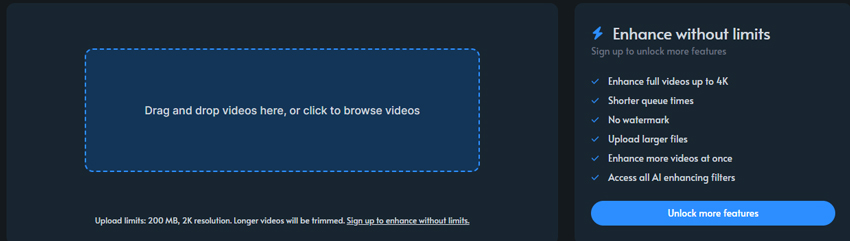
TensorPix's main advantage is not that every clip will automatically become perfect 4K footage; it is that common enhancement tasks can be handled online without local AI hardware. Results still depend heavily on the quality and type of the source.
Low-Resolution and Compressed Video
TensorPix is a practical fit for old SD footage, social-media re-encodes, and clips with visible compression. Combining moderate upscaling with a cleaning filter can often be more sensible than aggressively pushing a severely degraded source directly to 4K.
Low-Light and Noisy Footage
Denoising can make dark footage cleaner, but aggressive noise removal may also smooth real texture. Check skin, hair, fabric, foliage, water, and fine text at 100% before final export.
AI-Generated Video
TensorPix can be useful for AI-generated clips that arrive at 720p or contain soft details and compression. Upscaling may improve delivery quality, but enhancement cannot reliably fix structural generation errors such as malformed objects, incorrect anatomy, or fundamentally inconsistent motion.
Motion and Frame Interpolation
Frame interpolation can improve simple camera movement and lower-FPS footage. The hardest cases are fast motion, occlusion, thin objects, hands, and subjects entering or leaving the frame. Preview those sections before committing credits to the full clip.
Processing Speed
Because TensorPix runs online, processing does not load your local GPU. Short clips can be convenient to process in the cloud, but total turnaround also includes upload time, queue time, enhancement time, and download time. For long 4K footage, the upload and credit workflow can matter as much as the AI processing itself.
Tip: For a fair TensorPix test, use a 10–20 second difficult section of your own footage first. Include the exact details you care about—faces, hair, text, motion, low-light noise, or compression—and compare the preview at 100% before processing the full video.
TensorPix Pros and Cons
- Browser-based workflow with no desktop installation required.
- Cloud processing means you do not need a powerful local GPU.
- Supports video enhancement and upscaling to 4K.
- Includes denoise, deblur, stabilization, frame interpolation, and additional restoration tools.
- Free credits make it possible to test the service before paying.
- Unused subscription credits roll over for up to one year.
- Supports both video and image workflows in one platform.
- Higher plans offer API access and more concurrent processing.
- Free video enhancement input is limited to 720p.
- Credit usage becomes more important when processing long videos frequently.
- Every cloud workflow requires uploading the source media first.
- Total turnaround depends on upload speed, queue time, and server processing.
- Aggressive AI cleaning can sometimes smooth fine texture, depending on the source.
- Users who want detailed manual control may prefer a desktop enhancer with adjustable strength.
- Cloud processing may be less suitable for confidential client footage or large private archives.
Is TensorPix Safe and Legit
TensorPix is an active commercial AI platform with subscription billing, credit purchases, an official Help Center, and documented refund and privacy policies. According to its Help Center, payments can be made by credit/debit card through Stripe or by PayPal.
For data protection, TensorPix says stored data is protected with 256-bit AES encryption, account access is restricted, and users retain ownership of the videos and images they upload or enhance. Users can also delete files from the service.
The main privacy consideration is the cloud workflow itself. If you are working with unreleased productions, confidential business footage, private client material, or sensitive personal videos, review the current TensorPix privacy terms before uploading—or consider a local enhancer that keeps processing on your own computer.
TensorPix vs Aiarty Video Enhancer: Which Is Better for You?
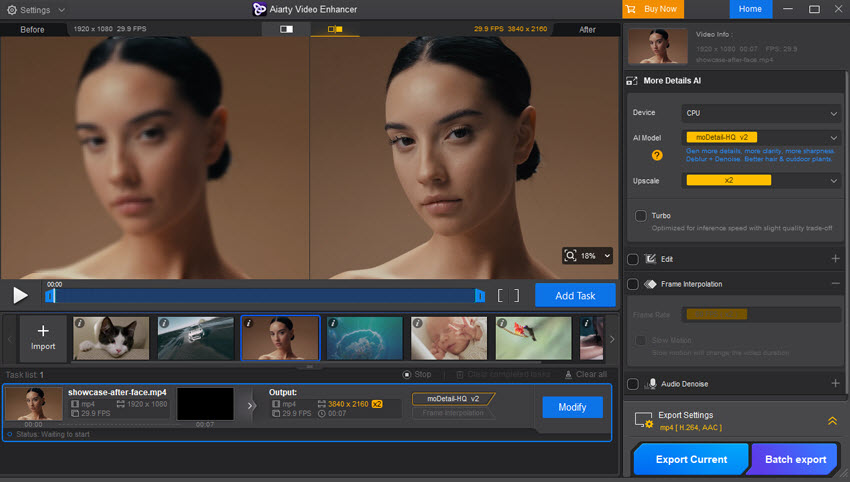
TensorPix and Aiarty Video Enhancer take different approaches to AI video enhancement. TensorPix emphasizes browser-based cloud convenience, while Aiarty is a Windows and macOS desktop application that performs AI processing locally.
That difference affects more than speed. It changes how you handle large files, privacy, internet dependence, repeated workloads, hardware requirements, and enhancement control.
TensorPix vs Aiarty Video Enhancer
*Check the latest Aiarty trial and export terms before use, as product policies may change.
Choose TensorPix If...
- Your computer does not have a strong GPU.
- You only enhance videos occasionally.
- You prefer working entirely in a browser.
- You mainly work with short clips.
- You do not mind uploading footage to a cloud service.
Choose Aiarty If...
- You frequently process large or long video files.
- You prefer to keep private or client footage on your own computer.
- You want local batch processing without repeated uploads.
- You want adjustable Strength Control to balance sharpness and natural texture.
- You have a capable NVIDIA, AMD, Intel, or Apple Silicon system.
Aiarty is optimized for local GPU acceleration across NVIDIA, AMD, Intel, and Apple Silicon hardware. In Aiarty's own RTX 5090 benchmark, 2K-to-4K upscaling reached 30 FPS with Turbo Mode, compared with 20 FPS with Turbo off. Actual speed varies by hardware, codec, source resolution, model, and settings.
Is TensorPix Worth It in 2026
TensorPix is worth considering if convenience matters more than local control. It removes the hardware barrier associated with many AI video enhancers and gives users a relatively simple way to upscale, denoise, stabilize, and interpolate video in a browser.
The Free plan and recurring free credits also make it easy to test the workflow before subscribing. For occasional short clips, that can be a practical fit.
The decision becomes less straightforward for frequent or long-form enhancement. Credit usage, upload time, storage, internet dependence, and privacy matter more as project volume grows. In those cases, a desktop workflow can become more predictable.
Bottom line: Choose TensorPix for cloud convenience and low hardware requirements. Choose a local alternative such as Aiarty when you prioritize privacy, repeated workloads, large files, and more direct enhancement control.
 FAQs About TensorPix
Yes. TensorPix has a Free Forever plan with signup and weekly login credits. Free users can enhance video inputs up to 720p, with 1 GB of storage and up to four Video Enhancer filters per video.
TensorPix's short Free Preview is watermarked. However, its current free enhancement pages state that completed enhancements processed with available free credits can be downloaded without a TensorPix watermark.
TensorPix offers a free tier plus Standard, Premium, and Elite plans. At the time of checking in August 2026, annual-billing monthly equivalents were $5.50, $12.42, and $30.25 respectively. Check TensorPix's official pricing page before purchasing because plans can change.
TensorPix uses credits for processing. Its pricing page estimates that 1 credit roughly equals 2 minutes of enhanced video, 8 generated images, or 15 seconds of generated video. The app shows the final credit cost before processing.
Yes. TensorPix can enhance video up to 4K. Paid plans currently accept Video Enhancer inputs up to 4K, while the Free plan limits enhancement inputs to 720p.
No powerful local GPU is required for TensorPix's online Video Enhancer because AI processing runs on cloud servers. You still need a stable internet connection to upload and download media.
Yes. TensorPix offers AI frame interpolation and FPS boosting to create smoother motion or slow-motion output. Always preview difficult motion such as hands, fast sports, overlapping subjects, and thin objects.
TensorPix is a legitimate cloud service with documented security and privacy practices. Because videos are uploaded for processing, users handling confidential or sensitive footage should review the current privacy terms before uploading.
The best alternative depends on your workflow. If you specifically want a desktop AI video enhancer that processes files locally rather than uploading them to the cloud, Aiarty Video Enhancer is one option to consider.
You May Also Like


This post was written by Brenda Peng who is a seasoned editor at Digiarty Software who loves turning ordinary photos into extraordinary works of art. With AI assistance for brainstorming and drafting, the post is reviewed for accuracy by our expert Abby Poole for her expertise in this field.
